IK Multimedia AXE I/O ONE Guitar Audio Interface
As an Amazon Associate I earn from qualifying purchases.
The IK Multimedia AXE I/O ONE Guitar Audio Interface is built around a simple idea: if most of what you record is guitar or bass, the interface should understand that instrument rather than treating it as just another audio source.
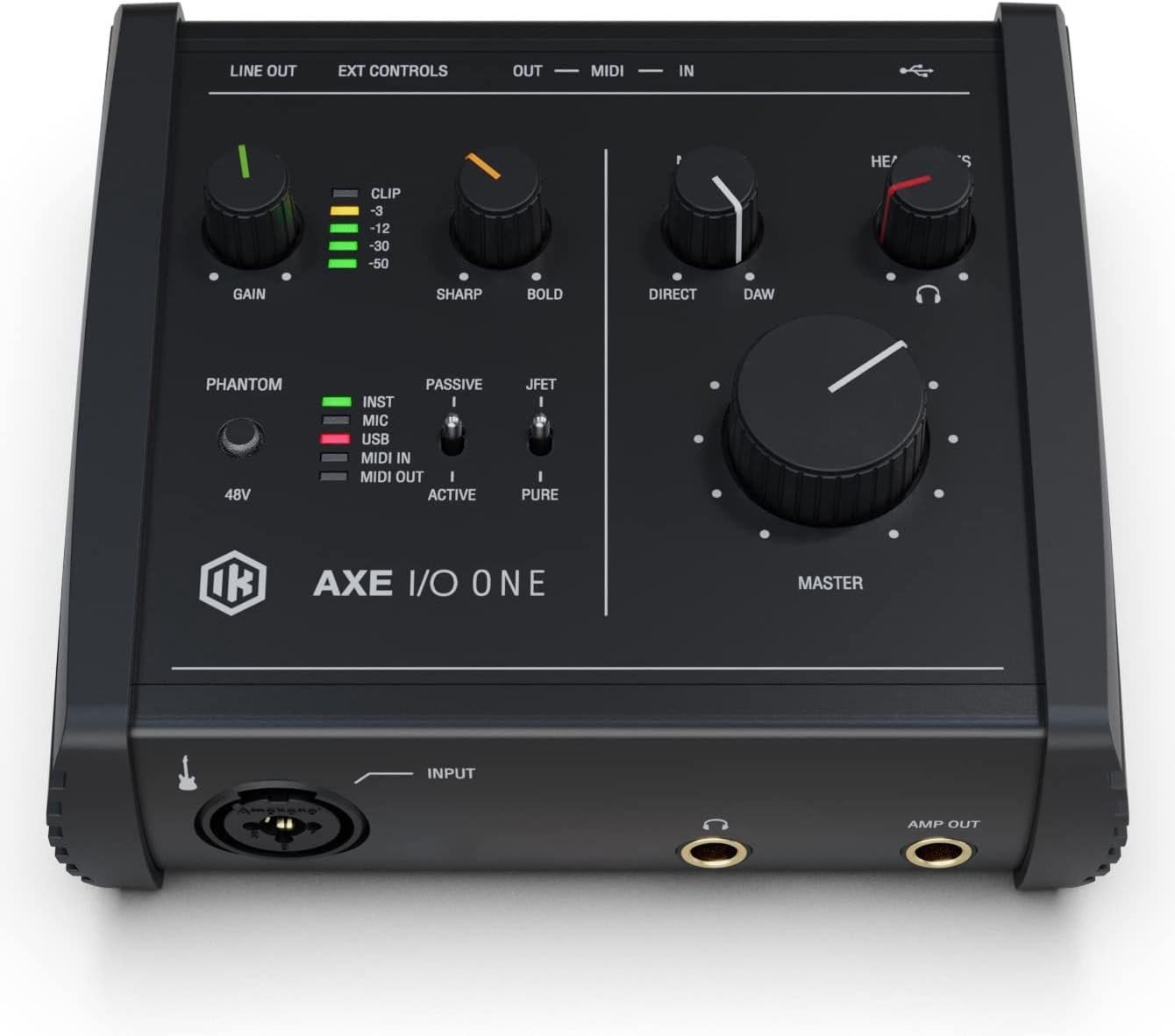
It still handles the normal jobs expected from a compact USB interface. You can record a microphone, connect studio monitors, use headphones and work inside a DAW. But the front-panel controls are clearly aimed at guitarists, with adjustable input impedance, selectable preamp character and a dedicated Amp Out for sending recorded guitar tracks back through a real amplifier.
That makes the AXE I/O ONE particularly interesting for a home studio where guitars are at the centre of the music.
Why it works for guitar recording
Most modern audio interfaces include an instrument input.
The difference here is how much attention IK Multimedia has given to that input.
The AXE I/O ONE lets you choose between Active and Passive pickup settings, followed by PURE and JFET input stages. It also adds the company’s Z-TONE impedance control, which can vary the passive instrument input impedance from 1 MΩ down to 2.2 kΩ.
That matters because electric-guitar pickups interact with the electrical load they are connected to.
Changing the impedance can alter the character of the instrument before software amp modelling or effects are involved.
Turn Z-TONE one way and the response can feel tighter and brighter.
Move it the other way and the guitar can become thicker and softer.
It gives you another way to shape the raw recorded signal without reaching for EQ afterwards.
PURE or JFET input character
The PURE/JFET switch gives the guitar input two different personalities.
PURE is intended to keep the signal transparent and accurate.
JFET uses a Class-A JFET input stage to introduce some extra harmonic character and a slightly more focused midrange response. IK Multimedia describes it as adding warmth and a more vintage-style feel.
The difference is not intended to turn one guitar into another.
It is more subtle than that.
If you are recording a clean direct signal that will later be processed with amp software, PURE gives you a neutral starting point.
If the raw guitar feels a little sterile, JFET can add some character before the signal even reaches the computer.
That choice becomes especially useful when recording several guitar parts.
A rhythm track might suit the cleaner PURE setting, while a lead part could benefit from the extra colour of JFET.
Active and passive pickups get their own setting
The AXE I/O ONE also includes a dedicated Active/Passive pickup selector.
Passive guitar pickups generally benefit from a high-impedance input, while active pickups already contain powered electronics and behave differently electrically.
Rather than expecting one fixed input to handle everything, the AXE I/O ONE lets you tell the interface what type of instrument is connected.
That is a small control, but it reflects the guitar-focused thinking behind the unit.
A player moving between a vintage-style single-coil guitar, a humbucker-equipped instrument and a bass with active electronics can adjust the input accordingly rather than relying on one compromise setting.
What it feels like to use
Physically, the AXE I/O ONE is compact.
IK Multimedia lists it at approximately 13 cm wide, 14.5 cm deep and 5.2 cm high, with a weight of only 0.37 kg / 0.8 lb.
That makes it easy to keep beside a computer without giving up a large section of desk space.
The important controls are also physical.
Input gain, pickup type, PURE/JFET selection, Z-TONE, monitor level and headphone level can all be reached without opening software.
For everyday recording, that is preferable to hiding basic adjustments behind menus.
You plug the guitar in, set the input gain, choose the input character and begin working.
The interface is USB-C bus powered, so it does not require a separate power adaptor for normal operation.
That helps keep a small recording setup tidy and also makes the unit easier to move between computers.
24-bit/192 kHz recording
The AXE I/O ONE supports audio conversion at up to 24-bit/192 kHz, with lower sample rates including 44.1, 48, 88.2, 96 and 176.4 kHz also available.
For most home recordings, there is no requirement to use the maximum setting simply because it exists.
Many perfectly serious recording projects are made at 44.1 or 48 kHz.
The important point is that the interface is capable of high-resolution recording and does not become the obvious weak link in a guitar-based home studio.
IK Multimedia quotes a 108 dB dynamic range for the main conversion path.
That gives plenty of room for clean guitar, bass, microphone and software-based recording without needing to push the signal excessively close to clipping.
Direct monitoring helps while recording
Latency can be distracting when playing through a computer.
If the guitar signal has to travel into the computer, through software and then back out to your headphones, even a small delay can make the instrument feel disconnected from your hands.
The AXE I/O ONE includes Direct/DAW monitoring, allowing the direct input signal and computer playback to be balanced for low-latency recording.
That is useful when recording a clean instrument signal or microphone.
You can hear yourself immediately while still listening to the backing track from the DAW.
When playing through software amp models, computer buffer settings still matter because the processed guitar sound has to pass through the computer.
But having a direct-monitoring option gives you more flexibility depending on what is being recorded.
Amp Out makes reamping straightforward
The dedicated Amp Out is one of the features that separates this from many compact interfaces.
It is designed to send a recorded guitar signal back out at an appropriate level for a guitar amplifier, pedalboard or tone-modelling setup. The output also includes a selectable ground-lift arrangement to help deal with ground-loop noise.
This opens up reamping.
You can record a clean direct guitar performance first.
Later, instead of committing permanently to the amplifier sound used during the session, the clean recording can be sent from the AXE I/O ONE into a real amplifier.
You can then change the amp settings, try different pedals, move microphones or completely alter the sound without asking the guitarist to perform the part again.
For home recording, that is an extremely useful option.
A good performance can be preserved while the tone remains flexible.
Useful with TONEX and AmpliTube
The AXE I/O ONE also comes with guitar-focused software rather than a random collection of plug-ins.
IK Multimedia currently includes AmpliTube 5 SE, TONEX SE and Ableton Live Lite.
AmpliTube provides virtual amplifiers, cabinets and effects.
TONEX focuses on captured amplifier and pedal tones.
Used together, they give a guitarist a complete recording environment without requiring a physical amplifier beside the desk.
The Amp Out also means you are not locked into software.
You can work entirely inside the computer one day and send the same recorded guitar out to a real amplifier the next.
That mixture of software and traditional guitar equipment is where the AXE I/O ONE becomes particularly flexible.
More than an instrument input
Although guitar is clearly the focus, the AXE I/O ONE is not limited to electric instruments.
The main input can also handle a microphone through its Class-A discrete microphone preamp, and phantom power is available for compatible condenser microphones.
That means an acoustic guitar can be recorded with a microphone rather than a pickup.
Vocals can also be captured through the same interface.
There are two balanced monitor outputs for studio speakers and a separate headphone output with its own level control.
For a compact home setup, that covers the essentials without requiring another monitor controller or headphone amplifier.
MIDI and external control
Another useful feature is MIDI input and output.
That allows compatible keyboards, controllers, electronic drums and other MIDI equipment to communicate with the computer through the interface.
There are also two configurable controller inputs that can accept expression pedals or footswitches.
For a guitarist, that opens some interesting possibilities.
An expression pedal can control software volume or wah effects.
A footswitch can be assigned to suitable software functions.
That means you can keep both hands on the guitar instead of repeatedly reaching for the mouse during practice or recording.
The drawbacks
The biggest limitation is right there in the name: ONE.
This is fundamentally a one-input interface.
That is perfectly adequate for a guitarist recording one part at a time, but it becomes restrictive when you want to record several sources simultaneously.
You cannot, for example, record a vocal microphone and a separate direct guitar signal through two independent main inputs at the same time.
Likewise, recording a stereo keyboard or two microphones together is not what this interface is designed for.
If your home studio is gradually moving towards recording bands, drums, stereo instruments or several performers at once, a larger interface will give you more room to grow.
The Z-TONE control is useful, but it introduces another variable into the recording process.
That is part of the appeal for somebody who likes experimenting.
For a beginner, however, it may create the feeling that there is another setting that must somehow be “correct”.
There is no universal correct Z-TONE position.
Its purpose is to let you listen and choose.
If you prefer an interface where the instrument input has one fixed character and you simply get on with recording, some of the AXE I/O ONE’s guitar-specific flexibility may be unnecessary.
The JFET stage creates a similar choice.
It can add useful warmth and harmonic character, but it is not automatically better than PURE.
A heavily processed guitar part may sound clearer from the neutral input.
Another part may benefit from JFET.
The interface rewards experimentation, which is enjoyable when you are interested in tone but less attractive if you want the fewest possible decisions between plugging in and recording.
Reamping also requires some understanding.
The Amp Out makes the hardware connection easier, but sending a recorded signal through a real amplifier still means dealing with amplifier volume, microphones, room acoustics and potentially ground noise.
It is a powerful feature rather than a one-button solution.
A guitarist who records entirely with software may rarely use it.
Conversely, somebody buying the interface specifically for reamping should understand that a real amplifier setup still needs to be recorded properly on the way back into the computer.
The AXE I/O ONE is also USB bus powered.
That keeps the setup tidy, but it means the interface depends on the computer or USB host for its power.
For a normal desktop or laptop studio this is convenient.
For unusual mobile setups, the available USB power and compatibility deserve checking.
The supplied cable is USB-A to USB-C, according to IK Multimedia’s current package specification.
If your computer has only USB-C ports, you may need an appropriate alternative cable or adapter.
That is a small point, but it is much better to discover it before sitting down for the first recording session.
The headphone output is practical, but the interface does not give several musicians separate headphone mixes.
Again, that is entirely reasonable for a compact one-person recording device.
It simply reinforces that this is aimed more at the individual guitarist or bassist than a multi-person studio.
There is also no built-in DSP system providing independent amp modelling inside the interface itself.
Software such as AmpliTube and TONEX runs on the connected computer.
That means the performance of the computer and the chosen audio-buffer settings still influence how low the latency can be when monitoring through software effects.
Direct monitoring avoids latency for the raw input, but if you specifically want to hear a processed virtual amplifier while playing, computer configuration still matters.
The included software is valuable, yet it also creates an ecosystem consideration.
If you already have favourite amp simulators, DAW software and plug-ins, you may not use everything included with the AXE I/O ONE.
That is not a problem — the interface works with normal recording software — but the software bundle should not be the only reason to choose the hardware.
The unit is compact and light at 0.37 kg, which is excellent for portability, but lightweight interfaces can move around a desk more easily when several stiff cables are attached.
A heavy guitar cable, two monitor cables and headphones can exert surprising force on a small box.
Positioning the interface where the cables are not pulling against it will make everyday use more pleasant.
The physical layout is also intentionally compact.
That means the controls are closer together than on a large desktop interface.
Someone with a permanent studio and plenty of desk space may prefer larger knobs, more meters and additional front-panel information.
And while the AXE I/O ONE can certainly record vocals and acoustic instruments, its strongest selling points are aimed at electric guitar and bass.
If you primarily record microphones rather than instruments, a more conventional interface with two or more mic preamps may be a better match.
Finally, it is worth remembering that a specialised guitar interface cannot make poor recordings disappear automatically.
Good playing, sensible gain staging, decent monitoring and thoughtful amp or plug-in choices still matter.
Z-TONE, JFET and Amp Out give you more useful tools.
They do not replace the need to learn how those tools affect the sound.
Who it suits best
The IK Multimedia AXE I/O ONE Guitar Audio Interface makes the most sense for a guitarist or bassist building a personal recording setup around one instrument at a time.
It is particularly well suited to somebody using amp-modelling software because the Z-TONE control, Active/Passive selection and PURE/JFET stages let you shape the signal before it reaches the virtual rig.
Players interested in reamping should find the dedicated Amp Out especially useful.
Home musicians who also record occasional vocals or acoustic guitar can use the microphone preamp rather than needing a separate interface.
And the MIDI and external controller connections add useful expansion for someone whose small studio gradually grows to include keyboards, foot controllers or other equipment.
Is it worth the studio space?
The AXE I/O ONE occupies very little physical space, but its real advantage is how deliberately that space has been used for guitar recording.
The Z-TONE input, Active/Passive pickup setting and PURE/JFET stages address the signal coming directly from the instrument. The Amp Out makes reamping easier, while balanced monitor outputs, headphones, MIDI, external controller inputs and up to 24-bit/192 kHz recording allow it to function as the centre of a compact home studio.
Its main limitation is equally clear.
One main recording input means it is not the interface to choose for a growing multi-microphone studio.
But for a guitarist or bassist who normally records one performance at a time, that simplicity may be exactly right.
Rather than filling the front panel with inputs you may never use, IK Multimedia has concentrated on giving the instrument input more control.
For a guitar-focused home studio, that makes the AXE I/O ONE more than a small USB interface with a guitar socket added to the front — the guitar signal is the reason the interface was designed in the first place.
Explore more recording equipment and studio gear in our Recording & Studio section.
As an Amazon Associate I earn from qualifying purchases.




One Comment
Comments are closed.