Epiphone Les Paul 100 E1
As an Amazon Associate I earn from qualifying purchases.
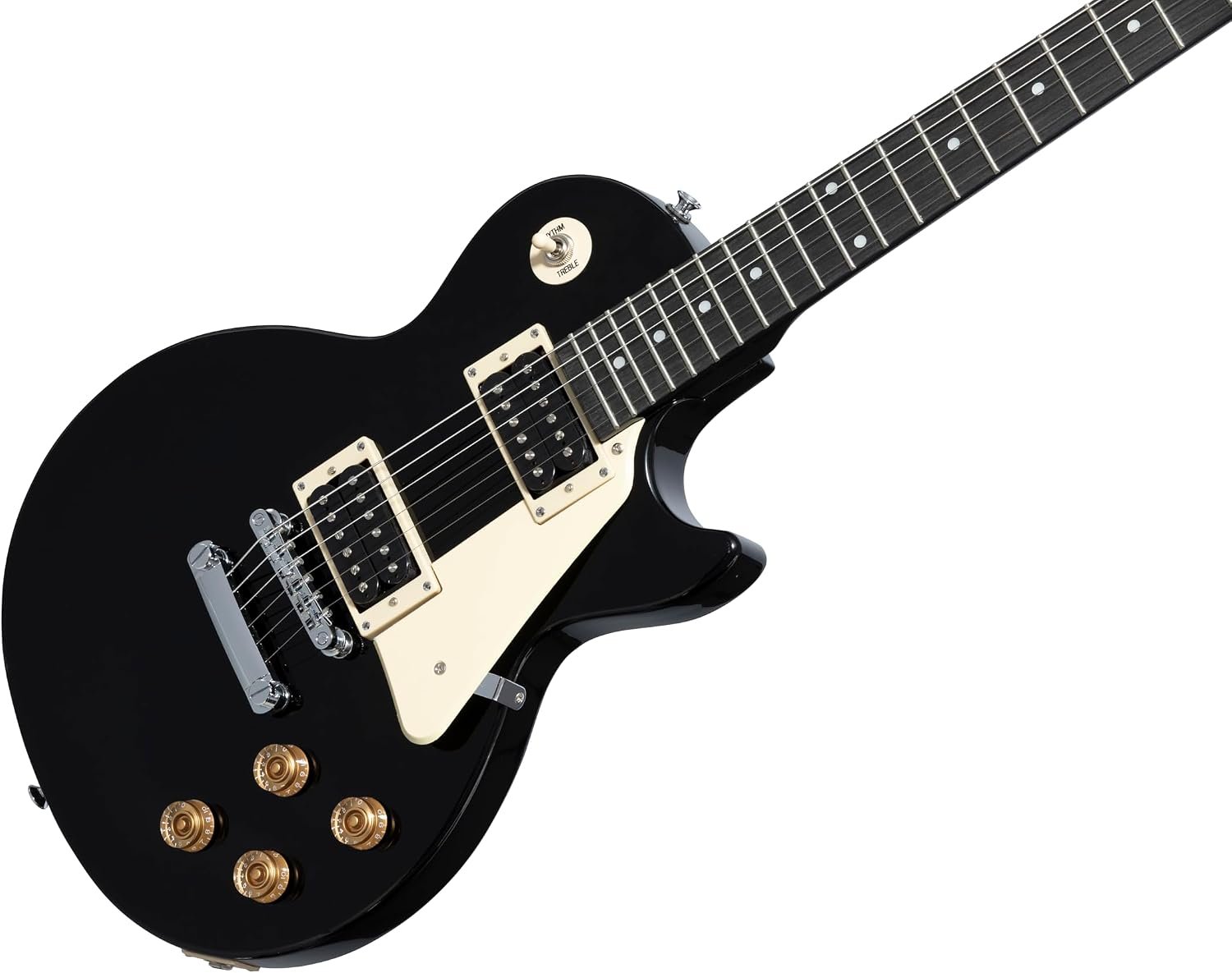
The Epiphone Les Paul 100 E1 is a stripped-back take on the familiar Les Paul formula. It keeps the single-cutaway shape, mahogany body, maple top, twin humbuckers and four-knob control layout, but uses a bolt-on neck rather than the set-neck construction associated with more expensive Les Paul models.
That makes it quite an interesting guitar in its own right. It looks unmistakably like a Les Paul, feels substantial in the hands, and keeps the traditional 24.75-inch scale, but it is not pretending to be identical to a higher-tier model.
Epiphone currently specifies the 100 E1 with a mahogany body, maple top, mahogany neck, laurel fingerboard, 22 medium frets and a 24.75-inch scale length. The Ebony finish is gloss, with cream pickup rings and pickguard providing the familiar contrast against the black body.
Why the Les Paul shape still works
The Les Paul body has a very different physical character from a Strat-style guitar.
It feels denser and more compact through the middle, with a rounded single cutaway rather than a pair of horns. The body sits firmly against you, and the shorter 24.75-inch scale gives the strings a slightly softer feel than a 25.5-inch instrument using the same gauge and tuning.
That can be particularly noticeable when bending notes. There is a little less resistance under the fingers, which some players find more comfortable for blues, rock and lead playing.
The 100 E1 keeps the basic shape and proportions familiar rather than trying to modernise them too aggressively. It is a straightforward electric guitar that immediately feels recognisable.
What it feels like to play
The neck is mahogany with a C-shaped profile, 43 mm nut width and 12-inch fingerboard radius. Epiphone uses a laurel fingerboard with simple dot inlays rather than the larger trapezoid markers found on many higher-spec Les Paul models.
A 12-inch radius gives the fingerboard a relatively flat feel compared with more strongly curved vintage-style designs. That can work nicely for string bending and lead playing without making ordinary chord work feel unnatural.
The shorter scale contributes to a slightly more relaxed string tension, while the C-shaped neck keeps the profile familiar rather than unusually thick or thin.
The bolt-on joint changes the feel around the heel compared with a traditional set-neck Les Paul. You can feel more of the joint structure as you move towards the highest frets, and players who spend a great deal of time at the top of the neck may notice that difference.
For ordinary rhythm playing, riffs and most lead work, however, the layout is conventional and easy to understand.
Two humbuckers and familiar controls
The Les Paul 100 E1 uses an Epiphone 650R open-coil humbucker at the neck and a 700T open-coil humbucker at the bridge. A three-way toggle switch selects neck, both or bridge pickups.
Each pickup has its own volume and tone control, giving the guitar the familiar two-volume, two-tone Les Paul arrangement.
That separate control layout is more useful than it first appears.
You can set the neck pickup darker and quieter, leave the bridge pickup brighter and louder, then switch instantly between them. Or both pickups can be blended in the middle position using their individual volume controls.
The open-coil appearance also suits the more straightforward character of the guitar. There are no decorative metal pickup covers hiding the coils, so the hardware looks functional rather than overly polished.
Bridge and hardware
Epiphone uses a Tune-O-Matic bridge with a Stop Bar tailpiece, one of the most established fixed-bridge arrangements in electric-guitar design.
The bridge allows individual saddle adjustment for intonation and overall height adjustment for action, while the separate tailpiece anchors the strings behind it.
There is no vibrato system here.
For players who never use a tremolo arm, that simplicity can be a real advantage. There are fewer moving parts, string changes are straightforward, and the bridge is mechanically easy to understand.
The guitar also uses Premium Die Cast tuning machines with a 14:1 ratio.
Again, nothing especially exotic. The emphasis is on familiar hardware rather than complicated features.
Where the 100 E1 fits
This guitar makes sense for someone who likes the Les Paul shape but does not necessarily need every traditional construction detail.
Its basic recipe is strong: mahogany body, maple top, mahogany neck, twin humbuckers, fixed bridge and a familiar control layout.
It can work naturally for rock, blues, classic rock, heavier rhythm playing and plenty of cleaner styles as well.
The bridge humbucker should suit firmer rhythm tones and overdrive, while the neck pickup offers a rounder, softer character for clean passages and lead playing.
Because there are no coil splits, phase switches or active electronics, the guitar remains simple. Plug it into an amplifier, choose a pickup and start playing.
The drawbacks
The biggest compromise is the bolt-on neck.
A traditional Les Paul is strongly associated with set-neck construction, and players specifically looking for that classic structure may see the 100 E1 as a different proposition immediately.
That does not automatically make the bolt-on joint poor, but it changes both construction and feel. The heel is more noticeable than on many set-neck models, and upper-fret access is not as seamless as it can be on guitars with more sculpted joints.
For someone who spends most of their time around open chords, power chords and the middle of the neck, this may not matter much. For a lead player regularly working right at the top of the fingerboard, it is worth considering.
The 650R and 700T open-coil humbuckers are another area where expectations should stay realistic. They give the guitar the familiar twin-humbucker format, but this is not the pickup specification used on Epiphone’s more expensive Les Paul ranges.
That does not mean they cannot sound good through the right amplifier. It simply means someone buying specifically for refined pickup response, very detailed clean tones or premium electronics may eventually want something further up the range.
The body also deserves a mention.
A Les Paul-style guitar tends to feel more compact and concentrated than a contoured Strat-style body. Some players love that solid, planted feel. Others find the sharper body edges and lack of extensive forearm contouring less comfortable during long seated sessions.
The gloss finish can add to that sensation. Against clothing, the polished body does not slide around as freely as a satin-finished instrument, and it can collect fingerprints quite quickly on an Ebony guitar.
Then there is the 24.75-inch scale.
The slightly softer string feel is attractive to many players, but someone who prefers a firmer response or has spent years on 25.5-inch guitars may need a little adjustment. The difference is not enormous, but it is physically noticeable.
The 22 medium frets are conventional, though players who specifically want 24 frets will obviously not get that extra upper range here.
There is also no vibrato system. For players who regularly use a tremolo arm for chord shimmer, pitch dips or more expressive lead effects, the fixed bridge means those techniques need to come from the fingers or external effects instead.
The traditional four-knob control layout is useful once you know it, but it is busier than the one-volume, one-tone arrangement found on many simpler guitars.
Beginners can sometimes find themselves turning the wrong knob initially, particularly when both pickups are active. It becomes intuitive with use, but it is not the absolute simplest control arrangement available.
The dot inlays and generally restrained appointments also make the 100 E1 visually simpler than many Les Paul models.
If part of the attraction for you is elaborate binding, trapezoid inlays, covered pickups or more decorative hardware, this model deliberately leaves much of that out. The cream pickguard and rings add contrast, but the overall specification remains fairly plain.
A further practical point is the case. Epiphone lists both an EpiLite case and a hardshell Les Paul case as optional rather than included.
That matters if the guitar is going to lessons, rehearsals or gigs. A proper case or bag becomes another item to organise rather than something already supplied.
Setup is another area worth treating realistically.
Production guitars can leave the factory within specification and still not arrive exactly how one particular player likes them. Action, neck relief, pickup height and intonation can all benefit from adjustment according to string gauge and playing style.
Someone completely new to electric guitars may not realise how much a sensible setup can change the feel of an instrument.
And finally, this is a guitar that deliberately sits below Epiphone’s more elaborate Les Paul models.
That is not a criticism; it is simply its position. Anyone expecting the same neck joint, finishing details, electronics or decorative specification as a considerably more elaborate Les Paul is likely to be disappointed.
The better way to look at the 100 E1 is as its own straightforward instrument: classic outline, familiar controls and humbuckers, but with simpler construction.
Who it suits best
The Epiphone Les Paul 100 E1 suits someone who wants the Les Paul shape and twin-humbucker layout without needing every traditional construction detail.
It could work particularly well for a developing guitarist moving beyond a very basic starter instrument and wanting something that feels more substantial and conventional.
The shorter scale may also appeal to players who find longer-scale electrics a little firm under the fingers.
It should suit rock and blues players naturally, but there is nothing preventing it being used for cleaner styles, effects-heavy setups or general practice.
Players who specifically want a set neck, premium pickups, extensive binding or a more refined upper-fret heel should probably look further up the Epiphone range instead.
Is it worth the guitar space?
The Epiphone Les Paul 100 E1 makes sense when judged for what it actually is rather than what its shape resembles.
You get a mahogany body with maple top, mahogany C-shaped neck, 24.75-inch scale, twin 650R/700T humbuckers, independent volume and tone controls, and a Tune-O-Matic bridge with Stop Bar tailpiece.
The compromises are real. The neck is bolt-on, the hardware and electronics are straightforward rather than premium, there is no vibrato, and a case is not included.
But those are useful things to know rather than reasons to dismiss it.
For someone who likes the physical feel of a Les Paul-style guitar and wants a simple twin-humbucker instrument without unnecessary electronics, the 100 E1 has a clear and honest place.
For more guitars with different pickup layouts and playing styles, explore our Electric Guitars guides on NoisyNeck.
As an Amazon Associate I earn from qualifying purchases.