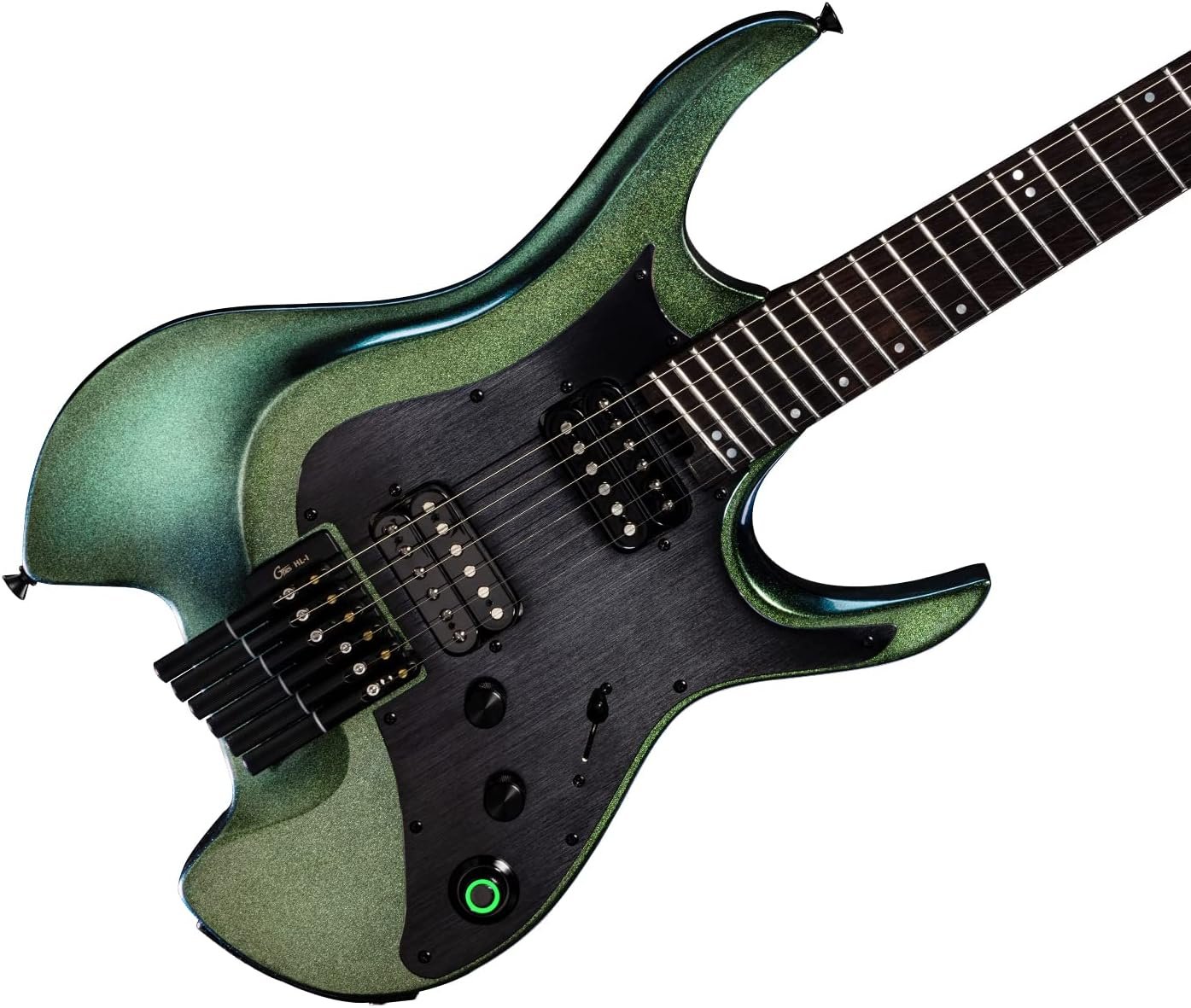
GTRS W900 Intelligent Headless Electric Guitar
As an Amazon Associate I earn from qualifying purchases.
The GTRS W900 Intelligent Headless Electric Guitar takes a very different approach to the idea of an electric guitar.
At heart, it is still a full-scale instrument with an alder body, two humbuckers and familiar volume, tone and pickup controls. But built inside it is an entire digital guitar system containing amp modelling, effects, guitar simulations, drum patterns, a metronome, looper, Bluetooth control, USB recording and wireless audio transmission.
That means the W900 can work like a conventional electric guitar when you want simplicity, yet it can also become a self-contained practice, recording and performance system without surrounding it with a large collection of extra equipment.
Why the headless design matters
The W900 uses a modern headless layout rather than a conventional neck with six machine heads sticking out beyond the nut.
Removing the traditional headstock shortens the overall instrument without shortening the 25.5-inch scale length. Your fretting hand therefore still encounters full-size spacing between the frets rather than the compressed feel of a short-scale travel instrument.
The tuning hardware is incorporated into the GTRS HL-I bridge system at the body end of the guitar.
That arrangement also changes the balance.
There is less hardware pulling down at the end of the neck, and the W-series body itself has been shaped with deep contouring and a reduced heel around the neck joint. MOOER describes the guitar as weighing around 2.5 kg, despite the processing system and rechargeable battery inside.
For longer practice sessions, rehearsals or playing while seated, that relatively light construction could be one of the W900’s most noticeable advantages.
What it feels like to play
The neck is a particularly interesting part of the instrument.
MOOER uses a five-piece roasted flame maple and rosewood construction, with a matte finish and a Standard C profile. The fingerboard is Indian rosewood with a 12-inch radius, and there are 24 frets across the full 25.5-inch scale.
The nut is 42 mm wide, giving the neck fairly familiar electric-guitar proportions rather than making it feel unusually narrow simply because the body design is modern.
The deep heel cut at the body is intended to make the upper frets easier to reach.
On a 24-fret guitar, that matters. There is little benefit in having those extra frets if the neck joint makes the highest positions uncomfortable to access.
The overall impression is of a guitar designed around modern playing rather than vintage tradition.
There is no attempt to recreate the feel of a 1950s instrument. The W900 is intended to feel light, streamlined and accessible all the way up the neck.
Dual Alnico V humbuckers
The W900 uses a pair of GTRS HM-2 Alnico V humbuckers, with an HM-2N at the neck and HM-2B at the bridge. A conventional three-way selector chooses between the two pickups or combines them.
That means the guitar does not depend on its digital processing to produce a usable basic electric-guitar sound.
You can treat it like an ordinary dual-humbucker instrument.
The bridge pickup provides the brighter, more direct voice normally used for rock rhythm, heavier tones and lead playing.
The neck pickup gives a smoother, warmer sound that works naturally for cleaner parts and fuller lead tones.
There is also a normal Volume and Tone control.
If the battery is not being used or you simply do not want the intelligent functions at that moment, the W900 can still operate as a traditional electric guitar.
That is an important distinction.
The technology is an additional layer rather than the only reason the instrument works.
The Super Knob changes the whole idea
The third main control is what GTRS calls the Super Knob.
This is where the W900 moves away from a normal electric guitar.
The Super Knob controls the intelligent processing system and allows stored sounds and functions to be accessed directly from the guitar rather than requiring a pedalboard beside your feet.
Inside the W900 are:
11 guitar simulations
126 guitar effects
40 drum patterns
10 metronome patterns
80-second looper
The processing system also includes amplifier and effects modelling that can be edited through the GTRS app.
That gives the guitar a completely different role from a conventional instrument.
You could practise through headphones with a processed sound, plug straight into suitable amplification, record through USB-C or build presets containing the sort of effects that would normally require several pedals.
App control without putting a screen on the guitar
The W900 connects to the GTRS mobile app over Bluetooth 5.0.
The app is available for iOS and Android and is used for editing sounds, managing presets and accessing the deeper parts of the processing system.
I like the basic idea here.
MOOER has resisted the temptation to bolt a large touchscreen onto the guitar itself.
When you want deeper editing, the phone provides the interface.
When you actually want to play, the guitar still looks and feels like an instrument rather than a computer controller strapped across your shoulder.
Once sounds have been created, the Super Knob can be used to access them without constantly reaching for the phone.
For somebody who enjoys modern modelling technology but dislikes menu-heavy floor processors, that could be a very appealing balance.
An entire practice system inside the guitar
The built-in drum machine, metronome and looper are not glamorous specifications, but they may become some of the W900’s most useful everyday features.
There are 40 drum patterns and 10 metronome patterns, giving you something rhythmic to practise against without needing another device running beside you.
The 80-second looper lets you record a chord progression and practise lead lines or improvisation over it.
That can make a short practice session much more productive.
Instead of spending the first ten minutes connecting an amplifier, pedalboard, looper and phone, the core tools are already available through the guitar system.
For someone trying to practise regularly, removing that setup time can matter more than adding another hundred effect models.
USB-C recording
The W900’s USB-C connection is not limited to charging.
MOOER specifies it for recording output as well as battery charging, allowing the processed guitar signal to be sent to a suitable computer or mobile device.
That makes the W900 particularly interesting for home recording.
You could create the complete sound inside the GTRS system and send it directly into recording software without placing a microphone in front of an amplifier.
For quick songwriting, demo recordings or practising with a DAW, that can reduce the amount of equipment needed considerably.
It can also be useful for live streaming or making guitar videos where a clean direct signal is easier to manage than recording a loud amplifier in the room.
Wireless output is built in
The W900 goes one stage further than the W800 by including a built-in UHF wireless transmitter.
MOOER specifies four wireless channels and a maximum transmission distance of up to 15 metres under suitable conditions.
A compatible GWU4 receiver is supplied with the W900 according to MOOER’s current product information.
That means you can play without a conventional guitar cable between the instrument and compatible receiving equipment.
For home practice, that simply removes one cable from the floor.
On stage or during rehearsal, the benefit becomes more obvious because you are no longer tethered to one position.
The wireless system is still subject to normal radio-frequency realities.
Walls, interference and the surrounding environment can affect usable distance, so the quoted 15 metres should be treated as an ideal maximum rather than a guarantee in every venue.
Rechargeable battery power
All of the intelligent features naturally require power.
The W900 uses a 4000 mAh rechargeable lithium battery, charged through USB-C.
MOOER’s model-specific product information and manual quote around 12 hours of operation under normal use and around 9 hours when using the built-in wireless output, although battery condition and usage will naturally affect those figures.
That is enough for a considerable amount of everyday playing between charges.
More importantly, the rechargeable system means you do not have to feed disposable batteries into the guitar every few sessions.
For ordinary passive playing, the instrument can still function as a traditional guitar, so a discharged intelligent system does not necessarily turn the W900 into something completely unusable.
A guitar that can replace several pieces of equipment
This is where the W900 becomes particularly interesting.
A normal electric guitar may require:
an amplifier,
several effects pedals,
a looper,
a tuner,
a drum or metronome app,
an audio interface,
and possibly a wireless guitar system.
The W900 contains versions of nearly all of those functions inside the instrument itself.
That does not automatically mean it replaces every specialist piece of equipment equally well.
A dedicated pedalboard will give you more physical switching control.
A high-end audio interface may offer more recording flexibility.
A favourite valve amplifier still has its own feel and character.
But having all of those functions immediately available inside one guitar can dramatically simplify casual practice and portable setups.
The drawbacks
The W900 is ambitious, and that creates more potential drawbacks than a simple passive electric guitar.
The first is complexity.
A traditional guitar with two humbuckers, a selector switch, volume and tone can be understood in minutes.
The W900 adds presets, modelling, effects, Bluetooth, an app, a looper, wireless transmission, USB recording and rechargeable battery management.
None of those features is particularly difficult individually, but together they create a learning curve.
Someone who simply wants to plug into an amplifier and never think about software may find much of the W900 unnecessary.
The app is useful, but it also means some of the deeper functionality depends on software.
Apps can be updated, operating systems change and wireless pairing occasionally requires troubleshooting.
A conventional passive electric from decades ago does not care which version of iOS or Android is running on your phone.
That simplicity has genuine value.
The rechargeable battery introduces another maintenance item.
The guitar may still work in its traditional passive role, but the intelligent processor, modelling and wireless features obviously depend on available battery power.
If you intend to use those features live, charging becomes part of your preparation in the same way you would check batteries in a wireless system or pedalboard.
Battery capacity will also gradually decline over many charge cycles, as it does with other rechargeable lithium-powered equipment. The GTRS manual notes that battery capacity reduces as the battery ages.
The headless bridge system may require some adjustment as well.
Players accustomed to reaching automatically for machine heads at the end of the neck will need to retrain that habit.
Tuning from the bridge is perfectly practical, but it feels different.
String changes may also seem unfamiliar the first few times simply because the entire system is arranged differently from a conventional guitar.
The modern body shape creates another preference issue.
At roughly 2.5 kg, the guitar is comparatively light, and the deep contouring makes upper-fret access excellent.
But some players genuinely like the substantial feel of a heavier traditional instrument.
A lightweight headless guitar does not provide the same physical experience as a large single-cut mahogany guitar hanging from the shoulder.
Neither is inherently better.
They simply appeal to different players.
The pickup layout is also fairly straightforward underneath all the digital capability.
There are two humbuckers and a three-way switch.
If you switch off the intelligent system, you do not suddenly have a huge collection of physical pickup combinations.
Players who want traditional single-coil sounds without digital simulation may prefer a guitar with actual single coils alongside humbuckers.
The onboard modelling also raises the question of how much equipment you really want inside the guitar itself.
Some musicians deliberately keep their guitar simple and replace amplifiers, pedals or recording devices independently as technology develops.
With the W900, a significant portion of the attraction is integrated permanently into the instrument.
That is wonderfully convenient today, but it is a different philosophy from buying a passive guitar that may remain technologically unchanged for decades.
The built-in wireless system is useful, but radio systems are never completely immune to interference.
MOOER’s quoted maximum range is measured under favourable conditions, and the company itself notes that actual performance depends on reflections, interference and absorption in the environment.
For critical live use, it would be sensible to keep a normal guitar cable available as a backup.
There is also the temptation to spend more time exploring sounds than actually practising.
With 126 effects, 11 guitar simulations and large numbers of configurable presets, it would be very easy to spend an evening changing tones rather than learning the piece of music you originally picked up the guitar to practise.
For some players, experimentation is part of the fun.
For others, too many choices can become a distraction.
The W900 also will not completely replace a pedalboard for everyone.
Although presets can be switched from the guitar and MOOER offers an optional GWF4 wireless foot controller, guitarists who regularly switch several individual effects on and off during songs may still prefer having dedicated switches under their feet.
The optional controller means the system can grow into a more performance-oriented setup, but that also means adding another piece of equipment.
Finally, the W900 is such a distinctive instrument that it probably makes more sense as a deliberate choice than an impulse purchase.
If you love traditional guitar design and want nothing more complicated than pickups, wood and an amplifier, there are simpler instruments.
The W900 earns its place when the technology itself is genuinely useful to you.
Who it suits best
The GTRS W900 should particularly appeal to guitarists who enjoy modern equipment and want to reduce the amount of gear needed around the instrument.
It makes a lot of sense for home players because the built-in effects, metronome, drum patterns and looper create an unusually complete practice setup.
It suits home recording because USB-C can send the guitar signal directly to compatible recording equipment.
Travelling musicians may appreciate the compact headless construction, relatively light weight and supplied gig bag.
Players who dislike being tied to a guitar cable gain the built-in wireless system.
And somebody who regularly explores different amplifier and effect sounds may enjoy being able to store those sounds inside the guitar itself rather than building a large collection of individual pedals.
It is also worth considering for a guitarist who wants one instrument that can move easily between straightforward passive playing and a much more elaborate digital setup.
Is it worth the guitar space?
The GTRS W900 is interesting because the technology has not replaced the guitar underneath it.
There is still an alder-bodied, full-scale electric with a five-piece neck, rosewood fingerboard, 24 frets and two Alnico V humbuckers.
You can plug it into normal guitar equipment and use it in the conventional way.
But press further into the GTRS system and the same instrument becomes an amp modeller, effects processor, practice tool, looper, wireless guitar and USB recording device.
That versatility is the W900’s strongest argument.
It is also the source of most of its drawbacks.
There is more to learn, more reliance on rechargeable electronics and software, and considerably more technology to think about than with a traditional passive electric guitar.
But for a player who genuinely wants those modern capabilities rather than merely tolerating them, the W900 offers something unusual: a full electric-guitar rig that begins inside the guitar itself.
Explore more modern instruments in our Electric Guitars section.
As an Amazon Associate I earn from qualifying purchases.