Epiphone Les Paul Custom Alpine White
As an Amazon Associate I earn from qualifying purchases.
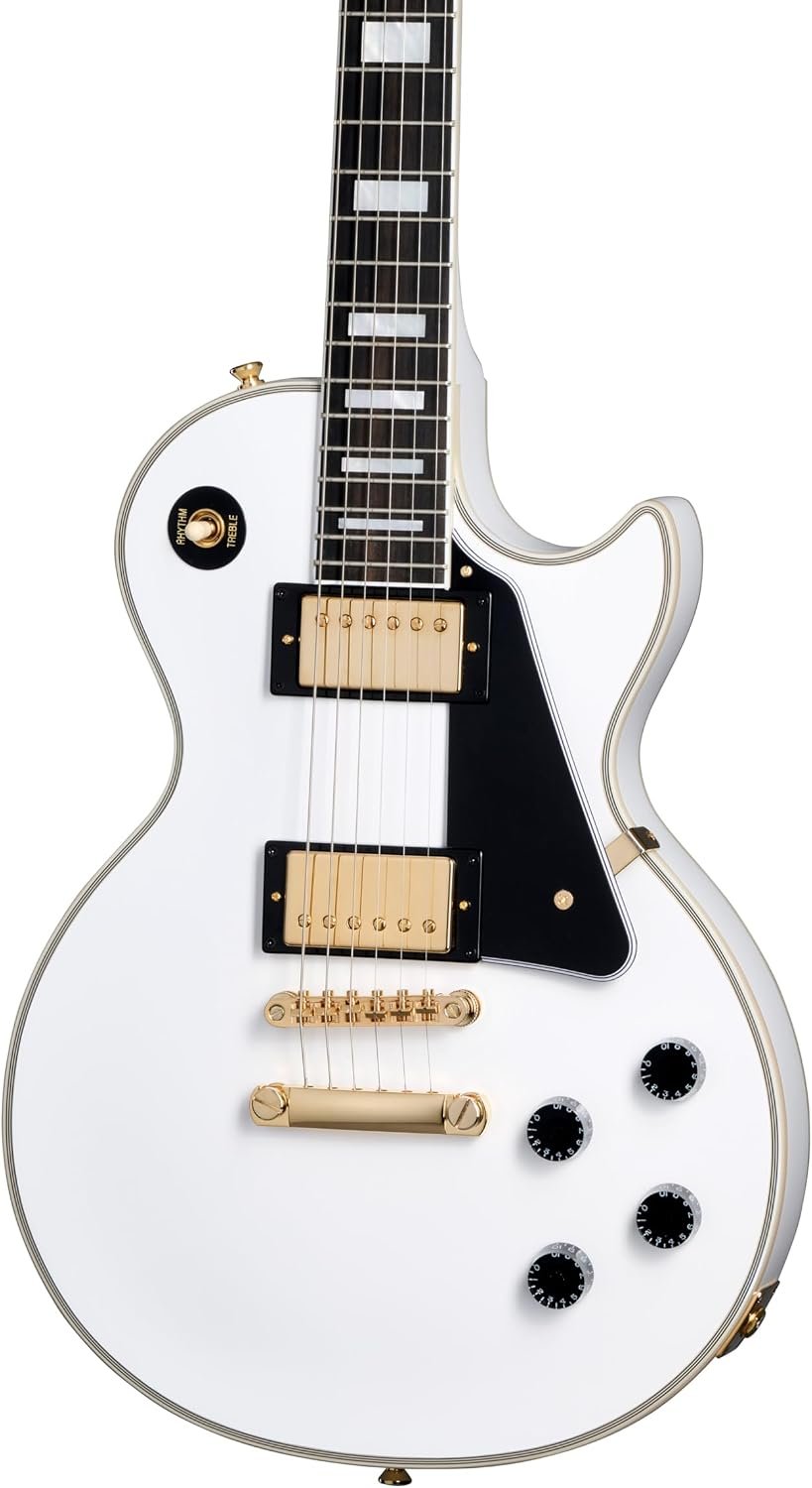
The Epiphone Les Paul Custom in Alpine White, from the Inspired by Gibson Custom collection, brings together the traditional elegance of a Les Paul Custom with a specification developed in collaboration with Gibson Custom.
With its Alpine White finish, gold hardware, ebony fingerboard and elaborate binding, this is a guitar that makes a strong visual impression before a single note is played.
However, the appeal goes considerably further than its appearance.
A solid mahogany body with a maple cap, one-piece mahogany neck, Gibson USA humbuckers and premium electronic components give this model a distinctive specification within the Epiphone range.
It is worth distinguishing this guitar from the standard Epiphone Les Paul Custom. Although they share a familiar appearance, the Inspired by Gibson Custom version uses different construction details, Gibson USA pickups and a supplied hardshell case.
For players who enjoy traditional Les Paul styling, substantial build quality and the familiar character of a dual-humbucker electric guitar, this Alpine White model deserves serious consideration.
Why the Inspired by Gibson Custom model stands out
The Les Paul Custom has always represented the more elaborate side of the Les Paul family.
Its origins go back to 1954, when Les Paul wanted a more elegant interpretation of his original solid-body guitar.
The Custom became associated with distinctive binding, block fingerboard inlays, decorative headstock detailing and a particularly formal appearance.
The Inspired by Gibson Custom version carries many of those traditional design ideas into the current Epiphone range.
The body features seven-ply binding around the top and five-ply binding around the back.
The headstock receives similarly elaborate binding, while the fingerboard has its own single-ply edging.
These details give the guitar a more finished, carefully dressed appearance than a basic solid-body instrument.
The Alpine White finish is particularly effective because it contrasts so strongly with the gold hardware and dark ebony fingerboard.
It is a guitar with plenty of visual character, but its underlying construction is equally important.
Mahogany body with a maple cap
Epiphone uses a solid mahogany body topped with a maple cap.
This is a familiar combination in traditional Les Paul construction.
The mahogany provides the main body structure, while the maple forms the upper portion beneath the finish.
Wood selection is only one part of an electric guitar’s final sound. Pickups, electronics, bridge construction, strings and amplification all influence what reaches the listener.
Nevertheless, this construction follows a well-established Les Paul approach rather than relying on an unusual or experimental design.
The body retains the traditional single-cutaway shape.
Its substantial construction gives the guitar a different physical character from lightweight, thin-bodied electric instruments.
For players who enjoy the solid, reassuring feel of a Les Paul resting against the body, that is part of the attraction.
The finish and binding also help define the appearance.
The combination of white, black and gold gives this version a particularly elegant character without relying on exotic figured wood or elaborate graphics.
What it feels like to play
The Inspired by Gibson Custom Les Paul Custom uses a 24.75-inch scale length, a familiar dimension across many traditional Les Paul instruments.
Compared with a 25.5-inch scale guitar using the same strings and tuning, the shorter scale generally produces slightly lower string tension.
That difference can make bends and vibrato feel a little less demanding, although string gauge and setup will have a substantial influence.
The neck is made from one piece of mahogany and is attached using a glued-in set-neck joint with a long tenon.
Epiphone identifies the neck profile in its detailed specifications as a Modern Medium C.
That suggests a neck intended to provide a substantial grip without becoming an exceptionally large vintage-style profile.
Players accustomed to very thin modern necks may notice the additional shape.
Others may appreciate having a little more material beneath the palm.
The ebony fingerboard has a 12-inch radius and 22 medium-jumbo frets.
Ebony is a dense, close-grained material that provides a firm playing surface and an attractive contrast with the white body.
The fingerboard also features genuine mother-of-pearl block inlays, reinforcing the traditional Custom appearance.
Together, these details create a guitar that is clearly influenced by established Les Paul construction while retaining a relatively modern playing specification.
Gibson USA 490R and 498T humbuckers
One of the most significant differences between this guitar and the standard Epiphone Les Paul Custom is its pickup arrangement.
The Inspired by Gibson Custom model uses genuine Gibson USA 490R and 498T humbuckers.
The 490R sits in the neck position, while the 498T is fitted at the bridge.
These are established Gibson pickup designs with distinct roles.
The 490R is associated with a warmer, rounded humbucker character that can suit blues, sustained lead lines and fuller clean passages.
The bridge-position 498T uses a higher-output design, providing a stronger foundation for driven rhythm playing and rock lead sounds.
That contrast allows the player to move between different musical approaches using the same instrument.
The neck position can provide a smoother starting point for melodic passages, while the bridge pickup offers a more assertive response.
Selecting both pickups together introduces another combination, useful for players who want something between the two individual positions.
Of course, the amplifier and playing technique remain central to the final sound.
The guitar’s electronics provide useful possibilities, but they do not replace the importance of choosing appropriate amplification and adjusting it carefully.
Traditional controls with premium components
The control layout is familiar to anyone who has played a conventional two-humbucker Les Paul.
There are two volume controls, two tone controls and a three-way pickup selector.
Each pickup has its own volume and tone adjustment.
That provides more flexibility than a simple master-volume arrangement.
For example, a guitarist can reduce the neck pickup volume for cleaner passages while keeping the bridge pickup ready for a stronger lead sound.
The middle selector position also allows the balance between the two pickups to be adjusted using the separate volume controls.
Epiphone uses hand-wired electronics with CTS potentiometers and Mallory capacitors.
The pickup selector and output jack are supplied by Switchcraft.
These are established component manufacturers, and their inclusion is a worthwhile part of the guitar’s specification.
There is no elaborate digital switching system or complicated collection of additional electronic functions.
Instead, the guitar concentrates on conventional analogue controls with components selected for the job.
For players who prefer straightforward operation, that simplicity has considerable appeal.
A neck designed around traditional construction
The glued-in mahogany neck is another important part of this model.
Epiphone uses a long-tenon neck joint, extending the neck into the body to provide a substantial connection between the two components.
This follows a traditional construction approach rather than the removable bolt-on arrangement used by many other electric guitars.
The 24.75-inch scale, 12-inch fingerboard radius and medium-jumbo frets provide familiar dimensions for blues, rock and general-purpose playing.
The ebony fingerboard adds a particularly attractive visual element.
Its dark surface contrasts with the mother-of-pearl block inlays, while the bound edges contribute to the finished appearance.
At the headstock, Epiphone uses the Gibson-style open-book shape with the traditional Custom split-diamond inlay.
This detail is particularly distinctive and helps separate the Inspired by Gibson Custom instrument from many other Epiphone models.
The result is a neck and headstock design that looks and feels closely connected to the traditional Les Paul Custom identity.
Gold hardware and a fixed bridge
The hardware continues the classic appearance.
Epiphone fits a LockTone Tune-O-Matic bridge with a LockTone Stop Bar tailpiece.
This fixed-bridge arrangement is straightforward and familiar.
The Tune-O-Matic allows individual saddle adjustments for intonation, while the stopbar provides the string anchoring point behind the bridge.
There is no tremolo system to balance or adjust.
That makes the guitar particularly suitable for players who prefer a stable, uncomplicated bridge and have no need for pitch-bending effects from a tremolo arm.
The gold-plated hardware complements the white finish beautifully.
Grover Rotomatic tuning machines with an 18:1 ratio provide the tuning mechanism.
The guitar also uses a Graph Tech nut.
Together, these components form a conventional but carefully specified hardware arrangement.
Reliable tuning will still depend on correct string installation, sensible setup and proper maintenance, but the components provide a sound foundation.
The Alpine White finish
There is something unmistakably elegant about a white Les Paul Custom with gold hardware.
The Alpine White finish gives the instrument a clean appearance, while the black pickguard, control knobs and pickup surrounds create strong visual contrast.
The multi-ply binding adds further definition around the body.
On the neck, the ebony fingerboard and mother-of-pearl block inlays continue the same formal appearance.
The headstock is particularly striking, with its decorative inlay and gold tuning machines.
It is a design that manages to look elaborate without relying on an excessive number of unrelated decorative features.
For guitarists who prefer the traditional Custom appearance, this version has a clear identity.
It would look equally appropriate in a home guitar collection, rehearsal room or on stage.
Hardshell case included
Epiphone supplies the Inspired by Gibson Custom Les Paul Custom with a black hardshell case.
The case features a goldenrod-coloured plush interior and Inspired by Gibson Custom branding.
This is a worthwhile inclusion.
A traditional Les Paul is not an instrument most owners will want to transport casually without proper protection.
The rigid case provides a more substantial barrier against everyday knocks and pressure than a lightly padded gig bag.
It also gives the guitar a sensible place to live when not being played.
For musicians travelling between home, rehearsals and performances, having an appropriately fitted case is particularly useful.
As always, it is worth confirming that the case is included with the exact retailer listing before ordering.
The drawbacks
The Epiphone Inspired by Gibson Custom Les Paul Custom is a substantial instrument with an appealing specification, but there are several practical compromises to consider.
The first is weight.
Traditional Les Paul construction is not generally associated with exceptionally lightweight guitars.
The mahogany body, maple cap, substantial neck and fixed bridge all contribute to an instrument that may feel considerably heavier than a slim-bodied electric guitar.
Individual guitar weights vary because wood density is not completely uniform.
That means two examples of the same model may feel noticeably different when lifted.
For someone who mainly plays seated, the additional weight may be manageable.
For a guitarist regularly standing through long rehearsals or performances, however, it deserves consideration.
A comfortable, supportive strap can help distribute the load, but it cannot completely remove the physical weight.
Players with shoulder or back problems should ideally establish the weight of the individual guitar before choosing it.
The second consideration is the traditional Les Paul body shape.
The single-cutaway design is attractive, but it does not provide the same unrestricted upper-fret access as some modern double-cutaway instruments.
Players who spend a great deal of time working at the highest frets may find the body and heel arrangement less convenient.
The set-neck construction and traditional body contours also create a different playing experience from a thin modern electric.
Someone accustomed to an exceptionally lightweight guitar with deep body contours may need time to become comfortable with the Les Paul format.
This is not a design flaw.
It is part of the traditional instrument’s character.
Nevertheless, appearance should not be the only consideration when choosing a guitar intended for regular playing.
The neck profile will not suit every player.
Epiphone’s detailed specifications identify the Modern Medium C profile, which is not the same as an extremely slim modern neck.
Some guitarists enjoy having a little more neck beneath the palm.
Others prefer a thinner profile that feels less substantial during fast passages or extended playing sessions.
Neither preference is automatically better.
Neck shape is one of the most personal aspects of guitar ownership, and it can make a significant difference to whether an instrument feels natural.
The 12-inch fingerboard radius is also worth considering.
It offers a relatively flat playing surface compared with some vintage designs, but players accustomed to much flatter modern fingerboards may still notice a difference.
Anyone buying primarily for a particular style of technical lead playing should consider these dimensions carefully.
The Gibson USA humbuckers are versatile within their intended character, but they are not designed to imitate every pickup type.
The 490R and 498T combination provides a conventional dual-humbucker arrangement, with a warmer neck pickup and a stronger bridge pickup.
For blues, classic rock, hard rock and sustained lead sounds, that is an attractive starting point.
However, someone who relies heavily on bright, traditional single-coil sounds may prefer a guitar fitted with actual single-coil pickups.
This model does not offer the elaborate coil-splitting and pickup-selection options found on some more modern electric guitars.
The three-way selector keeps things simple, but the available pickup combinations are necessarily limited.
For players who enjoy the sound and response of conventional humbuckers, that simplicity is appealing.
For someone wanting one guitar to imitate numerous different pickup configurations, it may be restrictive.
The higher-output bridge pickup also requires thoughtful amplifier settings.
The Gibson 498T is intended to provide a stronger output than a relatively mild vintage-style humbucker.
That can be useful for driven playing, but it may push an amplifier or effects pedal harder than a lower-output pickup.
A player who prefers exceptionally delicate, low-output bridge tones may need to adjust the guitar’s volume control or amplifier settings accordingly.
Pickup height and setup can also influence the response.
The 498T offers a particular character rather than automatically being the ideal bridge pickup for every style of music.
The fixed bridge is another compromise.
For guitarists who enjoy traditional Les Paul playing, the Tune-O-Matic and Stop Bar arrangement is straightforward and practical.
It avoids the additional complexity of a tremolo.
However, anyone who regularly uses a tremolo arm for expressive pitch changes will not find that facility here.
A fixed bridge cannot reproduce the same techniques without alternative equipment or different playing methods.
It is therefore worth deciding whether tremolo use is genuinely part of your playing before choosing this guitar.
The bridge also requires normal maintenance and adjustment.
String height, intonation and tailpiece position all influence the setup.
Although the design is relatively simple, it should not be mistaken for something that never needs attention.
The Alpine White finish needs care.
White gloss finishes are particularly attractive when clean, but they can show handling marks, dirt and discolouration more readily than some darker or textured finishes.
The area around the picking hand, body edges and frequently touched surfaces will benefit from regular cleaning.
Gloss finishes can also develop fine surface scratches through ordinary use.
Over time, exposure to light, environmental conditions and certain materials may affect the appearance of white finishes.
Anyone who wants the guitar to remain immaculate should take care with storage, cleaning products and prolonged exposure to direct sunlight.
The white finish is beautiful, but it is not necessarily the most forgiving choice for someone who treats a guitar as a rough working instrument.
Gold hardware also requires attention.
The gold finish is an important part of the Les Paul Custom appearance.
However, plated metal components can show fingerprints, wear and changes in appearance through regular handling.
Bridge saddles, tuning machines and other frequently touched hardware are particularly exposed to moisture and skin oils.
Regular wiping with an appropriate soft cloth can help maintain the finish.
Players who expect the hardware to remain completely unchanged after years of regular use may be disappointed.
Some wear is a normal part of ownership.
Another consideration is the distinction between Epiphone and Gibson Custom Shop construction.
This model is an Epiphone instrument developed in collaboration with Gibson Custom.
It includes genuine Gibson USA pickups and several premium components.
However, it should not be confused with a Gibson Custom Shop Les Paul Custom.
The instruments are produced through different manufacturing arrangements, and the Epiphone should be evaluated according to its own construction, finishing and playing characteristics.
The presence of Gibson pickups is a genuine advantage for players seeking that particular electronics specification.
It does not mean the entire instrument is identical to a Gibson Custom Shop model.
That distinction matters for anyone who takes a long time researching the exact guitar they want.
Individual setup and finishing also deserve inspection.
A guitar can have excellent specifications and still require adjustment to suit its owner.
Action height, neck relief, fret condition, nut slots and intonation all affect how comfortably it plays.
The factory string gauge may not be everybody’s preference.
Players who use lighter or heavier strings may want the instrument adjusted accordingly.
The binding and gloss finish should also be inspected carefully when the guitar arrives.
An elaborate finish gives the instrument much of its appeal, but it creates several areas where small cosmetic imperfections may be noticeable.
Checking the instrument before removing packaging and confirming that everything is satisfactory is sensible.
Finally, the hardshell case is protective but bulky.
A traditional fitted hardshell case offers useful physical protection, but it occupies more storage space than a soft gig bag.
It is also heavier and less convenient for someone who regularly walks long distances with a guitar.
For travel by car, rehearsal-room storage and home protection, the rigid case makes good sense.
For a musician who uses public transport every day, a suitable lightweight carrying arrangement might be more convenient.
The included case is an advantage, but its weight and size remain part of the overall ownership experience.
These drawbacks do not undermine the guitar’s appeal.
They simply reflect the fact that the Inspired by Gibson Custom Les Paul Custom follows a traditional design with a very specific character.
It will make more sense to players who genuinely want that character than to someone looking for the lightest, most flexible modern electric guitar available.
Who it suits best
The Epiphone Inspired by Gibson Custom Les Paul Custom is particularly well suited to guitarists who appreciate traditional Les Paul styling and dual-humbucker sounds.
It should appeal to blues, classic-rock and hard-rock players who enjoy a substantial solid-body guitar with familiar controls.
The Gibson USA 490R and 498T pickups provide a useful combination for musicians who move between cleaner passages, driven rhythm playing and sustained leads.
The ebony fingerboard, one-piece mahogany neck and premium electronic components also make this an interesting option for players moving beyond more basic electric guitars.
Visually, the Alpine White finish gives it a distinctive presence, particularly for those who appreciate the traditional Les Paul Custom appearance.
Players who prioritise low weight, unrestricted upper-fret access or tremolo-based techniques may prefer another instrument.
But for someone who has spent time searching for a guitar that combines traditional looks, a substantial playing feel and familiar Gibson humbucker character, this model has a great deal to offer.
Is it worth the guitar space?
The Epiphone Les Paul Custom Alpine White from the Inspired by Gibson Custom collection offers considerably more than a striking finish.
Its solid mahogany body with maple cap, one-piece mahogany neck and ebony fingerboard provide the foundations of a traditional Les Paul design.
The Gibson USA 490R and 498T pickups are a particularly appealing part of the specification, supported by CTS controls, Mallory capacitors and Switchcraft components.
Grover tuning machines, a LockTone bridge and the included hardshell case complete an instrument designed with serious guitar ownership in mind.
Its drawbacks are familiar.
The body can be heavy, upper-fret access is less open than on some modern designs, and the gold hardware and Alpine White finish deserve proper care.
It is also a guitar with a deliberate tonal identity rather than an instrument designed to imitate every possible electric-guitar sound.
For players who appreciate that traditional character, those compromises may be perfectly reasonable.
Ultimately, choosing a guitar is a personal decision.
Specifications can explain what an instrument offers, but they cannot completely describe how it will feel in your hands or whether its sound will suit your playing.
For someone drawn to the elegance of an Alpine White Les Paul Custom and the character of genuine Gibson USA humbuckers, this Epiphone is a compelling guitar to consider.
It has the appearance, construction and carefully chosen components to deserve more than a passing glance.
For more distinctive electric guitars and instruments worth exploring, browse our Electric Guitars guides.
As an Amazon Associate I earn from qualifying purchases.