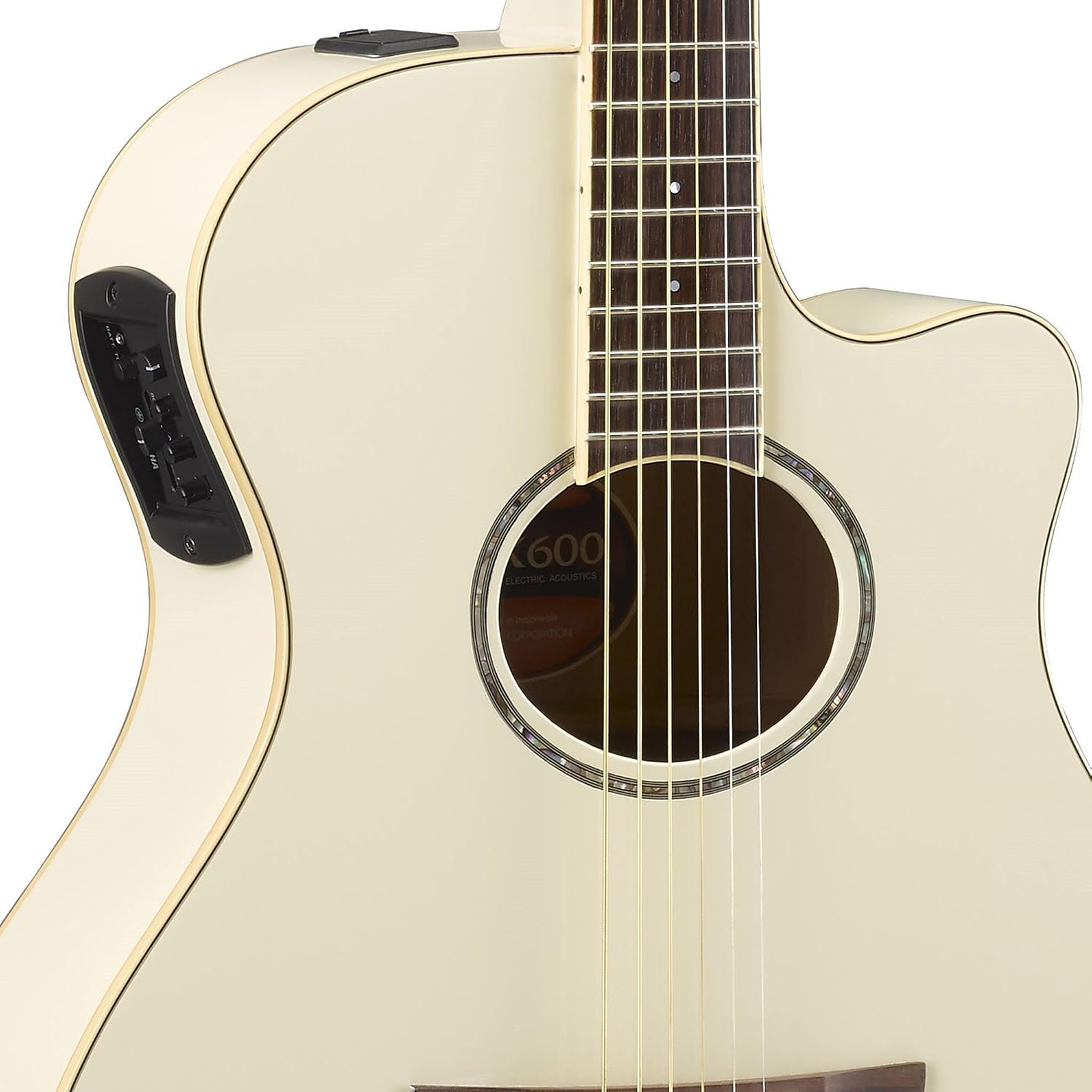
Yamaha APX600 Acoustic-Electric Guitar
As an Amazon Associate I earn from qualifying purchases.
The Yamaha APX600 Acoustic-Electric Guitar takes a noticeably different approach from the traditional full-depth acoustic. Its slim cutaway body is designed to sit closer to the player, making it particularly appealing to guitarists who find a large dreadnought cumbersome or who spend much of their time moving between acoustic and electric guitars.
The Vintage White finish gives this version a clean, slightly retro appearance, while the oval soundhole and compact APX body make it immediately recognisable as something different from Yamaha’s more traditional FG models.
At only around 80–90 mm deep, the body feels considerably slimmer against the ribs and picking arm than a full-bodied dreadnought. That reduced depth is one of the main reasons the APX600 has remained such a practical choice for players who value comfort and amplified use.
Why it works as an everyday acoustic-electric
The APX600 is built around convenience.
Its 634 mm, or 25-inch, scale length is slightly shorter than the scale used on many traditional steel-string acoustics. That small difference can make the strings feel a little less resistant under the fingers and reduces the overall reach slightly.
The 43 mm nut width keeps the neck familiar rather than unusually wide, which should make the transition easier for players accustomed to electric guitars.
The cutaway also gives the fretting hand more space when playing higher up the neck.
None of these individual differences is enormous, but together they give the APX600 a noticeably less bulky feel than many conventional acoustics.
For someone playing seated for long periods, rehearsing regularly or switching between electric and acoustic instruments, that comfort can matter just as much as appearance.
What it feels like to play
The first thing most players are likely to notice is how closely the body sits against them.
A large dreadnought projects several inches away from the player. The APX600 is much shallower, so the picking arm does not need to reach as far around the body.
That can feel especially comfortable when sitting.
The body is still wide enough to feel like a proper acoustic guitar, but it does not have the deep box-like sensation of a traditional dreadnought.
The 25-inch scale also contributes to the relatively approachable feel.
String gauge and setup will always affect how firm an acoustic feels, but the slightly shorter scale means the strings do not need quite as much tension as they would on a longer-scale instrument using an equivalent setup.
Players coming from an electric guitar may appreciate that.
The cutaway becomes useful once you move beyond open chords and first-position playing. Lead phrases, melodic playing and higher chord shapes are easier to approach because the body does not block the hand as early as a traditional non-cutaway acoustic.
Spruce top and slim APX body
Yamaha uses a spruce top with locally sourced tonewood for the back and sides.
The APX body has been designed around amplified performance rather than simply trying to shrink a dreadnought.
Yamaha also uses a bracing pattern intended to improve bass response from the thinner body.
That is significant because reducing body depth naturally changes the acoustic character of a guitar.
A deep-bodied acoustic has a larger internal air cavity and can usually produce a broader, fuller low end when played unplugged.
The APX600 sacrifices some of that physical volume in return for comfort, feedback resistance and stage practicality.
It is an intentional trade rather than an attempt to pretend that a thin guitar behaves exactly like a large one.
System65 electronics
The APX600 includes Yamaha’s System65 electronics.
The onboard controls provide volume, bass, middle and treble adjustment, together with an adjustable mid-frequency control.
That gives the player useful control before the signal ever reaches an amplifier or mixing desk.
The mid-frequency adjustment is particularly useful in a live setting.
Acoustic guitars can sometimes develop a boxy or harsh character through amplification, and being able to choose which part of the midrange is being adjusted makes the EQ more useful than a simple fixed three-knob arrangement.
There is also a built-in tuner.
That is a small feature that becomes very convenient when playing away from home. There is no separate clip-on tuner to lose, and tuning can be checked directly from the guitar before playing.
Designed with amplified playing in mind
The APX600 makes particular sense when the guitar is going to be connected to an amplifier or PA fairly regularly.
The slim body is easier to hold while standing, and its stage-focused pickup system is intended to help the guitar sit clearly in an amplified mix.
For a singer-guitarist, that can be more useful than having the biggest possible unplugged acoustic sound.
A guitar that works beautifully alone in a quiet room does not automatically behave equally well alongside vocals, keyboards or other instruments.
The APX approach prioritises a controllable amplified signal while still remaining perfectly usable as an unplugged acoustic for practice and songwriting.
That balance is really the point of the instrument.
A useful guitar for smaller spaces
The APX600 also makes sense away from the stage.
Its slimmer body can be easier to live with in a bedroom, home studio or smaller practice area.
It is still a full-length guitar, so it should not be confused with a travel instrument, but physically it feels less imposing than a large dreadnought.
For someone sitting at a desk with recording equipment nearby, that shallower body can also make it easier to hold the guitar without constantly bumping into furniture or the arms of a chair.
The clean Vintage White finish gives it a modern look without turning it into something overly flashy.
The drawbacks
The biggest compromise is the same feature that makes the APX600 attractive: the thin body.
At approximately 80–90 mm deep, it simply does not contain the same internal air volume as a full-depth dreadnought.
That means anyone looking primarily for a large, powerful unplugged acoustic sound may find the APX600 less satisfying than a deeper-bodied guitar.
Played on its own in a room, a traditional dreadnought can deliver more physical bass, more acoustic volume and a broader sense of resonance.
The APX600 is designed to trade some of that for comfort and amplified practicality.
If most of your playing is completely unplugged and you enjoy the feeling of a big acoustic body moving air against you, this may not be the obvious choice.
The spruce top is another point worth understanding.
Yamaha lists the APX600 simply as having a spruce top rather than describing it as solid spruce.
That puts it in a different construction category from Yamaha models that specifically advertise a solid top.
A solid-top acoustic can develop differently over time and is often preferred by players who place the greatest emphasis on purely acoustic tone.
The APX600 instead concentrates more heavily on consistency, comfort and plugged-in usefulness.
The System65 electronics are practical, but they are not Yamaha’s most elaborate acoustic pickup system.
They provide the controls most players actually need — volume, EQ, mid-frequency adjustment and tuning — but someone seeking sophisticated microphone modelling, multiple blended pickup sources or studio-style acoustic reproduction may want to look further up the range.
The amplified sound is designed to be useful and controllable rather than unusually complex.
The shorter 25-inch scale will also divide opinion.
Many players will appreciate the slightly softer feel and reduced reach.
Others prefer the firmer response of a longer-scale acoustic, particularly when tuning down or striking the strings hard.
A shorter scale is not automatically easier or better; it simply changes the feel.
There is also the relatively narrow 43 mm nut width.
For strumming, general chord work and players accustomed to electric guitars, it can feel comfortable.
Dedicated fingerstyle players sometimes prefer more space between the strings, especially at the nut.
Someone who plays intricate fingerstyle arrangements may therefore want to compare it with a wider-necked acoustic before deciding.
The Vintage White gloss finish looks smart, but pale glossy finishes tend to reveal fingerprints, small marks and grime around frequently touched areas.
That is only cosmetic, though anyone who likes a guitar to remain immaculate will probably wipe it down regularly.
The cutaway also has a small acoustic trade-off.
Removing part of the upper body improves access to the higher frets, but a traditional full-bodied non-cutaway design retains more body volume.
Again, Yamaha has clearly prioritised playability and stage use rather than chasing maximum unplugged resonance.
The onboard electronics also mean there is a battery to think about.
A purely acoustic guitar can sit in a case for months and still be ready to play once tuned.
An acoustic-electric with an active preamp needs a healthy battery when it is time to plug in.
For home use this is hardly troublesome, but anyone performing should get into the habit of checking the battery and carrying a spare.
The APX600 is also not a travel guitar despite its slim profile.
Its overall length is still just over 40 inches, so it requires proper guitar storage and an appropriately sized case or gig bag.
The shallow body makes it more comfortable; it does not make it miniature.
There is also a risk of choosing it for the wrong reason.
Someone who sees “thin body” and assumes it will reproduce the huge acoustic character of a deep dreadnought while simply being more comfortable may be disappointed.
The APX600 works best when its compromises match the player’s priorities.
If comfort, upper-fret access and amplified use matter most, the design makes sense.
If maximum unplugged volume, strong natural bass and a large resonant body are the priorities, a conventional acoustic may suit better.
Finally, as with almost any factory-built guitar, the setup deserves attention.
Action height, neck relief and string choice have a large effect on how an acoustic feels.
One player may find the factory setup comfortable immediately; another may prefer a lower action or different strings.
A sensible professional setup can often do more for everyday playing comfort than changing guitar models entirely.
Who it suits best
The Yamaha APX600 is particularly well suited to guitarists who want an acoustic-electric that feels less bulky than a traditional dreadnought.
It should appeal to singer-guitarists, electric players adding an acoustic to their collection, musicians playing through a PA and anyone who values comfort during longer sessions.
The cutaway also suits players who do more than first-position strumming and want easier access further up the fingerboard.
It is a particularly logical choice for someone who expects to use the guitar both unplugged at home and amplified for rehearsal or performance.
Players whose priority is a large, rich unplugged acoustic sound should probably compare it with a deeper-bodied model before deciding.
Is it worth the guitar space?
The Yamaha APX600 Acoustic-Electric Guitar makes sense because its design has a clear purpose.
The slim 80–90 mm body is noticeably easier to hold than a large dreadnought, the 25-inch scale keeps the playing feel approachable, and the cutaway gives better access higher up the neck.
The System65 electronics then give the guitar the controls needed for amplified playing without making the setup unnecessarily complicated.
Its limitations are equally clear.
The thin body cannot provide the same unplugged depth and physical low-end response as a larger acoustic, and players seeking a solid-top instrument or more sophisticated pickup system will need to look elsewhere.
But for someone who values comfort, clean stage connectivity and a guitar that feels relatively natural coming from an electric, the APX600 offers a well-balanced combination of acoustic character and everyday practicality.
For more acoustic instruments and related gear, explore our Acoustic Guitars guides.
As an Amazon Associate I earn from qualifying purchases.