MusicNomad MN676 Diamond Nut File Set
As an Amazon Associate I earn from qualifying purchases.
The MusicNomad MN676 Diamond Nut File Set is specialist guitar-maintenance equipment rather than the sort of accessory every player needs.
For somebody who sets up guitars regularly, however, a proper set of nut files can make a significant difference. Nut slots influence tuning stability, string height at the first fret, playing feel and the way the strings move through the nut when tuning or bending.
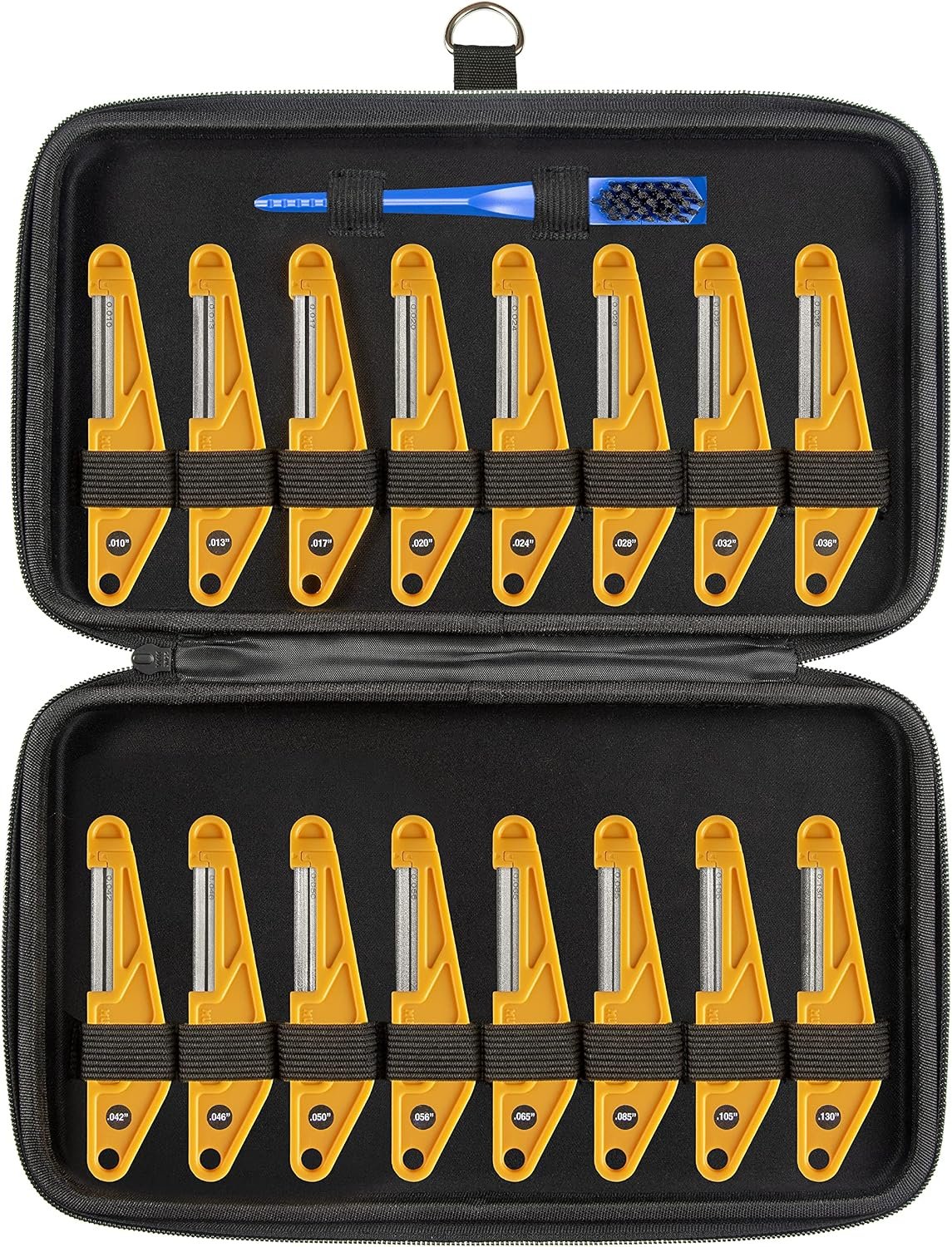
The MN676 is a 16-piece diamond nut file set supplied in its own storage case and intended to cover the range of string sizes encountered across electric guitars, acoustic guitars and basses.
It is the kind of tool set aimed more at serious home setup work, repair benches and players maintaining several instruments than somebody making an occasional adjustment to one guitar.
Why proper nut files matter
The nut looks like a small and fairly simple part of a guitar, but its dimensions have a surprisingly large effect on how the instrument behaves.
Each string needs a slot that is wide enough for the string to move freely but not so wide that the string rattles around.
The depth matters just as much.
A slot that is too high can make chords near the first few frets unnecessarily difficult to play and can cause notes to pull sharp when fretted.
A slot that is cut too deeply can create buzzing and may require the nut to be repaired or replaced.
This is why improvised tools are rarely a good idea.
Trying to open a nut slot with abrasive paper, a general-purpose needle file or an old piece of string can remove material, but controlling the width and shape accurately is considerably harder.
Dedicated nut files make the job far more predictable.
What the 16-piece set offers
The main advantage of the MN676 is the number of individual files included.
Rather than attempting to make a handful of files cover every string, the set provides a broad selection of sizes.
That becomes particularly useful when working on different instruments.
A light electric-guitar string and a heavy bass string require very different nut slots.
Acoustic guitars introduce another range of gauges, while players using heavier alternative tunings may need something different again.
Having a larger file selection gives you more chance of choosing a file close to the actual string size rather than forcing an approximate tool to do the job.
For anyone maintaining several guitars, that flexibility is much more useful than buying individual files one at a time.
Diamond cutting surfaces
Diamond-style nut files are intended to cut smoothly and accurately rather than aggressively tearing at the nut material.
That matters because nut work should be approached gradually.
The aim is not to remove material quickly.
It is to remove a very small amount, check the result and then decide whether another pass is required.
A controlled file is much easier to use sensibly than something that removes a large amount of material with every stroke.
This is particularly important when working with expensive replacement nuts or an instrument that you do not want to damage.
Clear individual files are easier to work with
A set containing many different sizes only becomes useful if you can quickly identify the file you need.
Keeping the files organised in their dedicated storage case helps enormously.
Nut files are small precision tools.
Leaving them loose in a general toolbox alongside screwdrivers, pliers and heavier equipment is not ideal.
The case keeps the set together, protects the cutting surfaces and makes it much easier to see whether one of the files has gone missing.
For a home guitar bench, that sounds like a small detail but quickly becomes valuable.
Useful for more than replacing a nut
You do not necessarily need to be fitting a brand-new nut to benefit from proper files.
Factory nut slots are not always perfectly matched to the strings a player ultimately chooses.
Changing to a heavier string gauge can sometimes leave a string binding in a slot that was cut for something thinner.
That can show itself as tuning instability.
You turn the machine head and nothing seems to happen, followed by the string suddenly jumping in pitch as it releases from the nut.
A correctly sized file can be used to make a careful adjustment.
The emphasis is on careful.
Nut work is one of those jobs where knowing when to stop is just as important as having the correct tool.
A useful tool for setup work
Players often concentrate on truss-rod adjustment, bridge height and intonation when setting up a guitar.
Those things matter, but the nut is part of the same overall system.
If the slots are too high, the guitar can still feel uncomfortable even when the bridge and neck relief are correctly adjusted.
The first few frets can also feel noticeably stiffer because the player has to push the string farther down before it contacts the fret.
Correct nut height can make an instrument feel easier and more natural to play.
This is one reason professional guitar technicians spend time on the nut rather than regarding it as a fixed component that should never be touched.
Particularly useful if you own several guitars
The MN676 starts to make more sense financially and practically when it will be used repeatedly.
Someone with an electric guitar, acoustic guitar and bass may encounter a considerable range of string gauges.
Add different tunings or several instruments belonging to friends and family, and a broad file set becomes genuinely useful.
It can also be valuable to somebody who buys used guitars and enjoys bringing them back into good playing condition.
A poorly cut replacement nut is not unusual on an older instrument.
Having the appropriate files available gives you the ability to correct it rather than simply accepting the setup.
The importance of matching the file to the string
Choosing the correct file is not simply a matter of finding one that looks approximately right.
The finished slot needs to allow the string to sit securely while still moving freely when the instrument is tuned.
Too narrow and the string can bind.
Too wide and the fit becomes unnecessarily loose.
A large set makes it easier to approach this properly.
The file should suit the string being installed rather than being chosen because it happens to be the nearest tool in the drawer.
This becomes even more important with bass strings, where the difference between gauges is far more obvious than it is on the thinner strings of an electric guitar.
Work slowly and check frequently
Nut filing is not a job to rush.
Once material has been removed, putting it back is much more difficult.
A sensible approach is to make a very small adjustment, reinstall or check the string, measure or test the result and then continue only if necessary.
It is easy to become impatient because each individual stroke removes so little material.
That slow progress is actually an advantage.
Precision guitar setup is usually safer when the tool encourages controlled adjustments rather than rapid cutting.
The drawbacks
The biggest drawback to the MusicNomad MN676 Diamond Nut File Set is not really a fault with the tools themselves.
It is the fact that nut filing is a job where a mistake can permanently alter the nut.
This is not the same as adjusting an amplifier knob and turning it back if you dislike the result.
If a nut slot is filed too deeply, the string can sit too close to the first fret and begin buzzing.
At that point the solution may involve filling and rebuilding the slot or replacing the nut completely.
That makes this a poor first job for somebody who has never attempted any guitar setup work before.
Sixteen files may be excessive for one guitar
The large file selection is a major strength for somebody working on many instruments.
For somebody who owns one guitar and always uses the same string gauge, much of the set may never be used.
A guitarist who simply needs to correct one troublesome slot could find themselves buying far more equipment than necessary.
This is why I see the MN676 as a proper workshop-style set rather than an essential accessory for every guitar case.
Precision tools do not replace measuring
Owning the correct files does not automatically mean the slots will be cut correctly.
You still need to assess string height and understand how low the slot can safely go.
Guessing by eye is risky.
Nut work benefits from proper measurement, good lighting and repeated checking.
Anyone expecting the expensive specialist tool to make the process foolproof may be disappointed.
The tool improves control.
It does not make the decisions for you.
The angle of the slot matters
Depth and width are not the only considerations.
The string needs to leave the nut cleanly toward the tuning machine.
A badly angled slot can cause its own tuning and contact problems even if the width is correct.
That means simply sawing straight downward until the string becomes lower is not good technique.
Anyone learning nut work should understand the basic geometry before starting on a valued instrument.
Different nut materials behave differently
Guitar nuts are made from a variety of materials.
Some are relatively easy to work.
Others are harder or respond differently to filing.
The same amount of pressure will not necessarily remove the same amount of material from every nut.
That makes patience especially important when moving from one instrument to another.
Experience with one guitar should not encourage you to assume the next one will behave identically.
File size still needs thought
Having sixteen files reduces compromise, but it does not remove the need to select carefully.
The file should be chosen with the actual string gauge in mind.
Using a much larger file simply because it moves more freely risks creating a slot wider than necessary.
Likewise, forcing a file that is too narrow into the slot can produce an unsuitable shape.
This is precision work, not general woodworking.
It is easy to chase perfection too far
One danger with owning specialist setup tools is finding problems that do not really need fixing.
If a guitar tunes properly, plays comfortably and the strings move through the nut without binding, there may be no reason to start filing.
Removing material simply because the tools are available can turn a perfectly serviceable setup into a problem.
The best guitar maintenance often involves recognising when something should be left alone.
Nut filing can affect tuning stability in both directions
Correcting a tight slot can improve tuning behaviour.
Cutting the slot incorrectly can make it worse.
A string that moves too freely in a badly shaped or oversized slot may not behave as intended.
This is why tuning problems should be diagnosed before reaching automatically for a file.
Machine heads, string installation, bridge components and the strings themselves can also contribute to tuning problems.
Bass work requires particular care
The larger gauges used on bass make the physical difference between files much more obvious.
The slots are also larger, meaning there is more material available to remove.
That can create a false sense that bass nut work is easier.
The same basic risk remains: go too low and the nut may need repair or replacement.
A broad file range is valuable here, but it should still be used gradually.
The set adds another specialist tool to the bench
For somebody who enjoys doing their own setups, that is hardly a problem.
For somebody who dislikes working on guitars mechanically, the MN676 could spend most of its life in the case.
There is no shame in taking nut work to a guitar technician.
In fact, for a valuable instrument and an inexperienced owner, paying somebody who does the job every day may be the better decision.
The value of this set comes from repeated use and the willingness to learn the process properly.
The files need looking after
Small precision files should not simply be thrown loose into a drawer.
Their cutting surfaces need to remain clean and protected.
The included case helps, but it only works if the files are returned to it.
They should also be cleaned after use rather than allowed to become clogged with nut material.
A professional-style tool set comes with professional-style maintenance expectations.
It will not cure every first-fret problem
A guitar that buzzes or feels difficult around the lower frets does not automatically need nut work.
Neck relief, fret condition, overall action and structural issues can produce similar symptoms.
Filing the nut before identifying the real cause could make the situation worse.
Diagnosis should always come before adjustment.
Who it suits best
The MusicNomad MN676 Diamond Nut File Set is best suited to somebody who already performs their own guitar setups and wants to take that work further.
It makes particular sense for:
Players maintaining several guitars with different string gauges.
Home guitar technicians who regularly fit or adjust nuts.
Musicians working on electric, acoustic and bass instruments.
People restoring or improving used guitars.
Small workshops that want a broad selection of dedicated nut files kept together in one case.
It is considerably harder to justify for a beginner who owns one guitar and has never performed nut work before.
In that situation, learning the principles first — or having the initial job performed professionally — may be the safer route.
Is it worth having on the guitar workbench?
For the right person, the MusicNomad MN676 Diamond Nut File Set is exactly the sort of specialist equipment that turns a general guitar workbench into a more capable setup area.
The 16-file selection means you are not trying to make one or two approximate tools cover everything from thin electric strings to substantially heavier gauges.
The storage case keeps an easily misplaced collection organised, while the diamond files are designed for the controlled material removal that good nut work requires.
The main reservation is equally clear.
These tools give you the ability to make very precise changes, and that means they also give you the ability to make very precise mistakes.
For somebody prepared to measure, work slowly and understand what the nut is supposed to do, the MN676 can become a long-term workshop tool.
For someone hoping to experiment on a valuable guitar without first learning the technique, it would be much wiser to practise on a spare nut or inexpensive instrument before touching the guitar that matters.
For more useful maintenance tools, cases and everyday guitar essentials, explore our Accessories guides on NoisyNeck.
As an Amazon Associate I earn from qualifying purchases.