
BOSS IR-2 Amp & Cabinet
As an Amazon Associate I earn from qualifying purchases.
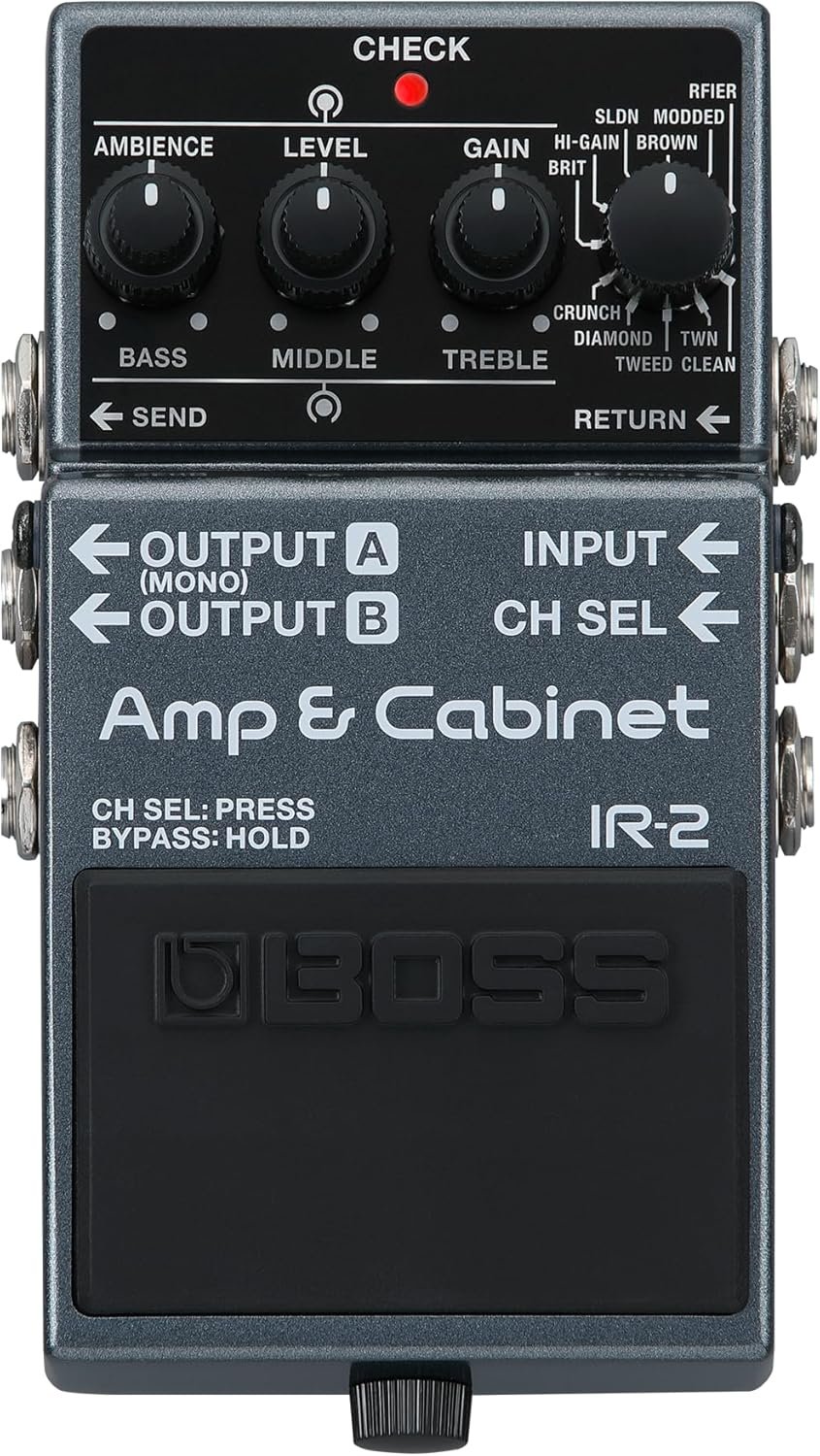
The BOSS IR-2 Amp & Cabinet is designed for guitarists who want the sound and response of an amplifier and speaker cabinet without having to take a conventional amp everywhere they play.
It packs amp modelling, cabinet impulse responses, stereo outputs, headphone monitoring, an effects loop and USB-C recording into the familiar footprint of a standard BOSS compact pedal.
That combination makes it useful for several very different situations: a compact ampless pedalboard, quiet practice at home, direct recording or sending a finished guitar sound straight to a PA system.
Why it works on a pedalboard
The IR-2 is small enough to sit alongside ordinary drive, modulation, delay and reverb pedals rather than requiring the space of a large multi-effects processor.
Despite the compact size, BOSS gives it 11 different amplifier types, each paired with a Celestion Digital cabinet IR. The range covers clean sounds, classic combo-style tones, crunch, British-style amplification and several higher-gain options.
The controls are deliberately familiar.
There are dedicated knobs for Gain, Level, Bass, Middle and Treble, along with an Ambience control. That means basic sound shaping feels more like working with a guitar amplifier than navigating pages of menus.
You select an amp type, adjust the tone controls and then decide how much ambience you want around the sound.
For a guitarist who likes physical controls, that simplicity is one of the IR-2’s strongest features.
What it feels like to use
Physically, the IR-2 follows the classic BOSS compact-pedal format.
It measures approximately 73 mm wide, 129 mm deep and 59 mm high, and weighs around 450 g including a battery.
That gives it the solid, dense feel expected from this style of stompbox without taking up a large area of the board.
There is no large screen dominating the front.
Instead, the amp type is chosen with a rotary control while the remaining knobs behave much like the controls on an amplifier.
This makes it particularly approachable if you would rather turn a knob and listen than scroll through graphical menus.
The pedal can also store two amp/cab setups that can be switched using the main pedal switch or an optional external footswitch.
That can be enough for a simple clean-and-driven arrangement without introducing a larger switching system.
Eleven amp sounds in one compact pedal
The 11 amp types cover a surprisingly wide range.
BOSS includes its own clean, crunch and high-gain designs alongside models intended to reproduce the character of well-known American and British amplifier styles. The selections range from clean combo sounds through vintage-style crunch and into modern high-gain territory.
Each amp type is paired with a selected Celestion Digital cabinet IR.
This is important because the speaker cabinet is a major part of an electric guitar sound. An amp model on its own can sound harsh when sent directly into full-range recording or PA equipment. The cabinet IR supplies the filtering and response that would normally come from a guitar speaker and its enclosure.
BOSS processes the IR-2 at 96 kHz with 32-bit floating-point processing, giving it considerably more going on internally than its straightforward front panel suggests.
You are not limited to the supplied cabinet sounds either.
The IR-2 can load your own cabinet impulse responses through USB-C using the dedicated BOSS IR-2 IR Loader application. BOSS provides 11 user IR cabinet slots, occupying the same positions as the preset cabinet IRs.
That gives experienced players room to personalise the cabinet side of the pedal without making custom IR loading compulsory for somebody who simply wants to plug in and play.
A useful effects loop
The effects loop is one of the features that makes the IR-2 particularly practical on a proper pedalboard.
Drive and compression pedals can be placed before the IR-2 in the normal way, while modulation, delay and reverb can be connected through the send and return loop so that they sit after the simulated amplifier section.
That is similar to the way many guitarists organise pedals around a real amplifier.
The return connection also supports stereo, allowing suitable stereo effects to feed the IR-2’s two audio outputs.
It means the pedal does not have to become an isolated box at the end of the signal chain. It can act as the central amp section around which the rest of the board is arranged.
Direct recording over USB-C
USB-C gives the IR-2 another useful role.
BOSS allows the complete guitar signal to be sent directly to recording software on a computer or compatible mobile device. Audio from the computer or mobile device can also be played back through the IR-2.
For somebody recording guitar at home, that can simplify the setup considerably.
You can build a sound with your usual pedals, amp model and cabinet IR, connect the IR-2 over USB and record without setting up a microphone in front of a loud guitar amplifier.
Headphones can be connected directly to the IR-2 for monitoring, so quiet recording and late-night practice are possible without a conventional amplifier running in the room.
It also makes it easy to practise along with backing tracks, recorded songs or online lessons while hearing both the guitar and playback through the same headphones.
Useful for an ampless live rig
The IR-2 can also become the centre of an ampless live setup.
Its outputs can feed a suitable PA system or other full-range equipment, providing the amp and cabinet sound before the signal reaches the venue system.
That means the basic character of the guitar rig does not depend as heavily on whichever amplifier happens to be available at a particular venue.
The stereo outputs are useful for players running stereo effects, although a conventional mono setup works perfectly well through the Output A connection.
For musicians who travel, play small venues or simply want less equipment to carry, having the core amplifier and cabinet sound inside one normal-sized pedal can make the whole rig considerably easier to manage.
The drawbacks
The IR-2 offers a lot for its size, but the compact format inevitably creates some compromises.
The first is limited immediate access to stored sounds.
There are 11 amplifier types available, but the pedal is not designed like a multi-effects processor with dozens of presets displayed on a screen. You can switch between two stored amp/cab setups from the pedal or with an external footswitch.
For a guitarist who needs only a clean sound and a driven sound during a performance, that may be ideal.
For somebody who wants six or seven completely different amplifier setups instantly available throughout a set, a larger modeller with extensive preset switching may be more suitable.
The lack of a display is another trade-off.
The physical controls make basic operation very quick, but you do not get a screen showing detailed preset names, cabinet information or parameter values.
That simplicity is part of the attraction, but players accustomed to modern floor processors may find the IR-2 less informative at a glance.
Custom IR loading also requires a computer.
The supplied Celestion cabinet IRs work straight from the pedal, but loading your own cabinet files requires the dedicated IR-2 IR Loader application over USB-C.
That is unlikely to bother somebody who changes IRs occasionally, but it is not something you would normally want to configure halfway through a rehearsal.
The IR-2 also needs some understanding of signal routing to get the best from it.
Placing drives before the amp model and delay or reverb in the effects loop can produce a very natural arrangement, but a player who has never used an amplifier effects loop may need some experimentation before everything is connected the way they want.
Its stereo capability is useful, although the main guitar input remains mono. Stereo operation is mainly provided through the return section and the two outputs rather than turning the whole pedal into a fully stereo processor from input to output.
Power is another consideration.
The IR-2 can operate from a 9V alkaline battery, but BOSS quotes approximately 3.5 hours of continuous use. It can also run from a BOSS PSA-series AC adaptor, which is sold separately.
For occasional practice, battery operation is useful as a backup.
For a permanent pedalboard, an appropriate external power supply is the more practical solution because a few hours of battery life would become inconvenient very quickly.
There is also the question of monitoring.
The headphone output makes silent practice straightforward, but when using the IR-2 live without a conventional guitar amplifier, the quality of the speaker, monitor or PA system becomes part of what you hear.
A good amp-and-cabinet model cannot make a poor full-range speaker behave like an excellent monitor.
Players switching from a real guitar cabinet may also need time to become accustomed to the sound of a mic’d cabinet simulation through headphones or studio monitors.
It can feel different from standing beside a loud guitar cabinet moving air in the room.
That does not mean one is better than the other; they are simply different listening experiences.
The 11 amp types provide useful variety, but the IR-2 is still not a complete multi-effects unit.
There are no large collections of delays, modulation effects, pitch effects, compressors and drives intended to replace an entire pedalboard. The onboard Ambience control adds space, but most players wanting a full range of effects will still use their existing pedals around the IR-2.
For some guitarists, that is exactly the point.
For others who want one box to provide the amp, cabinet and every effect in the rig, a larger processor would make more sense.
Finally, the usefulness of an IR pedal depends heavily on how you actually play.
If you always use the same traditional guitar amplifier, never record directly, never practise through headphones and have no interest in running into a PA, much of the IR-2’s capability could remain unused.
Its advantages become much clearer when portability, direct recording, silent practice or an ampless live setup genuinely matters.
Who it suits best
The BOSS IR-2 is particularly suited to guitarists who already own pedals they like and want to add an amplifier and cabinet section without replacing the rest of the board.
It is a strong fit for home recording because USB-C, cabinet IRs and headphone monitoring allow a finished guitar sound to be produced without setting up a conventional amplifier and microphone.
It also suits musicians building a lightweight live rig, players who travel regularly, and guitarists who want a compact backup solution should their normal amplifier become unavailable.
For bedroom practice, the combination of headphones and USB audio makes it useful without demanding a completely separate practice system.
Is it worth the pedalboard space?
The BOSS IR-2 earns its space by taking several pieces of a traditional guitar rig and fitting them into one familiar compact pedal.
There are 11 amplifier types, Celestion Digital cabinet IRs, user IR loading, a mono/stereo effects loop, headphone monitoring, stereo outputs and USB-C recording inside a pedal measuring only about 73 mm wide.
It is not intended to replace every pedal you already own, and guitarists who require large numbers of instantly accessible presets may prefer a more comprehensive modeller.
But for someone who wants to keep their existing pedalboard while adding a practical amp-and-cabinet solution for recording, practice and direct live use, the IR-2 provides a great deal of flexibility without turning the board into a computer at your feet.
Explore more guitar effects and useful gear in our Pedals section.
As an Amazon Associate I earn from qualifying purchases.



One Comment
Comments are closed.