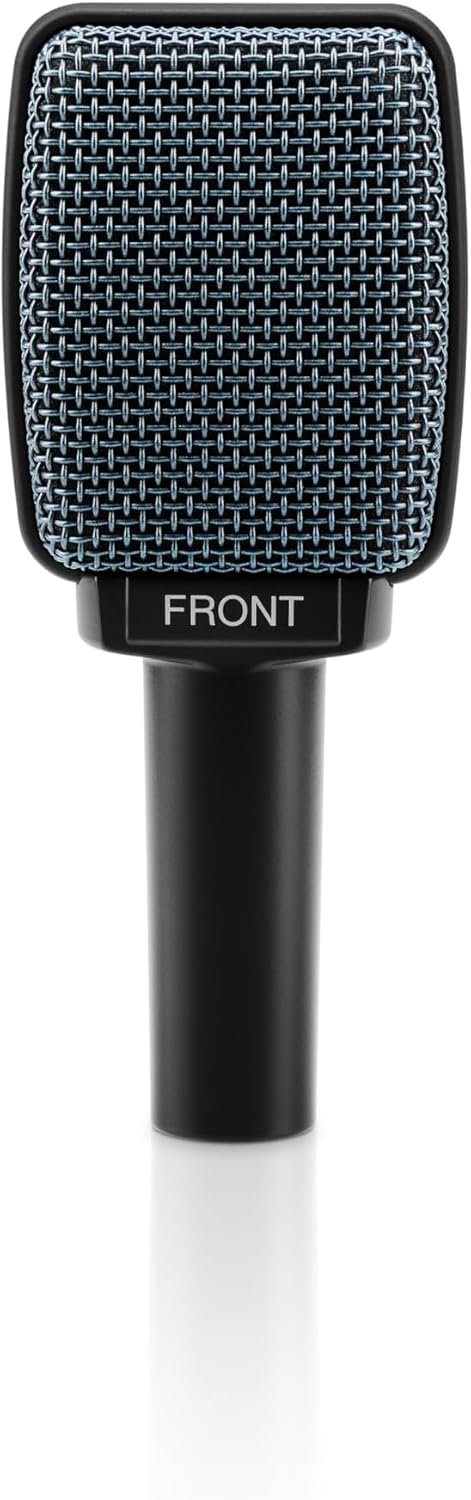
Sennheiser e906 Dynamic Microphone
As an Amazon Associate I earn from qualifying purchases.
The Sennheiser e906 Dynamic Microphone is designed for guitarists who want to capture the sound of their amplifier without unnecessarily complicated recording equipment.
Its distinctive flat-front design allows it to sit close to a guitar speaker, while the supercardioid pickup pattern helps focus the recording on the intended sound source.
Unlike a conventional microphone with a rounded grille, the e906 is particularly convenient for positioning directly in front of a guitar cabinet.
It also features a three-position presence switch, giving guitarists a choice between brighter, neutral and warmer tonal characteristics.
Built with a reinforced metal housing and a professional XLR connection, the e906 is intended for studio recording and live sound applications.
However, it requires suitable recording equipment, careful microphone positioning and a real guitar amplifier producing sound.
For musicians who prefer recording their amplifier rather than relying entirely on digital simulations, the Sennheiser e906 is a practical microphone worth considering.
Why It Works for Guitar Amplifier Recording
Recording an electric guitar amplifier involves capturing much more than the electrical signal coming from the instrument.
The amplifier, speaker and cabinet all influence the sound.
Even the position of a microphone in front of the speaker can change the tonal balance considerably.
The Sennheiser e906 was developed specifically with this application in mind.
Its flat grille allows the microphone to face the speaker directly without requiring an awkward mounting arrangement.
The microphone can be suspended in front of a suitable cabinet using its cable, although careful cable routing and secure positioning remain important.
Alternatively, it can be mounted using a conventional microphone stand and suitable clip.
This flexibility is particularly attractive in home studios where floor space is limited.
A microphone stand positioned in front of a guitar cabinet can interfere with other equipment, especially in a smaller room.
The e906 offers a simpler arrangement while still allowing the microphone position to be adjusted.
Its dynamic capsule is also well suited to capturing loud sound sources.
That makes it appropriate for close-miking guitar amplifiers, where the microphone may be positioned only a short distance from the speaker grille.
What It Feels Like to Use
The e906 has an unusual rectangular appearance that immediately distinguishes it from ordinary handheld microphones.
Its black metal housing incorporates a broad, flat grille and a narrow lower section containing the XLR connector.
The construction is straightforward and purposeful.
There are no digital displays, batteries or complicated electronic controls.
Sennheiser specifies a weight of approximately 140g and dimensions of 55 × 34 × 134mm.
This makes the microphone compact enough to transport in an ordinary equipment case.
The reinforced metal housing is intended to withstand the demands of regular studio and stage use.
However, a durable exterior does not mean the microphone should be treated carelessly.
The grille, connector and internal components still require sensible handling.
A Practical Shape for Guitar Cabinets
The flat design is one of the e906’s strongest features.
A conventional rounded microphone often requires careful positioning on a stand to keep the capsule facing the speaker correctly.
The e906 can be placed flat against or close to the speaker grille, depending on the preferred mounting arrangement.
This provides a useful starting point for recording.
It also makes small changes in microphone position relatively straightforward.
For musicians working in a compact home studio, reducing the amount of equipment surrounding the amplifier can be a welcome advantage.
The Three-Position Presence Switch
The e906 includes a switchable presence filter with three settings.
This is particularly useful because electric guitar sounds vary considerably.
A clean jazz tone may benefit from a different microphone response than a heavily distorted rock guitar.
Rather than relying entirely on recording software to shape the sound afterwards, the e906 offers a simple adjustment directly on the microphone.
Boosted Presence
The brighter setting increases presence around the upper-midrange region.
This can help distorted guitars achieve greater definition and attack.
It may be useful when recording aggressive rhythm parts or lead guitar that needs to remain audible within a dense arrangement.
However, adding presence can also make an already bright amplifier sound excessively sharp.
Normal Presence
The middle setting provides the microphone’s standard response.
This is a sensible starting point when recording an unfamiliar amplifier.
It allows the guitarist to evaluate the sound before deciding whether additional brightness or warmth is needed.
For many classic rock and general guitar applications, the normal setting may provide a useful balance.
Attenuated Presence
The darker setting reduces presence, creating a smoother tonal character.
This can be particularly useful with bright amplifiers, sharp single-coil pickups or guitar sounds that already contain considerable high-frequency energy.
Blues and jazz guitarists may appreciate this approach when seeking a warmer recorded sound.
The switch is adjusted using a small pointed tool, rather than a large external knob.
That makes accidental changes less likely, although it is less convenient when frequent adjustments are required.
Getting the Microphone Position Right
Microphone placement can influence a guitar recording as much as the selected presence setting.
A speaker does not produce identical sound across its entire surface.
The central area generally produces more pronounced upper frequencies, while moving towards the outer edge usually creates a smoother character.
Sennheiser provides specific guidance for experimenting with these positions.
Near the Speaker Centre
Positioning the e906 towards the central dome of the speaker generally produces a brighter, more aggressive sound.
This can work well when a guitar needs additional bite.
However, it may also emphasize unpleasant high-frequency distortion if the amplifier is already bright.
Between the Centre and Edge
Moving the microphone towards the area between the speaker centre and outer edge often produces a more balanced sound.
This is a useful starting position for many guitarists.
Small adjustments can then be made while listening to the recorded result.
Near the Outer Edge
Moving closer to the speaker’s edge generally reduces some upper-frequency emphasis.
This can help produce a warmer sound with more apparent lower-midrange character.
However, moving too far from the desired position can reduce the definition required for certain playing styles.
The important lesson is to experiment with placement before making extensive adjustments in recording software.
A small physical movement may produce a more natural improvement than applying several corrective equalizer settings afterwards.
Using the e906 in a Home Studio
The Sennheiser e906 uses a balanced three-pin XLR connection.
This means it requires a suitable microphone preamplifier, audio interface or mixing desk.
It does not connect directly to a computer using USB.
For guitarists building a practical recording setup, the microphone can work with an audio interface such as the Universal Audio Volt 276 USB Audio Interface.
The interface provides microphone inputs and allows the recorded signal to be transferred to a computer.
Does the e906 Need Phantom Power?
No.
The e906 is a dynamic microphone and does not require 48V phantom power to operate.
Its signal is generated by the moving-coil microphone capsule.
A suitable preamplifier is still necessary to bring that signal up to a useful recording level.
The gain should be adjusted carefully to avoid clipping when the amplifier is playing loudly.
Recording at Home
One important consideration is that the microphone captures the actual sound coming from the amplifier speaker.
This means the amplifier must be producing sound in the room.
Although a dynamic microphone positioned close to the speaker can help reduce the relative level of unwanted room noise, it cannot eliminate sound travelling through walls or disturbing other people.
For quiet recording, an alternative such as the BOSS IR-2 Amp & Cabinet may be more practical.
That pedal provides amplifier modelling and cabinet impulse responses for direct recording without requiring a conventional speaker cabinet to be playing in the room.
The two approaches serve different preferences.
The e906 captures a physical amplifier, while direct recording equipment offers greater control over volume and convenience.
Suitable for Live Performances
The e906 is also suitable for amplifying guitar cabinets during live performances.
Its supercardioid pickup pattern concentrates sensitivity towards the front while reducing sound arriving from many off-axis directions.
This can help limit unwanted spill from nearby instruments.
For example, a guitar cabinet microphone may be positioned relatively close to drums, stage monitors or other amplifiers.
A directional microphone helps the sound engineer concentrate on the intended source.
However, supercardioid microphones have some sensitivity behind the microphone and do not reject all surrounding noise.
Correct placement remains important.
The flat housing is particularly useful on crowded stages where conventional microphone stands can become inconvenient.
The Drawbacks
The Sennheiser e906 is a capable instrument microphone, but its specialized design introduces several limitations worth understanding.
It Requires Additional Recording Equipment
The e906 is an XLR microphone, not a USB recording device.
To record into a computer, guitarists generally need an audio interface with a microphone preamp, suitable XLR cable and recording software.
This makes the complete arrangement more involved than connecting a guitar directly to a USB-equipped amplifier or modelling processor.
For musicians starting from scratch, those additional requirements should be considered.
Microphone Position Changes the Sound
The e906’s flat design makes positioning relatively convenient, but it does not eliminate the need for experimentation.
Small movements across the speaker grille can produce noticeably different results.
An overly bright recording may be caused by microphone placement rather than a problem with the amplifier.
Someone expecting consistently identical results without paying attention to positioning may be disappointed.
It Cannot Make Loud Amplifiers Quiet
The microphone records sound produced by the actual amplifier speaker.
If a guitarist wants the sound of a heavily driven amplifier operating at considerable volume, the room must accommodate that sound.
The e906 does not provide silent recording or reduce the physical loudness of the amplifier.
This can be a significant limitation in apartments and shared accommodation.
The Presence Switch Offers Limited Adjustment
The three-position presence switch is useful, but it is not a complete equalizer.
It primarily changes the presence region rather than offering independent bass, middle and treble controls.
Guitarists wanting detailed tonal adjustment will still need to experiment with amplifier settings, microphone position or recording software.
The switch is best regarded as a convenient tonal option rather than a complete sound-shaping system.
It Is Not an All-Purpose Studio Microphone
Although the e906 can capture percussion, brass instruments and other sound sources, it is principally designed for close instrument recording.
It would not necessarily be the first choice for delicate acoustic guitar recordings, detailed room ambience or a versatile primary vocal microphone.
Someone building a studio around a single microphone should carefully consider their recording priorities.
A specialist guitar cabinet microphone is not automatically the most versatile choice.
Supercardioid Does Not Mean Complete Isolation
The directional pickup pattern helps reduce unwanted sound, but it cannot prevent every source of spill.
Nearby drums, other amplifiers and room reflections may still enter the recording.
The pattern also includes some rear sensitivity.
For live use, monitor placement and the surrounding stage arrangement remain relevant.
Good microphone technique is still necessary.
Hanging the Microphone Requires Care
The e906’s shape makes it practical to hang in front of a guitar cabinet.
However, the microphone must remain securely positioned.
An unsecured cable could allow the microphone to move, rotate or fall.
Cable strain and accidental pulling should also be avoided.
A conventional stand and clip may provide greater control when precise positioning is required.
Convenience should never come at the expense of protecting the equipment.
It May Be Unnecessary for Digital Guitarists
Some modern guitarists produce their entire sound through digital modelling, cabinet simulations and direct recording equipment.
For these players, a microphone designed to capture a physical loudspeaker may offer little practical benefit.
The e906 makes most sense when the guitarist genuinely wants to record a real amplifier and speaker cabinet.
It should be chosen for that purpose rather than simply because it is professional recording equipment.
Who It Suits Best
The Sennheiser e906 is particularly suitable for guitarists who use conventional amplifiers and want to capture their sound accurately.
Home recording musicians may appreciate its compact design and straightforward placement.
Live performers and sound engineers can also benefit from its directional pickup pattern and reinforced metal housing.
Its three-position presence switch offers useful flexibility for different styles, from warm blues sounds to more aggressive rock and metal.
However, musicians who mainly record through digital amplifier models or need a microphone for a wide range of acoustic sources may prefer another solution.
Is the Sennheiser e906 Worth the Studio Space?
The Sennheiser e906 offers a focused approach to recording electric guitar amplifiers.
Its flat design makes speaker positioning convenient, while the supercardioid pattern and three-position presence switch provide practical control over the captured sound.
The reinforced metal housing and standard XLR connection make it suitable for regular studio and live use.
Nevertheless, it requires additional recording equipment, careful positioning and an amplifier producing sound in the room.
For guitarists who value the character of their existing amplifier and want to capture it without unnecessary complexity, the e906 is a thoughtful and purpose-built option.
Its greatest strength is concentrating on the job it was designed to do: capturing the sound of a guitar speaker clearly and reliably.
Explore more carefully selected equipment in our Recording & Studio collection.
As an Amazon Associate I earn from qualifying purchases.