beyerdynamic DT 770 PRO X Studio Headphones
As an Amazon Associate I earn from qualifying purchases.
The beyerdynamic DT 770 PRO X Studio Headphones combine traditional German engineering with modern driver technology, offering guitarists, recording musicians and studio producers a dependable way to monitor their sound.
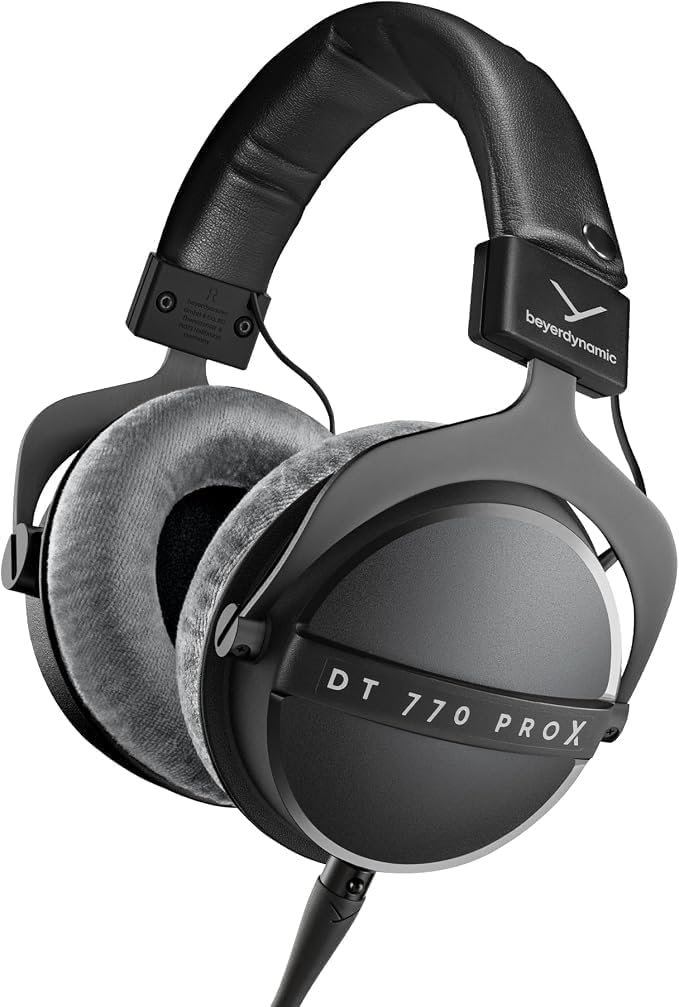
Built around beyerdynamic’s STELLAR.45 drivers, these 48-ohm closed-back headphones are designed for detailed recording and monitoring. Their substantial construction, soft grey velour ear pads and detachable cable give them a practical character that goes beyond ordinary everyday headphones.
The DT 770 PRO X follows the familiar design of the longstanding DT 770 PRO, retaining its distinctive black earcups and studio-focused appearance while introducing several worthwhile improvements.
For musicians recording electric guitars, monitoring vocals or working with amplifier simulations, the combination of isolation, detailed sound and replaceable components makes them particularly interesting.
However, these are not completely neutral headphones, and their firm fit will not suit everyone. Understanding their sound character and physical design is important before choosing them for a home studio.
Why They Work for Home Recording
A good pair of recording headphones should allow musicians to hear their performances clearly while reducing unwanted sound leakage into nearby microphones.
The DT 770 PRO X uses a closed-back design, with enclosed earcups that provide passive isolation from surrounding noise.
This is especially useful when recording vocals or acoustic guitar.
If a singer is listening to a backing track through headphones, excessive sound leakage can be picked up by the microphone.
The DT 770 PRO X is designed to reduce that problem while keeping the performer connected to the recording.
For electric guitarists, the headphones can also provide a convenient monitoring solution when using software amplifier simulations.
Instead of running a traditional amplifier at substantial volume, the player can listen directly through an audio interface or compatible guitar processor.
That makes them particularly useful in bedrooms, home studios and shared living spaces where loud guitar amplification may not be practical.
What They Feel Like to Wear
The DT 770 PRO X has a reassuringly substantial construction.
The black earcups, spring-steel headband and grey velour ear pads create a familiar professional studio appearance.
At approximately 305g without the cable, they are not exceptionally lightweight, but their over-ear design distributes the weight across the head rather than concentrating it on the ears.
The soft velour cushions are an important part of the design.
Unlike synthetic leather, velour has a fabric-like texture that feels soft against the skin and allows some breathability.
This can make longer recording sessions more comfortable, although closed-back headphones still retain some warmth around the ears.
The padded headband includes a recess intended to reduce pressure on the sensitive area at the top of the head.
Beyerdynamic also uses a relatively firm clamping force to keep the earcups securely positioned.
That firm fit helps maintain consistent contact around the ears, contributing to passive isolation.
However, head shape and personal comfort preferences vary, so the wearing experience will not be identical for everyone.
STELLAR.45 Drivers and Sound Character
The DT 770 PRO X uses beyerdynamic’s STELLAR.45 dynamic driver system.
These drivers have a nominal impedance of 48 ohms and a specified frequency response extending from 5Hz to 40,000Hz.
The broad specification reflects the driver’s operating range, although it should not be interpreted as a guarantee of perfectly flat sound reproduction.
Beyerdynamic describes the DT 770 PRO X as retaining the familiar sound character of the original DT 770 PRO, with an emphasis on bass and treble.
This gives the headphones a distinctive tonal balance.
Low-frequency information is presented with a sense of weight, while the upper frequencies receive additional emphasis.
That combination can be useful when listening for guitar attack, pick noise, cymbal detail and other elements within a recording.
However, musicians making critical mixing decisions need to understand that the headphones are not designed to provide completely neutral frequency reproduction.
For tracking instruments, editing audio and general monitoring, their character can be useful.
For final mixing decisions, checking the finished recording on other reliable speakers or headphones remains sensible.
A Practical Choice for Guitarists
Modern guitar recording often involves software rather than a conventional amplifier and microphone.
A guitarist may connect an instrument to an audio interface, select an amplifier simulation and listen through headphones while recording.
The DT 770 PRO X is well suited to this type of arrangement.
Its 48-ohm impedance allows it to work with a broad range of compatible audio equipment, including many home recording interfaces.
The enclosed earcups help reduce distractions from ordinary room noise, while the detailed sound can make it easier to hear changes in amplifier and effects settings.
This is particularly useful when adjusting distortion, delay, reverb or cabinet simulations.
A suitable audio interface remains important because it handles the connection between the instrument and the recording computer.
For example, our Universal Audio Volt 276 USB Audio Interface article explores a recording interface with dedicated instrument inputs, a Vintage preamp mode and analogue compression.
Paired with compatible recording equipment, the DT 770 PRO X can become part of a straightforward guitar recording setup without requiring a large studio.
Closed-Back Isolation and Studio Monitoring
The closed-back design is one of the main reasons to choose the DT 770 PRO X.
Unlike open-back headphones, which allow more sound to pass through their earcups, closed-back designs help contain the audio being reproduced.
That makes them particularly suitable for recording sessions where microphones are operating nearby.
A vocalist can listen to a backing track while recording, with less sound escaping into the microphone.
Drummers, keyboard players and other musicians may also appreciate the reduction in distracting room noise.
However, passive isolation is not the same as active noise cancellation.
The DT 770 PRO X does not use microphones or electronic processing to cancel external sound.
Its isolation comes from the physical construction of the earcups and the seal formed by the cushions.
That makes the fit particularly important.
If the pads do not sit correctly around the ears, the amount of isolation and perceived bass response can change.
Detachable Cable and Replaceable Components
One of the most useful improvements over the traditional DT 770 PRO is the detachable cable.
The DT 770 PRO X includes a three-metre straight cable with a locking mini-XLR connection at the headphone end.
This provides a secure attachment during ordinary studio use while allowing the cable to be disconnected when necessary.
The supplied cable terminates in a 3.5mm stereo plug, with a screw-on 6.35mm adapter for compatible studio equipment.
The longer cable provides freedom to move around a recording desk or reach equipment positioned away from the listening position.
Another advantage is serviceability.
Beyerdynamic offers replacement ear pads, headband components and compatible cables.
These parts are important because cushions and cables often experience more wear than the headphones themselves.
Being able to replace them can extend useful ownership without replacing an otherwise serviceable pair of headphones.
For musicians who value durable equipment, this is a particularly sensible approach to product design.
DT 770 PRO X Versus Simpler Studio Headphones
Not every home recording musician needs the same level of equipment.
Some players simply want a dependable pair of headphones for listening to a guitar signal while practising.
Others need comfortable monitoring for frequent recording and production work.
The DT 770 PRO X sits firmly in the second category, combining detailed sound with serviceable construction.
Its detachable cable, replaceable ear pads and substantial headband make it attractive for regular use.
However, musicians wanting a simpler alternative may also consider our Audio-Technica ATH-M20X Studio Headphones.
The Audio-Technica model takes a more straightforward approach to studio monitoring, while the beyerdynamic emphasises replaceable components, the STELLAR.45 driver system and its established studio design.
Choosing between them depends on comfort, intended use and the importance placed on long-term serviceability.
The Drawbacks
The beyerdynamic DT 770 PRO X has several attractive qualities, but its sound signature, firm fit and closed-back construction introduce important compromises.
These are particularly relevant for musicians spending several hours recording or making detailed decisions about the tonal balance of their music.
The Sound Is Not Completely Neutral
Although the DT 770 PRO X is designed for professional monitoring, it does not produce a perfectly flat frequency response.
Beyerdynamic acknowledges that its sound signature places emphasis on bass and treble.
This can make music sound detailed and engaging, but it also influences how individual instruments are perceived.
A guitarist adjusting an amplifier simulation might reduce treble because the headphones make the upper frequencies seem particularly prominent.
Similarly, a mix that sounds full through the DT 770 PRO X may reproduce differently on speakers with a more neutral response.
For that reason, musicians should avoid relying exclusively on one pair of headphones when making final mixing decisions.
The DT 770 PRO X is useful for monitoring, tracking and editing, but critical tonal decisions benefit from comparison with other trusted playback systems.
The Clamping Force Is Quite Firm
Beyerdynamic specifies a nominal headband pressure of 5.5 newtons.
This firm fit helps the earcups maintain contact around the ears, supporting passive isolation.
However, some users may find the pressure noticeable during extended sessions.
People with wider heads or those who wear glasses may be particularly sensitive to the contact around the temples.
The soft velour pads help distribute the pressure, but they cannot guarantee comfort for every individual.
The headband recess is a thoughtful improvement, although it does not eliminate the overall clamping force.
Anyone intending to wear the headphones for several hours at a time should consider whether this firmer studio fit suits their preferences.
Closed-Back Headphones Can Feel Warm
The velour cushions are soft and breathable compared with many synthetic leather alternatives.
Nevertheless, the enclosed earcups limit airflow around the ears.
During long recording sessions, particularly in warm rooms, heat can gradually build up.
This is a common characteristic of closed-back headphones rather than a particular defect in the DT 770 PRO X.
Open-back headphones generally feel more ventilated, although they also allow considerably more sound leakage.
For musicians recording with sensitive microphones, the additional isolation may be worth the compromise.
For people primarily mixing at a desk in a quiet room, an open-back model may offer a more comfortable alternative.
The Three-Metre Cable Is Not Always Convenient
A long detachable cable is useful when recording equipment is positioned some distance away.
However, three metres is more cable than some users need.
When working at a small desk, the excess length can become tangled around chair legs, guitar stands and other equipment.
It may also be inconvenient when connecting the headphones directly to a laptop or portable music player.
The locking mini-XLR connection is secure, but it uses a specific connector rather than a conventional detachable headphone cable fitted with standard plugs at both ends.
Replacement cables therefore need to be compatible with the headphone connection.
For permanent studio use, this is generally manageable. For compact portable setups, a shorter compatible cable may be more convenient.
They Are Not Wireless Headphones
The DT 770 PRO X uses a conventional wired connection.
There is no built-in Bluetooth, wireless receiver or rechargeable battery.
For recording and monitoring, a wired connection offers practical benefits, particularly predictable connectivity and avoiding Bluetooth transmission delays.
However, it also means the listener remains physically connected to the recording equipment.
Someone who regularly moves around a room or wants headphones for casual wireless listening may find this restrictive.
The DT 770 PRO X is designed primarily for serious wired audio applications rather than everyday wireless convenience.
Their Weight May Become Noticeable
At approximately 305g without the cable, these are substantial studio headphones.
The padded headband and large ear cushions help distribute that weight, but it remains present throughout a listening session.
Some musicians prefer a lighter pair, particularly when working for several hours or moving frequently between instruments.
The sturdy construction is part of the appeal, yet there is a balance between durability and physical comfort.
The DT 770 PRO X is not excessively heavy for its category, but buyers accustomed to lightweight portable headphones may notice the difference.
They Are Not the Obvious Choice for Final Mixing
Closed-back headphones are extremely useful during recording because they help contain sound.
However, their enclosed construction also affects the way audio is presented to the listener.
The perceived stereo space can feel different from that of open-back headphones or properly positioned studio monitors.
Combined with the DT 770 PRO X’s bass and treble emphasis, this makes it important to check mixes on other playback systems.
Beyerdynamic itself positions its more linear DT 700 PRO X as an alternative for recording, monitoring and mixing.
The DT 770 PRO X remains a capable studio tool, but its strengths are particularly convincing during tracking and general monitoring rather than as the only reference for final mastering decisions.
Good Headphones Cannot Correct a Poor Recording
The DT 770 PRO X can reproduce useful detail, but it cannot improve the original quality of a badly recorded signal.
Clipping, excessive background noise, unsuitable microphone placement or poor gain adjustment will remain audible.
Likewise, a poor amplifier simulation or badly balanced recording will not become accurate simply because it is played through professional headphones.
The headphones are one part of a complete recording arrangement.
A suitable interface, sensible recording levels, appropriate monitoring volume and careful listening remain important.
This is worth remembering before assuming that better headphones alone will transform an entire home studio.
Who They Suit Best
The beyerdynamic DT 770 PRO X is particularly suitable for guitarists, vocalists and home recording musicians who want dependable closed-back monitoring.
Its passive isolation makes it attractive for recording sessions involving microphones, while the 48-ohm drivers work with a wide range of suitable audio interfaces and playback devices.
Musicians who value substantial construction and replaceable components will also appreciate the practical design.
The DT 770 PRO X makes particular sense for regular recording, editing, headphone practice and monitoring amplifier simulations.
However, those who prioritise an especially light fit or a completely neutral listening experience may prefer another model.
The choice ultimately depends on how the headphones will be used and how comfortably they fit the individual listener.
Are the beyerdynamic DT 770 PRO X Worth the Studio Space?
The beyerdynamic DT 770 PRO X combines a respected studio design with worthwhile modern improvements.
Its STELLAR.45 drivers, detachable cable, soft velour cushions and replaceable components create an attractive package for musicians who value dependable equipment.
The closed-back construction makes it particularly useful for recording guitars and vocals, while its 48-ohm impedance offers practical compatibility with many recording interfaces.
The limitations are equally important. Its firm clamping force may not suit everyone, the bass and treble emphasis requires awareness when mixing, and the long cable can be awkward in smaller setups.
Nevertheless, for musicians seeking well-constructed, wired monitoring headphones that can support regular home recording and music production, the DT 770 PRO X is a sensible choice.
It is equipment designed to remain useful through many recording sessions, with practical features that matter more than unnecessary electronic extras.
Explore more carefully selected headphones, audio interfaces and recording equipment in our Recording & Studio collection.
As an Amazon Associate I earn from qualifying purchases.