
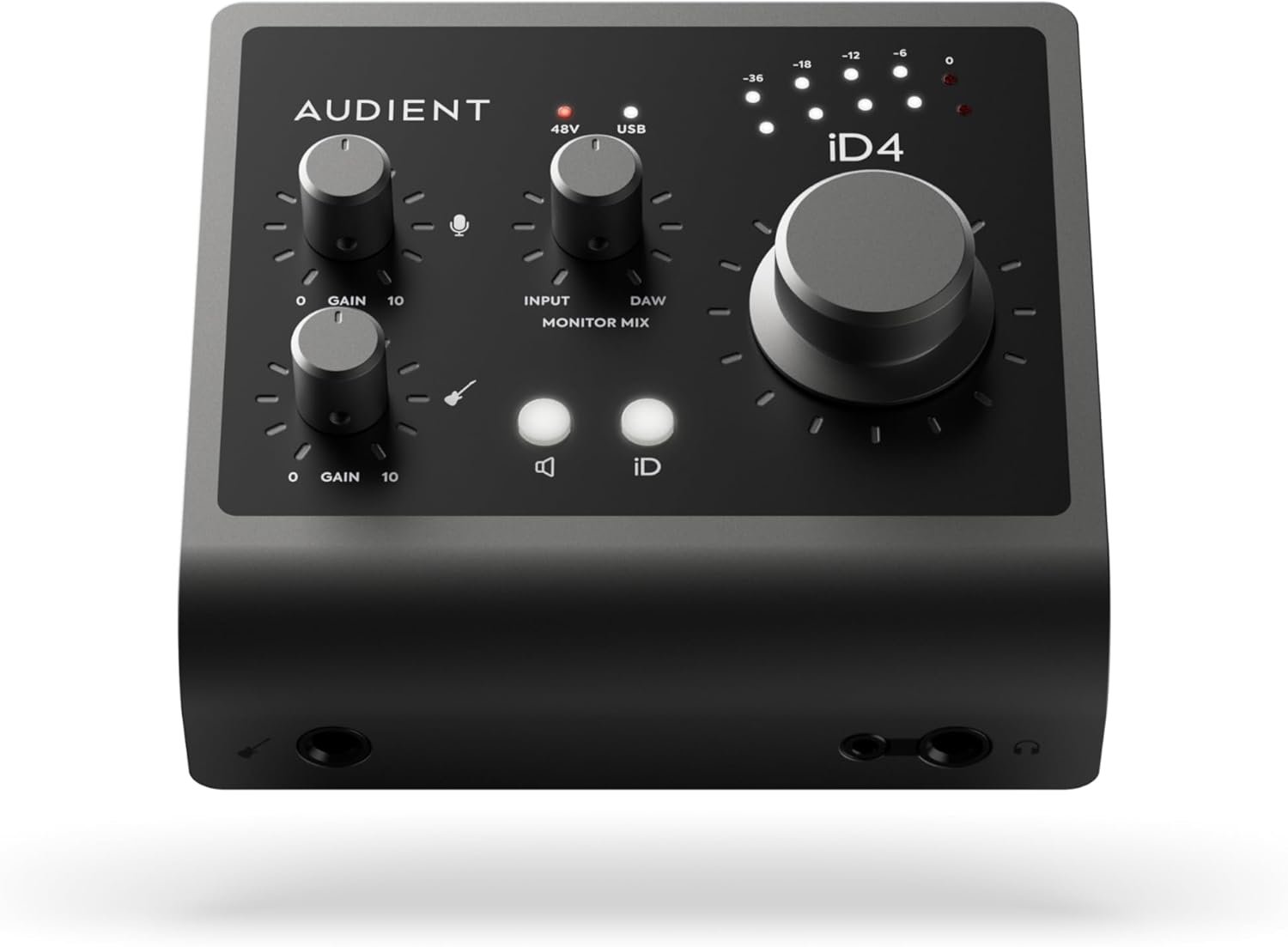
Audient iD4 MKII USB-C Audio Interface
As an Amazon Associate I earn from qualifying purchases.
The Audient iD4 MKII USB-C Audio Interface is designed for musicians who want dependable recording quality without filling their desks with complicated equipment. With a dedicated JFET guitar input, an Audient Console microphone preamp and a sturdy metal enclosure, it brings useful studio features into a compact desktop unit.
For guitarists recording at home, that combination makes considerable sense.
Whether you’re capturing electric guitar through amplifier software, recording an acoustic instrument with a microphone or working on original songs, the iD4 MKII provides a straightforward connection between your instruments and computer.
Its appeal isn’t an endless collection of effects or complicated processing options. Instead, Audient has concentrated on sound capture, practical monitoring and physical controls that keep the recording process manageable.
However, this is a compact two-input interface, and its limitations deserve just as much attention as its strengths.
Why It Works for Home Guitar Recording
A good audio interface should capture the instrument accurately and let the musician concentrate on playing.
The Audient iD4 MKII approaches this through a combination of quality analogue circuitry and capable digital conversion.
It includes one Audient Console microphone preamp and a separate JFET instrument input.
This arrangement allows a guitarist to record an instrument directly while also having access to a microphone connection.
For example, a singer-songwriter could record an electric guitar and vocal simultaneously, keeping the performances on separate tracks within compatible recording software.
Alternatively, the microphone input could be used for an acoustic guitar, vocal recording or another suitable sound source.
The interface supports recording at up to 24-bit/96kHz, providing ample resolution for typical home-studio projects.
Higher sample rates aren’t automatically necessary for better music. Recording technique, microphone positioning and sensible input levels remain much more important.
The iD4 MKII provides a capable foundation without requiring users to invest in a large recording system.
A JFET Input Designed for Guitar and Bass
One of the Audient’s most useful features is its dedicated JFET instrument input.
Unlike a standard line-level connection, this input is designed to accommodate the electrical characteristics of guitars and basses.
Audient uses JFET circuitry inspired by the input stage of a traditional valve amplifier.
The intention is to provide a responsive, musical input character before the signal reaches the computer.
For electric guitarists using amplifier-modelling software, this is particularly useful.
You can connect a guitar directly to the front instrument socket, adjust the gain and record a clean signal into your digital audio workstation.
From there, compatible software can add amplifier simulations, speaker cabinet modelling and other effects.
This approach works especially well for recording at home when using a loud guitar amplifier isn’t practical.
You can capture parts quietly through headphones and experiment with different amplifier sounds afterwards.
Bass players can also benefit from the dedicated instrument connection.
The important distinction is that the JFET input doesn’t replace an amplifier or provide a complete collection of guitar effects. It supplies the starting signal for further recording and processing.
The Audient Console Microphone Preamp
The microphone preamp is another significant part of the iD4 MKII’s design.
Audient uses an analogue circuit based on the company’s professional recording-console technology.
It provides up to 58dB of microphone gain, allowing suitable microphones to be connected for vocals, acoustic instruments and other recording tasks.
The preamp is designed for low noise and accurate signal reproduction.
For home recording, this matters because unwanted noise introduced during capture can become more noticeable when tracks are processed or amplified later.
The interface also provides switchable 48V phantom power for condenser microphones that require it.
That makes it suitable for many common home-studio microphone arrangements.
A guitarist could record an acoustic instrument using a condenser microphone, then switch to the instrument input for electric guitar parts.
The interface also provides a line-level option through its rear combination input.
Although the available connections are limited, the quality and flexibility of the main preamp make the iD4 MKII a sensible choice for individual musicians.
What It Feels Like to Use
The iD4 MKII has a compact, understated appearance.
Its black metal enclosure looks purposeful rather than decorative, with the main controls arranged across the upper surface.
The housing gives the unit a more substantial physical presence than a lightweight plastic interface, while its relatively small footprint makes it practical for a modest recording desk.
A large central rotary control handles the main output level and supports Audient’s ScrollControl function.
Smaller controls provide access to input gain and monitoring adjustments.
The front-mounted guitar and headphone connections are particularly convenient.
Guitarists regularly changing instruments don’t have to reach behind their computers every time they want to connect another lead.
The headphone sockets also accommodate both standard quarter-inch and smaller 3.5mm plugs.
For everyday recording, these details help keep the equipment approachable.
Once the interface is connected and the recording software configured, the usual routine is straightforward: connect the instrument, adjust the gain, set the monitoring balance and record.
There is no need to navigate an elaborate touchscreen simply to capture an idea.
Direct Monitoring and Headphone Control
One of the frustrations of computer recording is latency.
This is the delay that can occur when a guitar or microphone signal travels into the computer, passes through recording software and returns to the headphones.
Even a relatively small delay can make playing or singing uncomfortable.
The Audient iD4 MKII includes a Monitor Mix control that allows the incoming signal to be blended with playback from the computer.
This provides a practical way to hear the instrument directly while following an existing backing track.
For recording vocals, acoustic guitar or an unprocessed electric-guitar signal, direct monitoring can make the experience feel more immediate.
However, hearing software amplifier effects requires the signal to pass through the computer, so recording buffer settings remain important.
The two headphone sockets are useful when different headphone plug sizes are involved or two listeners need to hear the same mix.
The interface also provides stereo outputs for connecting suitable powered studio monitors.
These connections cover the basic monitoring requirements of a small home studio without introducing unnecessary complexity.
Useful Software and Loopback Features
Although the iD4 MKII concentrates on audio recording, it includes several features that extend its usefulness.
ScrollControl allows the main rotary encoder to operate compatible software controls, providing an alternative to adjusting certain parameters with a mouse.
This can be useful when working with recording software or plug-ins.
The interface also supports audio loopback through Audient’s software.
Loopback allows computer playback to be combined with input audio for recording or streaming.
For guitarists creating lessons, demonstrations or online performances, this can simplify the process of capturing instrument audio alongside computer sound.
Audient also provides access to its ARC software package for eligible registered products, although the included applications and offers should be checked against current availability.
These additions are useful, but the core attraction remains the interface’s recording and monitoring capabilities.
How It Compares With Other Audio Interfaces
The iD4 MKII faces strong competition from other compact recording interfaces.
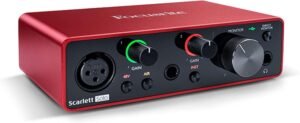
Our article on the Focusrite Scarlett Solo 4th Gen Audio Interface explores another straightforward option for guitarists recording at home.
Both interfaces provide dedicated guitar and microphone connections, making them practical for solo musicians and songwriters.
The Audient stands out through its JFET instrument circuitry, ScrollControl and two headphone sockets.
The Scarlett Solo takes a similarly compact approach, with Focusrite’s Air mode offering another way to shape the microphone signal.
For musicians wanting more recording inputs and additional onboard processing, the Universal Audio Volt 276 USB Audio Interface presents a different proposition.
The Volt 276 provides two microphone-capable input channels, Vintage preamp modes and built-in analogue compression.
That gives it more flexibility for certain recording situations.
The Audient focuses instead on a simple two-input arrangement built around one quality microphone preamp and its dedicated JFET instrument connection.
Choosing between them should depend on the instruments you record, the number of microphones required and how much control you want before the signal reaches your computer.
The Drawbacks
The Audient iD4 MKII offers an appealing combination of sound quality and compact design, but its streamlined construction introduces several limitations.
These are worth understanding before choosing it as the centre of a home-recording setup.
Only One Microphone Preamp
The most significant limitation is the single microphone preamp.
Although the interface has two analogue recording channels, only one accepts a microphone.
The other is dedicated to the JFET instrument connection.
This works well for recording a guitar directly alongside a vocal microphone.
However, it becomes restrictive when recording acoustic instruments using two microphones.
For example, a guitarist wanting to capture a stereo acoustic-guitar arrangement with two condenser microphones cannot connect both directly.
Recording a drum kit with multiple microphones is also beyond its capabilities.
Anyone planning these arrangements should consider an interface with at least two microphone preamps.
Very Limited Expansion
The iD4 MKII is intended for small recording setups.
It does not provide ADAT digital input expansion or additional recording channels for a growing studio.
That means its two-input configuration remains the practical limit.
For someone recording individual guitar and vocal parts, this may never become a problem.
However, musicians who gradually introduce keyboards, drum machines, external effects processors and additional microphones may outgrow it.
An interface with more physical inputs could avoid the inconvenience of repeatedly changing connections.
It is worth considering not only what you record today, but also how your equipment might develop.
USB Power Requirements Need Attention
The iD4 MKII is powered through its USB connection, which eliminates the need for a separate power adapter during normal operation.
However, Audient specifies a USB 3.0 connection capable of providing adequate current.
A suitable USB-C port is ideal, while compatible USB-A 3.0 connections can also work with the correct cable.
Older USB ports or poorly powered hubs may not supply enough current for reliable operation.
This becomes particularly important when using phantom power or demanding headphones.
Anyone working with an older computer should check its available USB connections before purchasing.
A powered USB hub with suitable specifications may be necessary for some systems.
Headphone Volume Is Not Independently Controlled
The interface includes two headphone sockets, but they share the same monitoring signal and level control arrangement.
There isn’t a completely independent headphone-volume knob for adjusting headphones separately from the main output level.
This can be inconvenient when switching between speakers and headphones.
It is also less flexible when two people want different listening volumes.
The dual sockets are useful for accommodating different connections, but they should not be confused with two independent headphone-monitoring systems.
A larger interface or external headphone amplifier may be more practical for collaborative recording.
Direct Monitoring Does Not Include Software Effects
The Monitor Mix control is valuable for hearing incoming signals without computer-processing delay.
However, the directly monitored guitar signal is not the same as hearing it through an amplifier simulation.
If you want to play through a software amplifier while recording, the signal needs to travel through the computer and return to the interface.
That introduces the usual considerations around buffer size, processor performance and software latency.
The iD4 MKII cannot eliminate delays created by external recording software.
For guitarists who depend heavily on real-time amplifier modelling, computer performance remains an important part of the recording setup.
No Dedicated MIDI Connections
The iD4 MKII doesn’t include traditional five-pin MIDI input or output sockets.
This isn’t particularly important for musicians recording only guitar, bass and vocals.
However, anyone using older MIDI keyboards, drum machines or hardware sequencers may need a separate MIDI interface.
Modern USB MIDI controllers can often connect directly to the computer, making the omission less significant.
Nevertheless, it is another indication that the iD4 MKII is designed primarily for straightforward audio capture rather than controlling a large collection of studio equipment.
It Isn’t a Standalone Recorder
Despite its professional recording features, the iD4 MKII depends on a compatible computer or mobile recording system.
It doesn’t contain an internal recorder or provide a way to save performances directly to removable storage.
You also need suitable recording software to capture, edit and arrange tracks.
For anyone already comfortable using a digital audio workstation, this is unlikely to be an issue.
However, musicians wanting a completely self-contained recorder for rehearsals or portable songwriting should consider a dedicated recording device instead.
Compact Doesn’t Mean Completely Cable-Free
The small enclosure saves valuable desk space, but a functioning recording setup still needs the appropriate cables.
Guitars require instrument leads, microphones need suitable connections, and studio speakers generally require their own audio cables.
Headphones and a USB connection also become part of the arrangement.
The interface keeps the recording hardware compact, but it doesn’t remove the practical need for organised cabling.
For a very small desk, this is worth planning before installation.
Who It Suits Best
The Audient iD4 MKII makes particular sense for guitarists, bass players and songwriters recording mainly on their own.
Its dedicated JFET input is useful for electric instruments, while the Audient microphone preamp provides a capable connection for vocals and acoustic recordings.
The compact metal enclosure also suits musicians who want equipment that feels substantial without occupying a large section of their working space.
It should appeal to home-studio users who appreciate direct physical controls, practical monitoring and straightforward connectivity.
However, musicians expecting to record multiple microphones simultaneously or expand into more complicated studio arrangements should consider a larger interface.
For other carefully selected microphones, interfaces, headphones and studio equipment, explore our Recording & Studio collection.
Is It Worth the Studio Space?
The Audient iD4 MKII is a well-considered audio interface for musicians who value quality recording fundamentals over extensive features.
Its combination of an Audient Console microphone preamp, dedicated JFET instrument input and practical monitoring controls makes it especially relevant to guitar-based home studios.
The metal construction and compact layout also help it feel like a serious piece of recording equipment rather than a disposable computer accessory.
Its limitations are equally clear.
One microphone preamp, limited expansion and shared headphone monitoring controls mean it is not the ideal choice for every recording arrangement.
For a solo guitarist or songwriter who wants a dependable connection between instruments, microphones and recording software, however, the iD4 MKII offers a focused and practical solution.
It earns consideration through the quality of its essential recording functions, rather than the number of features squeezed into its enclosure.
As an Amazon Associate I earn from qualifying purchases.



One Comment
Comments are closed.