
sE Electronics sE7 Microphone
As an Amazon Associate I earn from qualifying purchases.
The sE Electronics sE7 Microphone is a compact, small-diaphragm condenser designed for musicians who want to capture the natural character of acoustic instruments.
With its all-metal construction, cardioid pickup pattern and useful onboard controls, it offers a straightforward approach to recording acoustic guitars, percussion, piano and other instruments.
Rather than relying on complicated electronic features, the sE7 concentrates on accurate sound capture, practical microphone placement and dependable studio operation.
For guitarists building a home recording setup, it is an interesting alternative to larger studio microphones, particularly when detail, clarity and precise positioning matter.
Why it works for recording acoustic guitars
Acoustic guitar recording presents a particular challenge.
A guitar produces sound from several different areas, including the strings, bridge, soundboard and body. Positioning a microphone correctly can make a considerable difference to the final recording.
The sE7 uses a half-inch back-electret condenser capsule with a cardioid pickup pattern.
This directional design concentrates primarily on sound arriving from the front while reducing pickup from the sides and rear.
For acoustic guitar recording, that can help focus attention on the instrument without collecting quite as much unwanted sound from the surrounding room.
The microphone has a published frequency response of 20Hz to 20kHz, while its transformerless circuitry is designed to preserve clarity and detail.
Small-diaphragm condensers are often chosen for their ability to follow quick changes in sound, making them particularly useful for fingerpicking, delicate string movements and rhythmic acoustic playing.
The sE7 is also capable of handling louder instruments.
Its switchable -20dB attenuation pad allows the microphone to accommodate higher sound pressure levels without overloading the recording signal path.
That makes it useful beyond quiet acoustic guitar sessions.
For musicians primarily interested in recording amplified electric guitars, our Shure SM57 Microphone guide explores a different approach using a rugged dynamic microphone.
The sE7 is particularly attractive where capturing acoustic detail and natural instrumental character are priorities.
What it feels like to use
The sE7 has a simple, professional appearance.
Its narrow cylindrical body measures approximately 120mm long and 23mm in diameter, making it considerably smaller than many large-diaphragm studio microphones.
The all-metal housing has a reassuringly solid construction, while its relatively light 128g weight makes positioning on a microphone stand straightforward.
The dark finish and understated branding give it a purposeful appearance that suits both home and professional recording environments.
There are no screens, complicated menus or wireless connections to manage.
Instead, the microphone uses a conventional three-pin XLR connection and requires 48V phantom power from a suitable audio interface, mixer or microphone preamplifier.
Once connected, recording largely involves positioning the microphone, setting the input gain and checking the resulting sound.
Two small switches on the microphone body provide useful control.
The first activates the -20dB attenuation pad, helping manage particularly loud sound sources.
The second introduces an 80Hz low-cut filter.
This can reduce low-frequency disturbances such as floor vibrations, rumble and excessive bass caused by placing the microphone close to an instrument.
These are practical features that can save time during recording.
A microphone clip, thread adapter and windscreen are included, although a suitable XLR cable and recording equipment are still required.
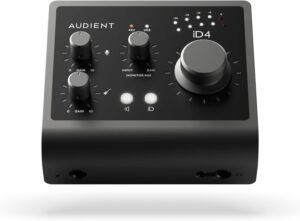
For guitarists who need a compact recording interface, our Audient iD4 MKII USB-C Audio Interface guide explores a compatible type of equipment with a microphone preamp and phantom-power capability.
Together, a suitable interface and a microphone such as the sE7 provide a practical foundation for recording instruments at home.
Getting the best from microphone placement
One of the appealing characteristics of a small-diaphragm condenser is how easily it can be positioned around an acoustic instrument.
For acoustic guitar, a useful starting point is approximately 8 to 12 inches from the instrument, aimed towards the area around the twelfth fret.
This position often provides a reasonable balance between string detail and body resonance.
Moving the microphone towards the soundhole generally increases bass response, although positioning it directly in front of the soundhole can produce an overly boomy recording.
Moving towards the neck can emphasise string articulation and fretboard detail.
These are starting points rather than fixed rules.
Different guitars, playing styles and recording rooms will produce different results.
The sE7’s compact body makes these small positioning adjustments relatively convenient.
It can also be used for percussion, piano and other acoustic instruments where a focused, detailed recording is required.
For musicians wanting a portable alternative with built-in stereo microphones, our Zoom H4essential Recorder guide explores a different approach to capturing rehearsals and acoustic performances.
The sE7 is more suitable for someone who wants to position an individual microphone precisely and build a conventional studio recording signal chain.
The drawbacks
The sE Electronics sE7 has several useful qualities, but it is important to understand its limitations before choosing it.
The first consideration is the need for additional recording equipment.
Unlike a USB microphone, the sE7 cannot connect directly to a computer using an ordinary USB cable.
It requires a balanced XLR connection and a suitable microphone input capable of supplying 48V phantom power.
Anyone starting from scratch will therefore need an appropriate audio interface, mixer or preamplifier.
A compatible microphone cable and stable stand are also necessary.
This makes the complete recording arrangement less straightforward than purchasing a basic USB microphone.
The second limitation concerns room acoustics.
The sE7 is a sensitive condenser microphone designed to capture instrumental detail.
Unfortunately, that sensitivity also means it can reveal unwanted background sounds.
Computer fans, traffic, room reflections and other household noises may become noticeable in recordings.
Its cardioid pattern reduces sound arriving from certain directions, but it cannot eliminate unwanted noise entirely.
A poorly treated room can still produce hollow or reflective recordings, regardless of the microphone’s technical capabilities.
For home studios, microphone positioning and simple acoustic treatment may therefore be just as important as the microphone itself.
A single sE7 records one microphone channel rather than a stereo pair.
This is perfectly adequate for many acoustic guitar recordings, particularly when the instrument will sit within a larger musical arrangement.
However, musicians wanting detailed stereo recordings of solo acoustic guitar, piano or drum overheads may prefer a matched pair.
That requires another microphone, an additional cable and enough recording inputs to accommodate both channels.
Stereo recording also introduces microphone-spacing and phase considerations that beginners may find challenging.
The microphone does not offer selectable pickup patterns.
Its fixed cardioid response is useful for many applications, but it cannot be switched to omnidirectional or figure-eight operation.
Those alternatives can be valuable when capturing room ambience, ensembles or more experimental recording arrangements.
Anyone needing several polar patterns from one microphone will need to consider a different design.
The built-in low-cut filter is useful but limited.
The switchable 80Hz filter can reduce rumble and excessive low-frequency energy, but it does not replace careful recording technique or comprehensive equalisation.
Some instruments also contain important information in their lower frequencies.
Activating the filter indiscriminately could remove useful warmth or body from a recording.
It is better to listen carefully before deciding whether to use it.
The -20dB pad also requires sensible operation.
It is valuable when recording loud instruments, but activating it unnecessarily reduces the output signal reaching the preamp.
For quieter acoustic sources, leaving the pad disengaged will often be more appropriate.
Correct gain staging remains essential, regardless of the selected setting.
Physical handling deserves attention as well.
Although the all-metal construction is reassuring, the condenser capsule remains a precision component.
The microphone should be protected from moisture, dust, accidental impacts and careless storage.
Its small size makes it easy to position, but it should still be mounted securely rather than balanced on an unsuitable stand.
Finally, not every musician needs the level of recording control this microphone offers.
Someone who simply wants to capture song ideas quickly may find a portable recorder or straightforward USB device more convenient.
The sE7 rewards careful microphone positioning and a properly configured recording setup.
For guitarists willing to develop those skills, that flexibility is valuable. For someone seeking immediate plug-and-play simplicity, it may introduce unnecessary complexity.
Who it suits best
The sE Electronics sE7 is particularly appealing for acoustic guitarists, home recording musicians and producers who want a compact, conventional studio microphone.
Its small-diaphragm design makes it useful for capturing fingerpicked passages, rhythmic strumming and other acoustic performances where detail matters.
It can also serve musicians recording percussion, piano, stringed instruments and selected amplified sources.
The microphone is a sensible choice for someone who already owns an audio interface with phantom power and wants to expand their recording equipment.
Its metal construction and straightforward controls also make it practical for musicians who occasionally record outside their usual studio.
However, absolute beginners seeking the simplest possible computer recording arrangement may prefer an integrated USB solution.
The sE7 makes most sense when recording quality, positioning flexibility and long-term studio usefulness matter more than convenience alone.
Is it worth the studio space?
The sE Electronics sE7 offers a thoughtful combination of compact construction, natural sound capture and useful onboard controls.
Its cardioid capsule, switchable attenuation pad and low-cut filter give musicians practical options for recording a wide range of acoustic instruments.
The microphone’s small dimensions make it easy to position, while the all-metal body provides a reassuring level of durability.
Its limitations are equally important.
The need for phantom power, an XLR recording setup and reasonably controlled room acoustics means it is not necessarily the simplest choice for everyone.
Nevertheless, for guitarists who enjoy the process of recording and want greater control over their acoustic sound, the sE7 offers a capable and adaptable option.
You can explore more microphones, interfaces and studio equipment in our Recording & Studio guides, covering practical tools for capturing and developing your music.
For musicians prepared to spend time with microphone positioning and recording technique, the sE7 is a worthwhile instrument microphone to consider.
Its greatest appeal lies in doing the fundamentals well, without unnecessary complications.
As an Amazon Associate I earn from qualifying purchases.