Alvarez AD60 Acoustic Guitar
As an Amazon Associate I earn from qualifying purchases.
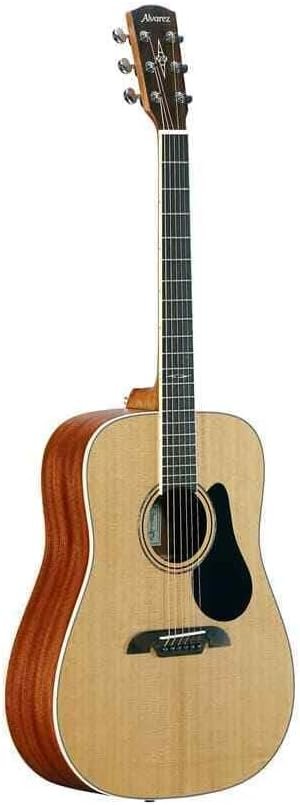
The Alvarez AD60 Acoustic Guitar combines traditional dreadnought styling with carefully considered construction and a solid Sitka spruce top.
Part of the established Alvarez Artist Series, the AD60 is designed for guitarists who value natural acoustic tone, comfortable playability and an instrument that responds well to different playing styles.
Its combination of a solid spruce soundboard, African mahogany back and sides, real bone nut and saddle, and Alvarez’s FS6 bracing system gives it a distinctive place among traditional steel-string acoustics.
The Natural Gloss finish adds a warm, familiar appearance, allowing the wood grain and understated details to remain the focus.
For players who enjoy strumming, fingerpicking and developing their acoustic technique, the AD60 offers an appealing balance of conventional design and thoughtful construction.
Why the Alvarez AD60 Works as an Acoustic Guitar
The attraction of the AD60 begins with its traditional dreadnought body.
Dreadnought guitars have remained popular for generations because their relatively large soundboxes can produce substantial acoustic volume, broad projection and a strong low-frequency response.
The AD60 follows that familiar arrangement, using a full-size body with a solid Sitka spruce top.
Sitka spruce is widely used for acoustic guitar soundboards because of its strength, relatively low weight and ability to respond across a broad range of playing dynamics.
The back and sides use laminated African mahogany, providing a durable construction while contributing to the guitar’s traditional appearance.
Alvarez combines these materials with its FS6 forward-shifted bracing system, designed to encourage the soundboard to vibrate freely while maintaining structural support.
This gives the AD60 the potential for an open, responsive acoustic character with clear trebles and a substantial bass register.
Unlike acoustic-electric instruments designed primarily for amplified performance, the standard AD60 concentrates on producing its sound naturally.
There are no onboard electronics, digital effects or complicated controls.
The relationship is straightforward: the player’s hands, the strings and the wooden soundbox.
What the Alvarez AD60 Feels Like to Play
The AD60 has the familiar proportions of a full-size dreadnought acoustic.
Its 25.5-inch scale length provides conventional steel-string tension and spacing, while the 1¾-inch nut width offers a little more room between the strings than some narrower-necked acoustics.
That additional width can be particularly appealing for fingerstyle players who appreciate space for individual string movements.
The mahogany neck has a semi-gloss finish, which may feel less sticky under the hand than a heavily polished gloss neck.
For players moving between chord shapes and melodic passages, that finish can be a welcome practical detail.
The fingerboard uses Indian laurel, with a traditional appearance that complements the darker bridge and natural body finish.
The neck meets the body at the 14th fret, providing the familiar layout associated with modern steel-string acoustic guitars.
There are 21 frets in total.
The larger dreadnought body gives the guitar a substantial physical presence when seated.
The soundbox rests against the player’s body, while the picking arm reaches across the broad upper bout.
That sense of size is part of the traditional dreadnought experience, although it will not suit everyone.
Players who prefer a thinner acoustic-electric may find our Yamaha APX600 Acoustic-Electric Guitar guide useful for comparing the comfort of a much shallower body.
The Alvarez takes a more traditional approach, favouring acoustic depth and projection over compact proportions.
Solid Sitka Spruce and Natural Acoustic Tone
The solid Sitka spruce top is one of the AD60’s most important features.
A solid soundboard is made from solid wood rather than layers of laminated material.
This allows the top to respond as a continuous vibrating surface, with the bracing system controlling its movement.
The AD60 uses Alvarez’s FS6 bracing design, which incorporates forward-shifted structural elements intended to support a lively, responsive sound.
The result is a design intended to produce a broad tonal character rather than concentrating entirely on one frequency range.
When strummed with a pick, the dreadnought body can provide a full sound with a strong bass foundation and clear higher notes.
For quieter fingerpicking, the spruce top is intended to respond to lighter touches without requiring aggressive playing.
The balance between bass, midrange and treble will naturally depend on string choice, playing technique and the individual instrument.
The AD60’s construction is designed to offer enough acoustic presence for everyday playing while retaining clarity for individual notes.
It is especially worth considering for guitarists who enjoy hearing the natural interaction between the strings and soundboard.
The FS6 Bracing System
Acoustic guitar bracing has an important influence on sound and structural strength.
The thin wooden soundboard must withstand considerable string tension while remaining flexible enough to vibrate.
Alvarez developed its FS6 bracing arrangement to achieve a suitable balance between these requirements.
The system uses forward-shifted bracing with shaped tone bars to help control the movement of the spruce top.
Rather than simply making the soundboard as rigid as possible, the intention is to encourage useful vibration across its surface.
This contributes to the AD60’s intended combination of projection, definition and dynamic response.
The design can be particularly relevant when moving between different playing techniques.
Gentle fingerpicking places different demands on the soundboard from energetic rhythm strumming.
A responsive acoustic guitar should be able to accommodate both without feeling restricted to one playing style.
Although bracing is hidden inside the body, its design is an important part of what distinguishes a carefully developed acoustic instrument from one built primarily around appearance.
Bone Nut, Saddle and Bi-Level Bridge
Alvarez includes a real bone nut and saddle on the AD60.
These are important contact points because they help establish the vibrating length of each string.
Bone is commonly valued for its hardness, durability and ability to provide a consistent contact surface when properly shaped.
It does not guarantee that every guitar will sound better, but it is a worthwhile construction detail.
The AD60 also features Alvarez’s bi-level bridge design.
This arrangement is intended to improve the relationship between the strings, saddle and soundboard by maintaining an appropriate break angle over the saddle.
The bridge is made from Indian laurel on the current model.
Together, these components support the guitar’s traditional acoustic construction.
The chrome closed-gear tuning machines complete the practical hardware arrangement.
They provide familiar tuning operation without introducing unusual mechanisms or proprietary electronics.
For a guitarist who values simplicity, these details contribute to an instrument that can be maintained using conventional acoustic guitar techniques.
Everyday Practice and Songwriting
The AD60 makes considerable sense as a guitar for regular home playing.
Its natural acoustic volume means there is no amplifier to connect, no battery to charge and no software to configure.
A player can simply take the guitar from its stand, check the tuning and begin.
That immediacy is particularly appealing for songwriting.
Chord progressions can be explored naturally, while the full-bodied dreadnought sound gives rhythm parts enough presence to accompany singing.
The guitar is equally suitable for working through fingerpicking patterns, developing timing or practising chord changes.
Its conventional scale length makes it a useful reference point for players developing established acoustic techniques.
For musicians who enjoy a more technology-focused approach, our Enya NOVA GO SP1 Smart Acoustic Guitar guide explores an alternative with built-in effects and connectivity.
The Alvarez AD60 is deliberately different.
Its main attraction is the natural acoustic experience, without electronic features competing for attention.
The Drawbacks
The Alvarez AD60 has several appealing qualities, but its traditional design also introduces compromises.
These are worth considering carefully, particularly for players choosing their first serious acoustic guitar.
The dreadnought body may feel bulky.
The AD60 is a full-size instrument with a relatively deep soundbox.
That provides the internal air volume associated with traditional dreadnought projection, but it also creates a larger physical object to hold.
Players with smaller frames may find the body uncomfortable during long seated practice sessions.
The picking arm must reach over the upper bout, which can place the shoulder in a less relaxed position than when playing a smaller concert or orchestra-model guitar.
For someone who mainly plays seated, comfort may matter more than maximum acoustic volume.
A smaller body shape could prove more enjoyable for daily use.
There are no built-in electronics.
The standard AD60 is a purely acoustic guitar.
It does not include an onboard pickup, preamp, equaliser or electronic tuner.
For home practice, that simplicity is attractive.
However, anyone planning to perform regularly through a PA system will need an external microphone or a separately fitted pickup system.
Both approaches introduce additional considerations.
A microphone can capture natural acoustic character, but placement and feedback become important during live performances.
Installing a pickup may involve additional hardware and professional fitting.
Players who want immediate plug-in capability may prefer an acoustic-electric instrument from the outset.
Our Fender CD-60SCE Acoustic-Electric Guitar guide explores that alternative, combining a dreadnought body with a cutaway and onboard Fishman electronics.
The back and sides are laminated, not solid.
This is an important construction distinction.
Although the AD60 has a solid Sitka spruce top, Alvarez uses laminated African mahogany for the back and sides.
Laminate construction can provide useful stability and durability, but it differs from an all-solid-wood instrument.
Players specifically seeking an entirely solid-wood acoustic should understand that the AD60 does not meet that requirement.
The solid top remains the main vibrating surface, so the design is still capable of a satisfying acoustic response.
However, construction preferences vary, and some experienced players may prefer the characteristics of an all-solid instrument.
The longer scale may feel demanding.
At 25.5 inches, the AD60 uses a conventional full-length acoustic scale.
With equivalent strings and tuning, longer-scale guitars generally require slightly greater tension than shorter-scale instruments.
This can produce a firm, responsive feel, but beginners may find fretting more demanding.
Players with smaller hands may also notice the distance between frets, particularly when working through stretches near the nut.
A comfortable setup and suitable string gauge can help, although the underlying scale length remains unchanged.
The nut width will not suit everyone.
The 1¾-inch nut provides useful spacing for fingerstyle playing.
However, players accustomed to particularly narrow electric guitar necks may initially find the wider fingerboard unfamiliar.
Some rhythm guitarists prefer a narrower nut when moving rapidly between certain chord shapes.
Others appreciate the additional space because it reduces accidental contact with neighbouring strings.
Neither preference is automatically better.
The important consideration is how naturally the neck fits the player’s hand and technique.
There is no cutaway.
The traditional dreadnought body extends fully around the neck joint.
This preserves the conventional appearance and body shape, but access to the highest frets is restricted.
Players who spend most of their time strumming open chords or playing in the middle of the neck may never notice the limitation.
However, musicians who regularly play solos, melodic passages or complex chords high up the fingerboard may prefer a cutaway design.
Although the AD60 has 21 frets, comfortably reaching all of them is not the same as on an electric guitar or cutaway acoustic.
The natural gloss finish requires some care.
The glossy spruce top has an attractive appearance, allowing the wood grain to remain visible beneath the clear finish.
However, polished surfaces can show fingerprints, fine scratches and marks caused by regular handling.
Repeated contact from picks, clothing and accessories may gradually leave visible signs of use.
The finish also needs appropriate cleaning products.
Harsh household cleaners and abrasive cloths should be avoided.
A soft guitar-safe cloth is generally the sensible choice for routine cleaning.
A solid spruce top responds to its environment.
Solid wood can react to changes in temperature and humidity.
Excessively dry conditions may contribute to changes in the soundboard, fret ends and overall setup.
High humidity can also affect the instrument’s structure and playing feel.
Owners should avoid storing the guitar near radiators, direct heating sources or locations exposed to substantial temperature changes.
A suitable case and sensible humidity management can help protect the instrument.
This is normal acoustic guitar care, but it is especially important for guitars incorporating solid wooden soundboards.
The factory setup may need adjustment.
A well-designed guitar can still feel uncomfortable if the string action is too high or the neck relief is unsuitable.
Individual instruments may arrive with slightly different setup characteristics.
String height at the nut and saddle can influence how much pressure is required for clean notes.
A professional setup may improve playability considerably, especially for beginners.
However, saddle adjustments on acoustic guitars require care because material removed cannot simply be replaced by turning an adjustment screw.
A protective case may need to be purchased separately.
The standard AD60 specification does not establish that every retailer includes a case.
Anyone intending to transport the guitar should check the exact package contents.
A full-size dreadnought requires a correctly sized gig bag or hard case.
Its broad body also makes storage more demanding than for a compact travel guitar.
Its acoustic volume may be unnecessary in some homes.
A dreadnought can produce a substantial sound, which is an advantage for unamplified performance and accompanying vocals.
However, that same projection may be inconvenient in shared accommodation or homes where quiet practice is important.
Although playing more gently helps, the AD60 is not designed to be a silent practice instrument.
Players who primarily practise through headphones may prefer an instrument intended for amplified or electronic use.
Finally, it is a traditional instrument rather than an all-purpose guitar system.
The AD60 does not provide built-in effects, recording connectivity, onboard tone controls or instant amplification.
Its appeal depends on enjoying the sound and feel of a conventional acoustic guitar.
For players who frequently change between live performance, direct recording and processed guitar sounds, additional equipment may be necessary.
These limitations do not undermine the AD60’s strengths. They simply demonstrate that it is best suited to musicians who value natural acoustic sound, conventional construction and a full-bodied playing experience.
Who the Alvarez AD60 Suits Best
The Alvarez AD60 is particularly appealing to guitarists who enjoy the traditional sound of a full-size dreadnought.
Its solid Sitka spruce top and FS6 bracing make it worth considering for players who want an acoustic instrument with an emphasis on natural response and projection.
Singer-songwriters may appreciate its substantial sound when accompanying vocals.
Rhythm players can benefit from the broad acoustic character associated with dreadnought construction, while fingerstyle guitarists may enjoy the slightly wider nut and responsive soundboard.
It may also suit intermediate players moving beyond a basic beginner instrument and looking for more carefully considered construction.
However, the AD60 is less suitable for someone who needs built-in electronics, a compact body, easy upper-fret access or a particularly light string feel.
The best choice depends on playing style and comfort rather than specifications alone.
Is the Alvarez AD60 Worth the Guitar-Case Space?
The Alvarez AD60 offers a considered combination of traditional styling, solid-top construction and practical acoustic features.
Its natural finish gives the instrument a timeless appearance, while the Sitka spruce soundboard and FS6 bracing provide the foundation for a responsive dreadnought sound.
The bone nut and saddle, bi-level bridge and conventional hardware are worthwhile details for players who appreciate straightforward acoustic construction.
The larger body, lack of electronics and full-scale neck will not suit everyone, but those are understandable compromises within its traditional design.
For other instruments with different body shapes, playing characteristics and acoustic features, explore our Acoustic Guitars guides.
The AD60 is particularly worth considering for guitarists who enjoy playing unplugged and want an instrument focused on the relationship between the player, strings and wooden soundbox.
For those who appreciate the familiar feel and generous sound of a traditional dreadnought, it offers a thoughtful and capable acoustic guitar design.
As an Amazon Associate I earn from qualifying purchases.