Xvive U2 Wireless Guitar System
As an Amazon Associate I earn from qualifying purchases.
The Xvive U2 Wireless Guitar System offers a straightforward way to remove the traditional instrument cable between a guitar and amplifier without introducing a complicated wireless setup.
Using a compact rechargeable transmitter and receiver, the U2 sends a digital audio signal over the 2.4GHz wireless band, allowing guitarists to move more freely while practising, rehearsing or performing.
Its plug-in design is particularly appealing. There is no separate bodypack to clip onto a belt, no long antenna to manage and no additional receiver box requiring space on a pedalboard.
The black finish gives both units a discreet appearance, while their compact, lightweight construction keeps them practical for everyday use.
With 24-bit digital audio, approximately 5ms latency and an advertised wireless range of up to 70 feet, the Xvive U2 provides a useful alternative to a conventional guitar cable.
However, wireless convenience brings its own considerations, particularly concerning interference, rechargeable batteries and instrument compatibility.
Why the Xvive U2 Makes Sense
A traditional guitar cable remains one of the simplest ways to connect an electric guitar to an amplifier.
It requires no charging, no wireless pairing and very little thought beyond plugging it in.
However, cables can become inconvenient.
They trail across the floor, twist around microphone stands and occasionally get caught beneath furniture or equipment.
For guitarists who practise standing up or move around while playing, the cable can become a constant restriction.
The Xvive U2 removes that physical connection.
One compact unit plugs into the guitar’s output socket, while the other connects to an amplifier, pedalboard or compatible audio interface.
The two devices communicate wirelessly, carrying the guitar signal without a cable stretched between them.
This arrangement makes particular sense for home practice, where removing a cable can help keep a small playing area organised.
It is also useful during rehearsals, allowing guitarists to move around without worrying about stepping on a trailing lead.
The benefit is simple: greater freedom of movement without replacing the guitar or amplifier.
What It Feels Like to Use
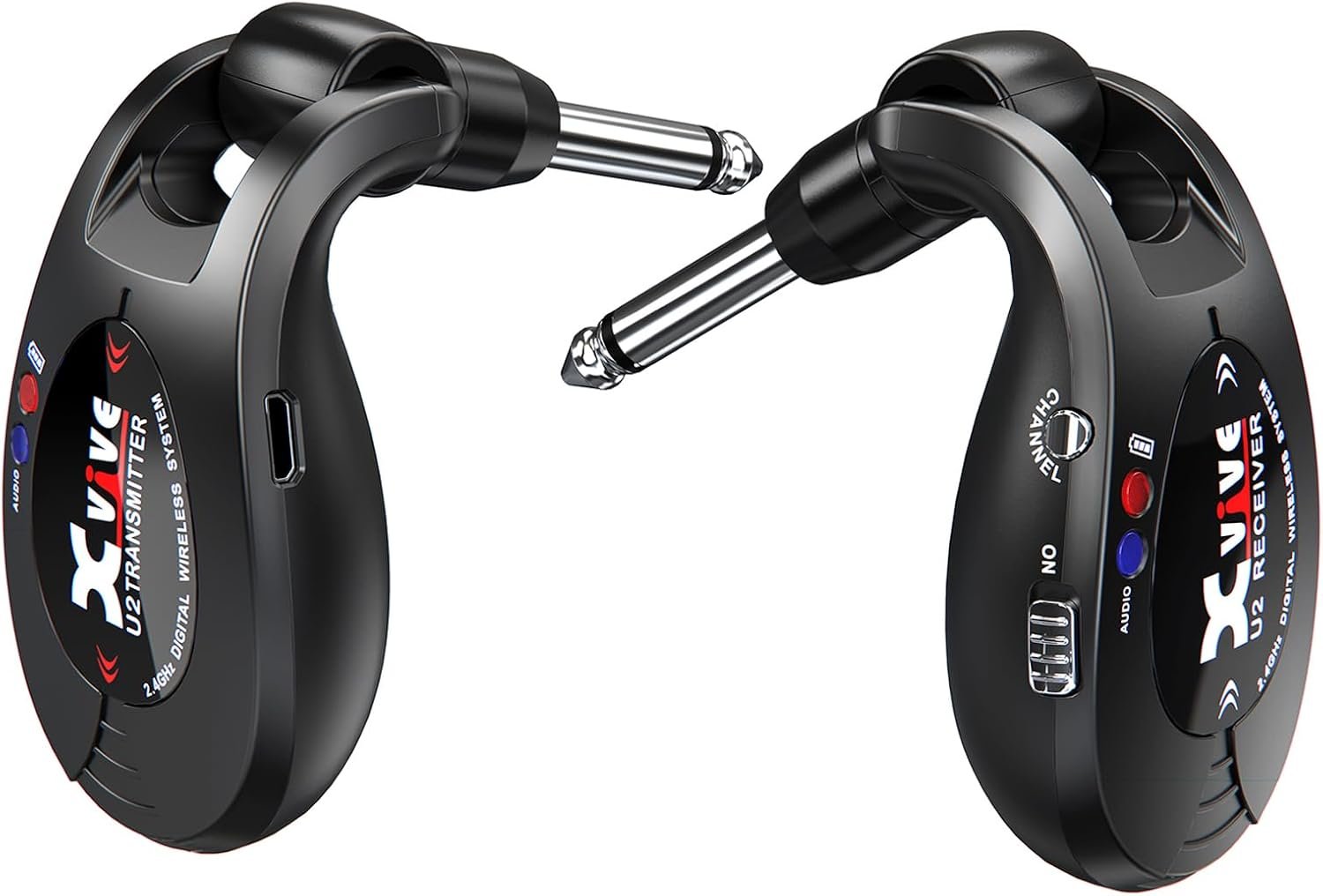
The Xvive U2 uses two small, similarly shaped units.
Each has a standard quarter-inch jack connector and a rotating section that allows the body to sit at different angles.
This adjustable design is particularly useful because guitars do not all have their output sockets in the same position.
Some use a socket on the body edge, while others place it on the front or in a recessed mounting plate.
Being able to change the angle of the transmitter helps accommodate different instrument designs.
Each unit weighs approximately 40 grams, making the system relatively lightweight.
Once connected, the transmitter becomes a small extension of the guitar rather than a separate piece of equipment hanging from the player’s clothing.
The receiver fits directly into a compatible amplifier or other instrument-level input.
There is no need for a dedicated wireless receiver mounted on a shelf or pedalboard.
The controls are uncomplicated, with power switching, channel selection and indicator lights.
This simplicity is one of the U2’s strongest qualities.
A guitarist can connect the units, switch them on, select matching channels and begin playing without navigating menus or configuring an app.
Digital Wireless Sound Without a Cable
The Xvive U2 transmits digital audio at 24-bit/48kHz.
This specification provides a high-resolution audio connection designed to retain the detail and frequency range of the incoming instrument signal.
Xvive quotes a frequency response extending from 20Hz to 20kHz, covering the normal audible range and the frequencies relevant to electric guitar and bass.
For players, the important question is whether the wireless connection feels responsive and allows their playing dynamics to remain recognisable.
Xvive specifies latency of approximately 5 milliseconds.
That is a relatively short delay, intended to make the wireless connection feel responsive during ordinary playing.
However, the overall playing experience will also depend on any additional digital processing, amplifier modelling or recording equipment connected after the receiver.
A wireless system does not automatically eliminate latency elsewhere in the signal chain.
The U2 can be used with conventional guitar amplifiers and other suitable equipment with quarter-inch instrument connections.
For example, our BOSS Katana-50 Amplifier guide explores a versatile amplifier that provides different sounds for home practice and more demanding playing situations.
The U2 does not alter an amplifier’s underlying tone or available effects. Its purpose is simply to replace the cable connecting the instrument to the rest of the equipment.
Four Wireless Channels for Greater Flexibility
The U2 operates on the 2.4GHz wireless band.
This frequency range is widely used by everyday wireless equipment, including Wi-Fi devices.
To provide some flexibility, Xvive includes four selectable wireless channels.
The transmitter and receiver must operate on matching channels.
If interference becomes a problem, changing channels may help establish a more reliable connection.
Xvive also specifies that up to four U2 systems can operate simultaneously under suitable conditions when assigned separate channels.
That makes the system potentially useful for small bands where several musicians want wireless instrument connections.
However, channel availability and reliability depend on the surrounding wireless environment.
In a quiet rehearsal room with relatively few wireless devices, the system may have fewer competing signals to contend with.
A crowded venue containing multiple routers, phones and other wireless equipment can present a more difficult environment.
Understanding this limitation is important before relying on any wireless instrument system for live performance.
Rechargeable Batteries for Everyday Practice
Both U2 units contain rechargeable lithium-ion batteries.
Xvive advertises approximately five hours of operation from a full charge.
That should be sufficient for many individual practice sessions and shorter rehearsals, depending on actual use and battery condition.
The supplied dual USB charging cable allows the transmitter and receiver to be charged together from a suitable 5V USB power source.
Xvive quotes a charging time of approximately two hours, although the actual time can vary with the charging supply.
This arrangement avoids the need to purchase disposable batteries for everyday operation.
For someone who practises regularly, keeping the system charged can become part of the normal routine of putting away an instrument.
The advantage is convenience.
The disadvantage is that another piece of equipment now depends on battery power.
Remembering to charge the transmitter and receiver is essential, particularly before rehearsals or performances.
Useful for Home Recording
Although the Xvive U2 is often associated with amplifiers and live playing, it can also be useful in a small recording setup.
The receiver can connect to a compatible instrument input on an audio interface, allowing a guitarist to record without a long cable running across the room.
This can be particularly convenient when the computer and recording equipment are positioned some distance from the usual playing area.
A guitarist may prefer standing while recording rhythm parts or moving naturally while working through a performance.
Removing a cable can make the recording space feel less restrictive.
However, the U2 does not replace an audio interface, amplifier simulator or recording software.
It simply carries the instrument signal wirelessly.
Our IK Multimedia AXE I/O ONE Guitar Audio Interface guide explores a recording interface designed specifically for electric guitar and bass.
For a guitarist interested in recording, the wireless connection and audio interface perform different jobs within the same setup.
The Drawbacks
The Xvive U2 is convenient, but it is important to understand where a traditional guitar cable may still be the more reliable choice.
Wireless systems introduce additional electronics, rechargeable batteries and radio-frequency conditions that do not affect an ordinary cable.
Interference Can Affect Reliability
The most significant limitation is the 2.4GHz operating frequency.
This wireless band is shared with many household and commercial devices.
Wi-Fi routers, wireless accessories and other nearby equipment can compete for space within the same frequency range.
In busy environments, this can cause interruptions or reduced wireless reliability.
Changing channels may improve the connection, but it cannot guarantee a completely interference-free signal.
Xvive recommends keeping suitable distance between the receiver and nearby Wi-Fi transmitters.
The positioning of the transmitter and receiver also matters.
Metal objects, walls and other obstacles may reduce signal quality.
For musicians performing in venues with crowded wireless networks, testing the system before playing is particularly important.
A conventional guitar cable remains a sensible backup.
The Advertised Range Is Not Guaranteed
Xvive specifies a wireless operating range of up to 70 feet under line-of-sight conditions.
That is useful for understanding the system’s intended capability, but it should not be treated as a guaranteed distance in every environment.
Walls, stage equipment, metal structures and other objects can interfere with signal transmission.
Even the position of the instrument and the player’s body can influence reception.
A guitarist moving across a rehearsal room may experience different results from someone performing on a crowded stage.
The best approach is to test the system in the actual environment where it will be used.
Anyone regularly performing across large stages or in challenging venues may prefer a more advanced wireless system with additional interference-management features.
Battery Life Requires Planning
The advertised five-hour battery life is convenient for ordinary sessions, but it introduces a limit that a traditional cable does not have.
Both the transmitter and receiver need sufficient charge.
If either unit runs out of power, the wireless connection cannot continue normally.
Battery capacity may also reduce gradually with age and repeated charging.
For players who regularly attend long rehearsals or performances, remembering to charge the system becomes another responsibility.
The rechargeable batteries are built into the units, so they are not as straightforward to swap during a performance as ordinary removable batteries.
A spare guitar cable is an inexpensive and sensible precaution.
Active Pickup Compatibility Needs Checking
The U2 works with conventional passive electric guitar pickups and suitable piezo-equipped instruments.
However, guitars with active electronics require more careful consideration.
Xvive specifies that the output from an active pickup system must remain below its supported maximum input level of 5.6Vp-p.
High-output active electronics may exceed the suitable input range and introduce unwanted distortion.
The manufacturer also advises against connecting the transmitter directly to high-output equipment that could overload its input.
For guitarists using unusual pickup systems, powered preamps or high-output instruments, checking compatibility is important.
The U2 should not be assumed to work equally well with every possible electronic instrument.
Plug Shape Can Cause Physical Problems
The compact plug-in design is convenient, but not every guitar has an easily accessible output socket.
Some instruments use deeply recessed sockets or unusual jack arrangements.
The physical shape of the transmitter may make it awkward to connect or position correctly.
On certain guitars, the transmitter could also sit close to the player’s body or interfere with a strap.
The rotating connector helps, but it does not guarantee perfect physical compatibility.
Checking the instrument’s socket position before buying is worthwhile.
Wireless Does Not Mean Completely Cable-Free
The U2 removes the cable between the guitar and the receiving equipment.
However, it does not eliminate the other cables required by a typical guitar setup.
Amplifiers still require power.
Pedalboards still need their own connections and power supplies.
Recording interfaces still connect to computers and monitoring equipment.
The Xvive also requires a charging cable.
This is not necessarily a serious drawback, but it is important to understand exactly what the product changes.
It simplifies one part of the signal chain rather than replacing the entire collection of cables surrounding a musician.
Four Channels May Be Restrictive
Four selectable channels provide some flexibility, particularly for home use and small rehearsal spaces.
However, more demanding wireless environments may require additional channel options or more sophisticated frequency management.
If several musicians are already using wireless instruments, microphones and monitoring systems, coordination becomes increasingly important.
The U2 is designed around simplicity rather than advanced wireless-frequency control.
That makes it approachable, but it may not be the best choice for larger professional setups.
Digital Wireless Is Not for Every Playing Style
Although the U2 offers high-resolution digital audio and low latency, some musicians will still prefer the simplicity of a wired connection.
A traditional cable has no pairing requirements, no internal battery and no radio-frequency interference to manage.
Players who regularly change instruments may also find moving the transmitter between guitars less convenient than leaving separate cables connected.
The U2 can provide excellent practical freedom, but that freedom only matters if the musician actually benefits from it.
For players who remain seated beside an amplifier, a conventional cable may be entirely satisfactory.
Who It Suits Best
The Xvive U2 is particularly suitable for guitarists who want more freedom during home practice, rehearsals and smaller performances.
It should appeal to players who regularly practise standing up or move around while playing.
The compact transmitter and receiver make it convenient for musicians who dislike complicated wireless equipment.
It may also be useful for home recording, particularly where the guitarist prefers standing away from the computer and recording interface.
However, musicians working in crowded wireless environments or using unusual active pickup systems should consider their requirements carefully.
For guitarists whose main priority is completely private practice, our BOSS Waza-Air Wireless Guitar Headphones guideexplores a different wireless approach that combines headphone listening with built-in amplifier modelling.
Anyone interested in other practical equipment for playing, maintaining and organising instruments can explore our Accessories guides.
Ultimately, the U2 makes the most sense for players who genuinely want freedom from a traditional instrument cable while keeping the rest of their familiar guitar setup.
Is the Xvive U2 Worth Considering?
The Xvive U2 Wireless Guitar System offers a practical way to introduce wireless freedom without building a complicated setup.
Its compact plug-in design, rechargeable batteries, digital audio transmission and straightforward controls make it particularly appealing for everyday guitar use.
The ability to move around without a trailing cable can make practice feel more relaxed and give performers greater freedom on stage.
However, the limitations deserve attention.
Wireless interference, battery management, physical compatibility and the relatively small number of available channels mean the U2 cannot provide the absolute predictability of a conventional instrument cable.
For guitarists who value simple equipment and normally remain close to their amplifiers, those compromises may outweigh the benefits.
For players who want to move freely, avoid tangled leads and keep their existing amplifier or pedalboard, the Xvive U2 offers a useful and uncomplicated solution.
It does not change how a guitar sounds at its source or replace the equipment that shapes its tone.
It simply removes one cable from the journey between instrument and amplifier — and for the right guitarist, that can make playing considerably more comfortable.
As an Amazon Associate I earn from qualifying purchases.