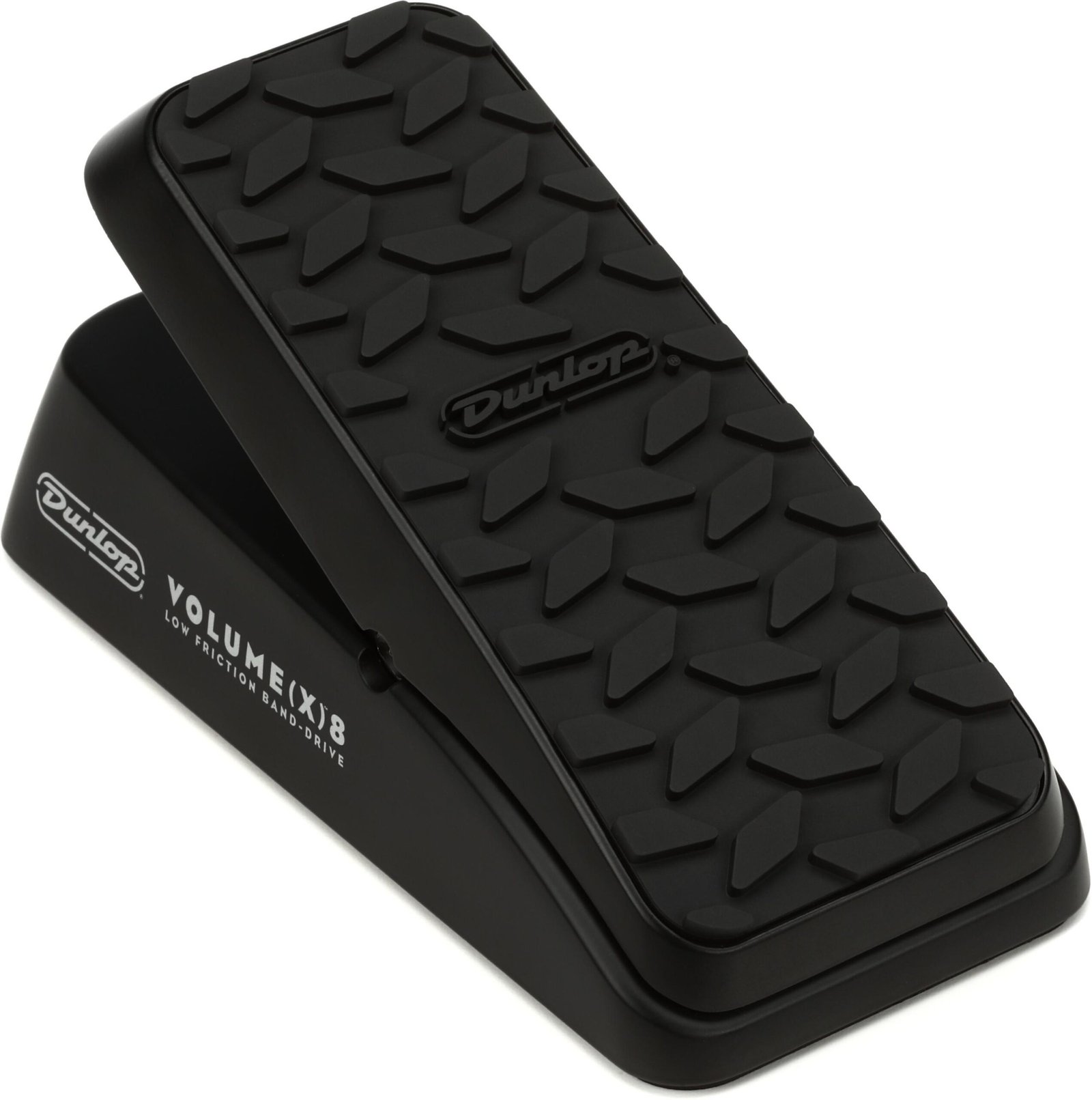
Dunlop DVP5 Volume X8
As an Amazon Associate I earn from qualifying purchases.
The Dunlop DVP5 Volume X8 is a compact volume and expression pedal for guitarists who want hands-free control without giving up too much pedalboard space.
Rather than creating distortion, delay or modulation, it allows players to adjust their guitar’s volume or control a compatible effect through a foot-operated treadle.
That makes it useful for smooth volume swells, controlled changes in dynamics and expressive playing techniques.
Its sturdy metal housing and textured treadle give it the purposeful appearance of equipment designed for regular use.
Why It Works on a Guitar Pedalboard
A volume pedal gives guitarists a different way to control their sound.
Instead of reaching for the guitar’s volume knob, players can gradually increase or reduce the signal level while keeping both hands on the instrument.
This is particularly useful during live performances, where smooth changes in volume can become part of the music.
The DVP5 also offers expression functionality, allowing it to control supported parameters on compatible equipment.
For guitarists exploring multi-effects processors, our Mooer GE100 guide explains how different effects and control options can shape a guitar’s sound.
The Dunlop provides a dedicated physical controller rather than combining numerous effects inside one unit.
What It Feels Like to Use
The DVP5 has a solid metal enclosure and a textured foot platform designed to provide grip during operation.
Its compact dimensions make it easier to accommodate on a crowded pedalboard than some larger volume pedals.
The treadle moves through a controlled range, allowing the player to make gradual adjustments with their foot.
For volume swells, the guitarist can pick a note with the volume reduced and then slowly bring the sound forward.
This softens the initial attack and creates a smooth, almost bowed quality.
It takes practice to coordinate the movement, but the technique can add considerable expression to melodic playing.
The pedal is also useful for straightforward volume adjustments between musical passages.
Understanding Volume and Expression Control
Although the two functions involve similar foot movements, they serve different purposes.
Volume Control
When connected as a volume pedal, the DVP5 adjusts the level of the audio signal passing through it.
This allows gradual changes without touching the guitar’s controls.
It can be useful for quiet introductions, dramatic crescendos and reducing volume between songs.
The position of the pedal in the signal chain matters.
Placed before an overdrive pedal, reducing the signal may change how strongly the overdrive circuit responds.
Placed later in the chain, the result can be quite different.
Our BOSS BD-2 Blues Driver guide explores the characteristics of a traditional overdrive pedal and how it responds to guitar playing dynamics.
Expression Control
Expression mode is different because it controls a parameter on another compatible device.
Depending on the receiving equipment, this could involve adjusting a supported effect setting.
Compatibility is essential.
Not every processor or effects pedal accepts an external expression controller, and connection requirements can vary.
Always check the specifications of both devices before connecting them.
Creating More Expressive Guitar Sounds
One of the most appealing uses for a volume pedal is creating atmospheric guitar passages.
By reducing the initial pick attack and gradually increasing volume, guitarists can produce notes that emerge smoothly.
Combining this technique with delay or modulation effects can create rich, layered sounds.
Chorus can add movement and width, while delay can produce repeating echoes behind sustained notes.
Our Aklot Chorus Pedal guide explores how chorus effects can introduce depth and movement to guitar tones.
The DVP5 does not produce those effects itself.
Instead, it gives the player another way to control how notes enter the effects chain.
For ambient guitar, melodic passages and recording work, this can be particularly useful.
The Drawbacks
The Dunlop DVP5 Volume X8 offers useful control, but it is a specialist piece of equipment with several limitations worth considering.
It Does Not Create Effects
Unlike an overdrive, chorus or delay pedal, the DVP5 does not produce a new guitar effect.
Its purpose is to adjust volume or control compatible equipment.
A guitarist hoping to expand their range of sounds may find a conventional effects pedal more useful.
The DVP5 makes sense when the player specifically wants foot-operated control.
Expression Compatibility Requires Checking
Not every piece of equipment with an expression connection uses identical wiring or control arrangements.
Players should check the manufacturer’s specifications before assuming compatibility.
An unsuitable connection may prevent the expression function from working correctly.
This is especially important when buying the pedal to control one particular processor or effect.
A Smaller Treadle May Not Suit Everyone
The compact design saves space, but it also provides a shorter foot platform than some traditional volume pedals.
Players accustomed to larger pedals may prefer a longer movement range.
Footwear, playing position and personal preference can influence how comfortable the pedal feels.
Compact construction is useful, but it is not automatically the most comfortable option for every guitarist.
Smooth Volume Swells Take Practice
Creating consistent volume swells requires coordination between picking, fretting and foot movement.
Beginners may initially bring the volume up too quickly or struggle to produce an even transition.
The pedal provides the control, but developing the technique takes time.
Players looking for instant changes in sound may prefer conventional effects that require less physical coordination.
Pedalboard Placement Matters
A volume pedal can behave differently depending on where it sits in the signal chain.
Positioning it before drive effects may influence the amount of distortion produced.
Placing it after certain effects can change the overall level without producing the same response.
Experimentation may be necessary to find the preferred arrangement.
Additional Cables Are Required
The DVP5 needs suitable connections for its intended function.
Volume and expression applications use different signal paths, so players must select the appropriate cables.
Before purchasing, it is worth checking what is already available in the pedalboard setup.
It Still Takes Up Space
Although smaller than many conventional volume pedals, the DVP5 still occupies a dedicated position.
For guitarists using very small pedalboards, that space could otherwise accommodate another effect.
The decision comes down to whether regular volume or expression control is more valuable than an additional sound-shaping pedal.
Existing Equipment May Already Offer Similar Control
Some multi-effects processors include built-in expression pedals or alternative ways to adjust volume.
Adding the DVP5 may therefore duplicate an existing function.
A separate controller can still be useful for convenience, but it should serve a clear purpose rather than simply adding more equipment.
Who It Suits Best
The Dunlop DVP5 Volume X8 is particularly suitable for guitarists who enjoy expressive volume techniques and want a dedicated foot controller.
It also makes sense for musicians using compatible effects processors that benefit from external expression control.
Live performers may appreciate being able to adjust volume without removing their hands from the guitar.
Recording musicians can use gradual volume changes to create softer, more atmospheric passages.
For more equipment ideas, explore our Pedals guides, covering effects, processors and practical additions to guitar setups.
Players who only need occasional volume adjustments may find their guitar’s existing controls sufficient.
Is the Dunlop DVP5 Volume X8 Worth the Space?
The Dunlop DVP5 Volume X8 offers a practical combination of compact construction, volume control and expression functionality.
Its greatest appeal is the ability to make gradual, expressive adjustments while continuing to play.
The sturdy enclosure and pedalboard-friendly design are attractive, although its compact treadle and compatibility requirements deserve consideration.
For guitarists who regularly use volume swells or compatible expression-controlled equipment, it is a sensible addition to a carefully organised setup.
For everyone else, the question is whether dedicated foot control will genuinely improve the way they play.
As an Amazon Associate I earn from qualifying purchases.