Zoom H4essential Recorder
As an Amazon Associate I earn from qualifying purchases.
Recording a guitar performance shouldn’t always mean switching on a computer, opening complicated software and connecting several pieces of equipment. Sometimes, the most useful recording setup is one that can capture an idea the moment inspiration arrives.
The Zoom H4essential Recorder offers exactly that flexibility.
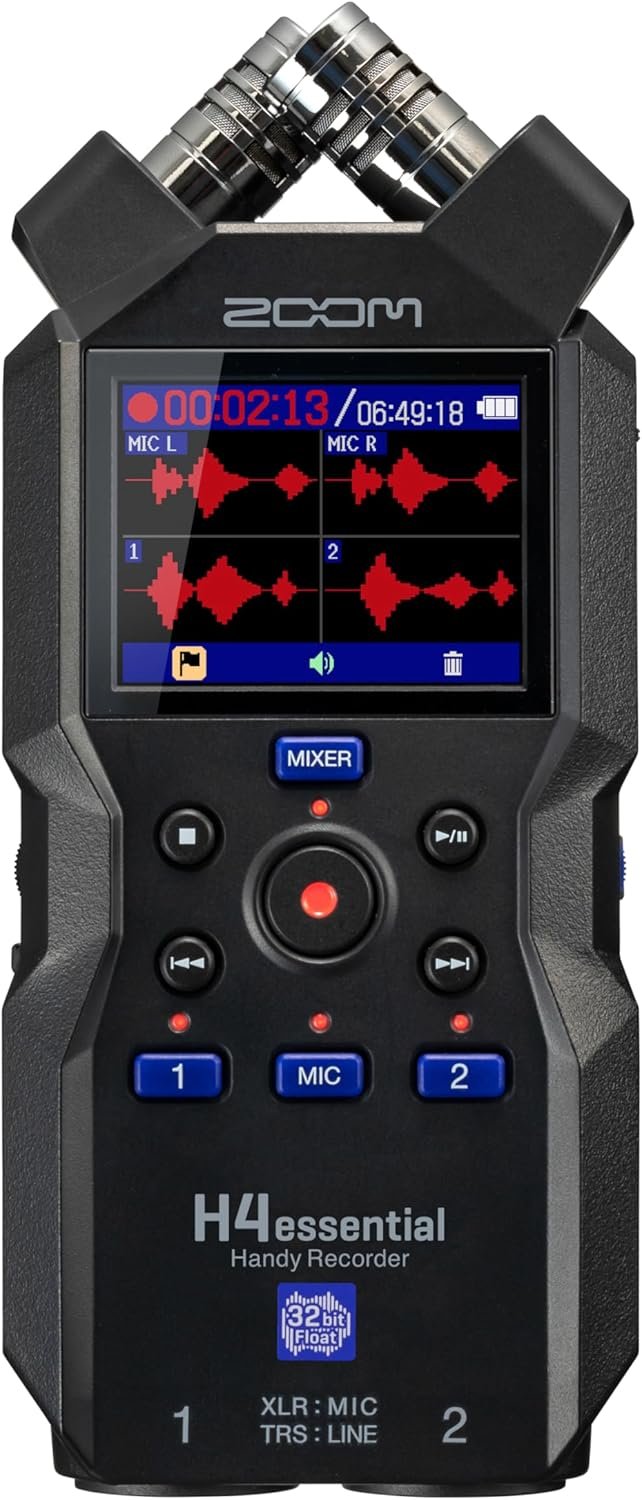
With 32-bit float recording, built-in stereo microphones and two XLR/TRS inputs, this compact four-track recorder can capture acoustic instruments, rehearsals and live performances without requiring a computer.
It also works as a USB audio interface, making it an interesting choice for musicians who want both portable recording and home-studio connectivity.
Why the Zoom H4essential Works for Musicians
The H4essential combines several recording functions in one handheld device.
Its built-in microphones allow musicians to capture rehearsals, acoustic guitars and room recordings without connecting additional equipment.
For more controlled recording, two XLR/TRS inputs accommodate suitable external microphones, mixers and line-level sources.
This gives musicians several options.
An acoustic guitarist could record a performance using the stereo microphones, while a small ensemble could use those microphones alongside two external inputs.
The recorder is also compact enough to carry between home, rehearsal spaces and performance venues.
For musicians who regularly want to capture ideas away from a studio desk, that portability is a genuine advantage.
Understanding 32-Bit Float Recording
One of the H4essential’s most important features is 32-bit float recording.
Traditional digital recording requires careful attention to input levels. Record too quietly, and raising the volume afterwards may reveal unwanted noise. Record too loudly, and digital clipping can permanently damage the signal.
32-bit float recording provides much greater flexibility when adjusting recorded levels during editing.
The H4essential uses dual analogue-to-digital converter technology on its two XLR/TRS inputs to handle a wide range of incoming signal levels.
This is particularly useful when recording rehearsals or live music, where sudden changes in volume can be difficult to anticipate.
However, 32-bit float cannot repair distortion caused by an overloaded microphone or poor microphone placement.
The technology makes level management more forgiving, but capturing a good performance still requires sensible recording technique.
Built-In X/Y Stereo Microphones
The H4essential features two microphones arranged in an X/Y configuration.
This arrangement captures a stereo sound field while maintaining a focused centre image.
For acoustic guitar, the microphones can capture the instrument’s body, string detail and surrounding room sound.
For rehearsals, they can record the overall balance of a group without requiring individual microphones for every instrument.
Zoom specifies a maximum sound pressure level of 130 dB SPL for the built-in microphones, allowing them to accommodate relatively loud sound sources within their operating limits.
Microphone positioning remains important.
Moving the recorder closer to an acoustic guitar produces a different balance from placing it several feet away.
The position of the instrument, nearby walls and other sound sources all influence the result.
Two XLR/TRS Inputs for Greater Flexibility
The two combination inputs support suitable microphones and line-level equipment.
They also provide 48V phantom power for condenser microphones that require it.
This means a guitarist could use the built-in microphones to capture the room while connecting an additional microphone to record a particular instrument.
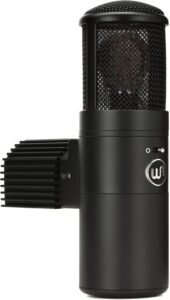
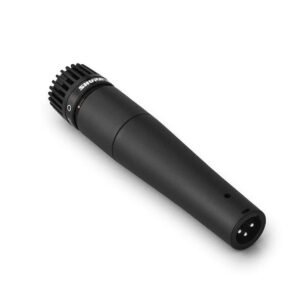
For example, the sE Electronics V7 X Microphone is designed for recording guitar amplifiers and other instruments.
Connecting a suitable instrument microphone to the H4essential provides another way to capture a more focused sound.
Importantly, the recorder’s XLR/TRS inputs are not dedicated high-impedance guitar inputs.
Passive electric guitars and basses should be connected through suitable equipment rather than plugged directly into these inputs.
Recording Without a Computer
One of the H4essential’s strongest advantages is its independence from a computer.
Recordings are saved to a compatible microSD card, with support for microSDXC capacities up to 1TB.
The colour display provides access to recording information, menus and track controls.
A built-in mixer allows individual track levels to be adjusted for monitoring, while the waveform display shows recorded audio activity.
Headphones can be connected for checking recordings, and the built-in speaker provides a convenient way to listen back when headphones are unavailable.
The recorder operates using two AA batteries or a suitable external USB-C power source.
That makes it useful for recording away from a permanent studio setup.
A Portable Recorder and USB Audio Interface
The H4essential can also function as a four-input, two-output USB audio interface with compatible computers and mobile devices.
This provides an alternative to using it purely as a standalone recorder.
However, musicians who primarily record electric guitar directly into computer software may prefer an interface with a dedicated instrument input.
Our Audient iD4 MKII USB-C Audio Interface guide explores a desktop option featuring a JFET guitar input and dedicated monitoring controls.
The distinction is straightforward.
The Audient is built around computer recording, while the Zoom offers the additional convenience of recording independently.
Choosing between them depends on where and how the music will be recorded.
The Drawbacks
The Zoom H4essential offers impressive recording flexibility, but there are several compromises worth considering before choosing it.
Microphone Placement Still Matters
The built-in X/Y microphones are convenient, but they capture surrounding sounds as well as the intended performance.
In an untreated room, reflections from walls and hard surfaces can affect clarity.
Recording acoustic guitar too far from the microphones may produce more room sound than desired.
Placing the recorder close to a loudspeaker or amplifier also requires care to avoid overloading the microphone.
Good positioning remains essential, regardless of recording resolution.
Battery Life Varies Considerably
The H4essential operates on two AA batteries, but recording conditions influence operating time.
Zoom estimates approximately nine hours using alkaline batteries when recording two tracks with the built-in microphones under specified conditions.
That figure falls to approximately 2.5 hours when recording four tracks with headphones connected under the manufacturer’s test conditions.
Using phantom power or other additional functions can further influence battery consumption.
For longer recording sessions, USB power is worth considering.
A Memory Card Is Required
The recorder needs a compatible microSD card to store recordings.
This is another item to purchase and manage, especially for musicians who record frequently.
High-resolution recordings also occupy more storage space than compressed audio files.
Regularly transferring important recordings to another device is sensible because memory cards can fail or become damaged.
The H4essential should not be treated as the only storage location for valuable performances.
No Dedicated Guitar Instrument Input
This is an important limitation for electric guitarists.
Although the H4essential provides two XLR/TRS inputs, they are not designed for direct connection to passive electric guitars or basses.
A suitable DI box, effects unit, preamp or mixer is needed to provide an appropriate signal.
Anyone hoping to connect a guitar directly and immediately use amplifier simulation software may find a dedicated guitar audio interface more convenient.
32-Bit Float Doesn’t Guarantee Perfect Audio
32-bit float recording provides valuable protection against digital level problems, but it cannot correct every recording mistake.
An overloaded microphone, excessive wind noise, poor positioning or unwanted room reflections can still spoil the result.
Recordings may also require level adjustment and editing before they are ready to share.
The technology reduces one important difficulty; it does not eliminate the need for recording skills.
Limited Physical Controls
The H4essential’s compact size is an advantage when travelling, but its screen and controls are smaller than those on a desktop interface or mixing console.
Navigating menus and adjusting settings may feel less convenient during longer sessions.
The built-in microphones are also attached to the recorder, so changing their position means moving the entire device.
External microphones provide greater placement flexibility but require additional cables and equipment.
Wireless Functions Need an Accessory
Bluetooth remote control is possible using Zoom’s compatible BTA-1 adapter.
However, the adapter is sold separately.
The recorder does not provide those wireless functions straight out of the box.
Musicians who want remote operation should factor in the additional accessory and check software compatibility.
Who It Suits Best
The Zoom H4essential is particularly suitable for acoustic guitarists, songwriters, small ensembles and musicians who want to record rehearsals or live performances.
Its built-in microphones make spontaneous recording convenient, while the external inputs provide room for more controlled setups.
It also makes sense for musicians who occasionally need a USB audio interface but do not want to depend entirely on a computer.
For other useful recording equipment, explore our Recording & Studio guides, covering microphones, interfaces, headphones and studio essentials.
Musicians who mainly record electric guitar directly into software may prefer a dedicated desktop interface.
Is the Zoom H4essential Worth Carrying?
The Zoom H4essential combines portable recording, flexible microphone connections and 32-bit float technology in a compact, practical device.
Its greatest strength is the freedom to capture music without setting up a complete studio.
The main compromises are variable battery life, dependence on a memory card and the absence of a dedicated high-impedance guitar input.
For musicians who regularly record acoustic performances, rehearsals and musical ideas away from their computers, the H4essential offers a useful balance of recording capability and portability.
It’s a recorder designed to make capturing music more convenient, leaving more time for the part that matters most: playing.
As an Amazon Associate I earn from qualifying purchases.