Roland JC-22 Jazz Chorus Amp
As an Amazon Associate I earn from qualifying purchases.
Some guitar amplifiers are designed around heavy distortion and endless sound options. Others concentrate on delivering a clear, responsive guitar sound that allows the instrument and the player’s technique to come through.
The Roland JC-22 Jazz Chorus Amp follows the second approach.
This compact 30-watt stereo amplifier brings Roland’s established Jazz Chorus sound into a smaller cabinet, complete with two 6.5-inch speakers, built-in chorus and reverb, and useful connections for external effects.
For guitarists who appreciate clean tones, atmospheric effects and straightforward controls, the JC-22 offers an interesting alternative to more complicated modelling amplifiers.
Why the Roland JC-22 Stands Out
Roland’s Jazz Chorus amplifiers have developed a reputation for distinctive clean guitar sounds and spacious stereo modulation.
The JC-22 retains that approach in a more manageable size.
Rather than providing numerous amplifier models, it concentrates on one fundamental clean sound that can be adjusted using familiar bass, middle and treble controls.
A Bright switch provides additional high-frequency emphasis when required.
This arrangement makes the amplifier particularly relevant for jazz, blues, clean rhythm guitar and ambient playing.
Individual notes remain an important part of the sound, while chords benefit from the clarity associated with the Jazz Chorus design.
Guitarists who prefer to create their overdrive and distortion sounds using pedals may also appreciate the relatively straightforward amplifier section.
Two Speakers and Genuine Stereo Chorus
The JC-22 uses two independent amplifier channels driving separate 6.5-inch speakers.
Together, they deliver 30 watts of rated output.
This arrangement allows Roland’s Dimensional Space Chorus effect to create movement and width between the two speakers.
Unlike a simple mono chorus effect, the stereo system produces differences between the left and right channels, creating a broader sense of space.
The effect is particularly appealing when playing clean arpeggios, sustained chords or atmospheric guitar passages.
Speed and Depth controls allow the guitarist to adjust the chorus movement.
A subtle setting can add gentle richness without dominating the original sound.
More pronounced settings create the spacious, shimmering character associated with Roland’s larger Jazz Chorus amplifiers.
Built-In Reverb and Straightforward Controls
Alongside the stereo chorus, the JC-22 includes a built-in reverb effect.
This adds a sense of space to the guitar without requiring another pedal.
For clean melodic playing, a modest amount of reverb can help notes sound less dry.
Longer atmospheric passages can also benefit from combining reverb with the amplifier’s stereo chorus.
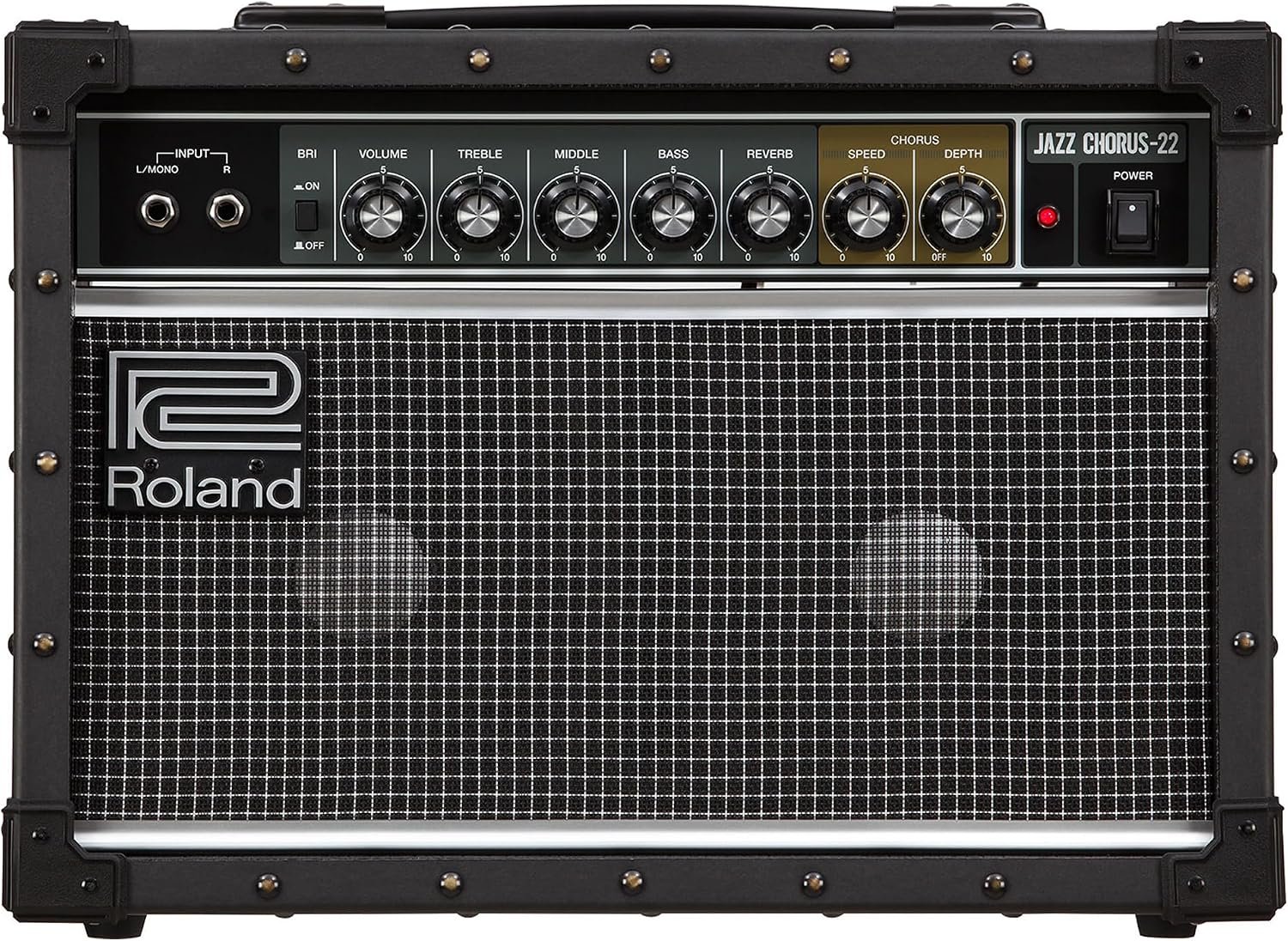
The front panel remains relatively straightforward, with Volume, Bass, Middle, Treble, Reverb, Speed and Depth controls.
There is no complicated preset system or display to navigate.
This makes the amplifier attractive to guitarists who prefer turning physical controls rather than working through software menus.
Stereo Inputs for Guitar Effects
The JC-22 includes left and right instrument inputs.
A conventional guitar can connect through the L/Mono input, while compatible stereo effects processors can use both connections.
This is particularly useful for guitarists using stereo delay, reverb or modulation pedals.
Instead of combining everything into one mono signal, the amplifier can reproduce the separate left and right channels through its two speakers.
The rear panel also includes a stereo effects loop with selectable series or parallel operation.
This provides additional flexibility when integrating external effects into a more developed guitar setup.
For musicians who enjoy experimenting with stereo processing, these connections are a significant part of the amplifier’s appeal.
Home Practice and Recording
Although the JC-22 is smaller than Roland’s larger Jazz Chorus models, it still offers several useful connections.
A headphone output allows private practice and automatically mutes the built-in speakers.
Stereo line outputs provide connections for suitable recording equipment or mixing systems.
For guitarists who want an entirely wireless personal practice arrangement, our BOSS Waza-Air Wireless Guitar Headphones guide explores a different approach using amplifier modelling and headphones.
Those interested in another clean-focused combo may also want to explore the Fender Tone Master Princeton Reverb, which offers a different interpretation of traditional amplifier sound.
The JC-22’s main strength is combining a dedicated clean amplifier with genuine stereo speaker operation and useful external connections.
Construction and Everyday Practicality
The JC-22 follows the familiar Jazz Chorus appearance, with a black cabinet, protective corners and a silver grille.
Its dimensions are approximately 18.2 inches wide, 9.4 inches deep and 13.3 inches high.
At 26.5 pounds, it is more compact than the larger Jazz Chorus amplifiers, although still substantial enough to require care when carrying.
The cabinet is designed for conventional mains-powered operation, with the power cord included.
Optional footswitches can provide hands-free control of chorus and reverb, making the amplifier more convenient for performance use.
The Drawbacks
The Roland JC-22 has several appealing features, but its clean-focused design and compact stereo arrangement won’t suit every guitarist.
No Dedicated Overdrive Channel
The most significant limitation is its emphasis on clean amplification.
There is no dedicated high-gain or distortion channel.
Guitarists who enjoy blues, rock or heavier sounds will generally need suitable external overdrive or distortion pedals.
This isn’t necessarily a disadvantage for someone who already owns a pedalboard, but it does mean additional equipment may be required.
Players wanting several amplifier sounds from one device may prefer a modelling amplifier.
Smaller Speakers Limit Its Range
The two 6.5-inch speakers are central to the compact design, but they cannot be expected to deliver the same low-frequency weight as larger guitar speakers.
The JC-22 can be useful for practice, recording and suitable smaller performances, but musicians playing with a particularly loud drummer may need more amplification.
Its 30-watt rating should not be confused with the capabilities of a much larger stage amplifier.
The appropriate volume depends on the room, band and playing style.
Heavier Than Its Size Suggests
Although Roland describes the JC-22 as compact, it weighs approximately 26.5 pounds.
That is noticeably heavier than many miniature practice amplifiers.
The sturdy cabinet and dual-speaker arrangement contribute to its substantial construction, but carrying it regularly may become inconvenient.
Anyone prioritising lightweight equipment for travel or frequent rehearsals should consider the weight carefully.
Headphones Don’t Reproduce the Full Stereo Experience
One important detail concerns the headphone output.
Roland explains that the headphone connection is not designed to reproduce the same true stereo effect heard through the two built-in speakers.
Instead, its output is intended to approximate the experience of listening to the amplifier from a central position.
Headphones remain useful for quiet practice, but buyers shouldn’t assume they will hear exactly the same spatial chorus presentation as they would from the speakers.
Footswitches Are Sold Separately
The JC-22 supports external footswitch control for switching chorus and reverb on or off.
However, compatible BOSS footswitches are optional accessories.
Without them, players must use the amplifier’s controls to make the relevant changes.
For home practice, this may be perfectly acceptable.
During live performance, having to reach over and adjust settings can be inconvenient, particularly when changing effects between songs.
Limited Built-In Effects
Chorus and reverb are useful additions, but the JC-22 doesn’t include delay, tremolo, distortion or extensive amplifier modelling.
Guitarists who enjoy experimenting with numerous sounds will need additional pedals.
That can increase the overall cost, cabling and space required for a complete guitar setup.
For someone who wants an all-in-one practice amplifier, a modern modelling combo may provide more flexibility.
Stereo Benefits Depend on Placement
The amplifier’s stereo chorus is a major attraction, but its impact depends partly on listening position and room acoustics.
Sitting directly in front of the cabinet may provide a more balanced stereo impression than listening from an awkward angle.
Placing the amplifier against furniture or in a cramped corner can also influence how the speakers are heard.
The JC-22 provides genuine stereo operation, but the physical separation between its speakers is naturally smaller than that of two separate amplifiers.
Who It Suits Best
The Roland JC-22 is particularly suited to guitarists who value clean tones, stereo chorus and straightforward amplifier controls.
It makes sense for jazz players, clean rhythm guitarists and musicians creating atmospheric sounds with delay and modulation pedals.
Its headphone connection and line outputs also make it useful for home practice and recording.
For more options covering compact combos, traditional amplifiers and modern guitar technology, explore our Amplifiers collection.
Players who primarily want built-in distortion, extensive presets or lightweight battery-powered operation may prefer another amplifier.
Is the Roland JC-22 Worth Considering?
The Roland JC-22 succeeds by concentrating on a clear purpose: providing the familiar Jazz Chorus clean sound in a more compact stereo amplifier.
Its two speakers, built-in chorus and reverb, stereo inputs and flexible effects loop make it particularly appealing to guitarists who enjoy clean and atmospheric playing.
The main compromises are its limited built-in effects, relatively substantial weight and modest speaker size.
For players who value clarity, straightforward operation and genuine stereo chorus, however, the JC-22 offers a thoughtful alternative to more complicated guitar amplifiers.
As an Amazon Associate I earn from qualifying purchases.