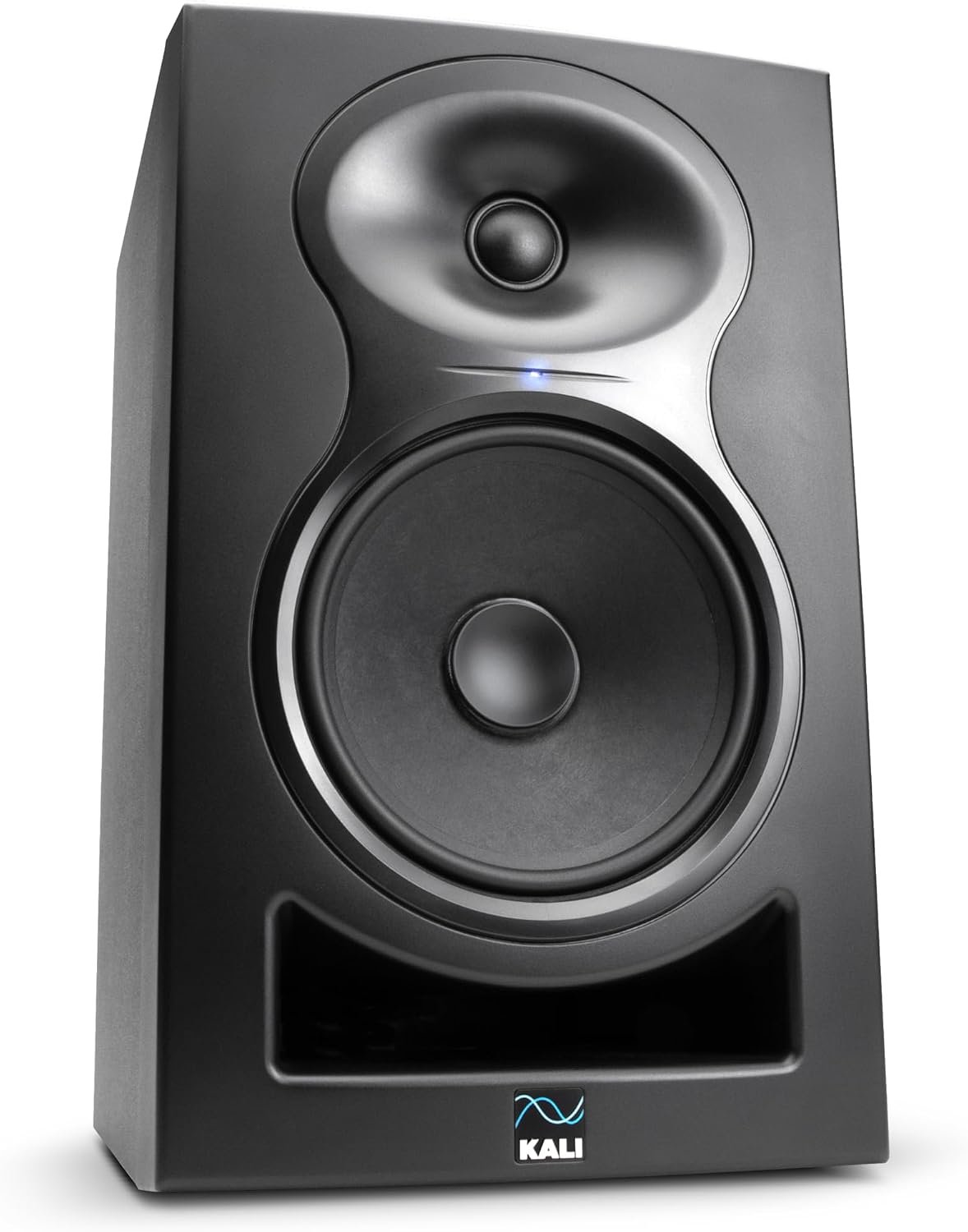
Kali Audio LP-6 V2 Studio Monitor
As an Amazon Associate I earn from qualifying purchases.
A good pair of studio monitors can make a considerable difference to the way musicians record, mix and understand their music.
Unlike ordinary speakers designed primarily to make music sound exciting, studio monitors aim to reproduce recordings accurately. That allows musicians to hear details that might otherwise be hidden by exaggerated bass or treble.
The Kali Audio LP-6 V2 Studio Monitor has been designed with exactly that purpose in mind.
Featuring a 6.5-inch woofer, 1-inch tweeter, dedicated amplification and adjustable Boundary EQ settings, it offers a thoughtful combination of sound reproduction and practical studio features.
For guitarists, producers and home-recording musicians, the LP-6 V2 is an interesting option when dependable monitoring becomes an important part of the recording process.
Important: This particular product is sold as one speaker. A conventional stereo monitoring setup requires two.
Why the Kali Audio LP-6 V2 Stands Out
Kali Audio developed the LP-Series monitors to provide clear, accurate sound without unnecessary emphasis on particular frequencies.
The LP-6 V2 belongs to the second generation of the company’s Lone Pine range.
Compared with the original model, the updated version features refinements to the amplifier platform, frequency response and internal processing.
Kali reports a lower noise floor and greater maximum output than the first-generation design.
These improvements are particularly relevant when working in a quiet home studio.
Unwanted amplifier noise can become distracting during detailed editing or quieter recording sessions.
The aim isn’t to create an artificially impressive sound. It’s to provide a reliable listening reference so musicians can make informed decisions about their recordings.
A 6.5-Inch Woofer and Dedicated Tweeter
The LP-6 V2 uses a two-way speaker arrangement.
A 6.5-inch woofer handles lower frequencies, while a 1-inch textile-dome tweeter reproduces higher-frequency detail.
Each driver has its own Class D amplification.
Kali specifies 40 watts for the woofer and 40 watts for the tweeter, providing 80 watts of total continuous amplifier power per speaker.
This dedicated amplification allows the drivers to operate within a system designed specifically for their characteristics.
Hearing the Details in a Recording
For guitarists recording at home, accurate monitoring becomes particularly useful during mixing.
A guitar part that sounds impressive through heavily bass-boosted speakers may become muddy when played elsewhere.
Similarly, excessive high frequencies can make distortion sound harsh and tiring.
A studio monitor is intended to help identify those problems.
Kali specifies a frequency range of 47 Hz to 21 kHz within ±3 dB for the LP-6 V2.
That provides useful coverage for electric guitar, acoustic instruments, vocals and many music-production tasks.
However, the lowest bass frequencies remain an area where speaker size, room acoustics and monitoring position matter.
The 3-D Imaging Waveguide
One of the LP-6 V2’s distinctive design features is the waveguide surrounding the tweeter.
This is intended to control how high-frequency sound spreads into the listening area.
Consistent sound dispersion helps produce a more stable stereo image when two monitors are positioned correctly.
For musicians mixing recordings, stereo imaging matters when deciding where instruments sit within a song.
Rhythm guitars, vocals, keyboards and effects can occupy different positions across the stereo field.
A well-arranged monitoring system makes these relationships easier to judge.
However, the waveguide cannot overcome poor speaker placement or an unsuitable listening position.
Its advantages are most useful when the monitors are arranged carefully.
Boundary EQ for Different Rooms
The LP-6 V2 includes one of the more practical features found on modern studio monitors: Boundary EQ.
A speaker’s position can significantly influence its frequency response.
Placing a monitor near a wall may increase certain bass frequencies, while a large desk can introduce unwanted reflections.
Kali addresses these problems with selectable EQ settings designed for common studio arrangements.
These include monitors positioned on stands, placed on desks or located closer to walls.
Additional high- and low-frequency adjustments provide further control.
Why This Matters at Home
Many home recording spaces are not purpose-built studios.
Musicians often work in bedrooms, spare rooms or home offices where the desk and speakers must fit around existing furniture.
Boundary EQ can help compensate for some predictable placement effects.
However, it isn’t an automatic room-correction system.
The correct settings must be selected manually, and serious acoustic problems may still require improved placement or room treatment.
The feature is useful because it acknowledges the practical limitations of real recording spaces.
Front Bass-Reflex Port
The LP-6 V2 uses a front-facing bass-reflex port.
Kali designed the port to reduce unwanted air turbulence that can create audible noise at higher output levels.
The front position also provides additional placement flexibility compared with some rear-ported designs.
That can be helpful when speakers must sit reasonably close to a wall.
Nevertheless, a front port does not eliminate the acoustic effects of nearby surfaces.
Wall distance, desk reflections and room dimensions still influence the final sound.
Careful positioning remains essential.
Connections for a Home Studio
The LP-6 V2 provides three analogue audio input options.
XLR: Balanced connection for suitable audio interfaces and professional recording equipment.
6.35 mm TRS: Another balanced input option for compatible studio equipment.
RCA: An unbalanced input for suitable consumer audio sources.
These connections provide useful flexibility when building a home recording system.
For example, the Focusrite Scarlett Solo 4th Gen Audio Interface offers stereo monitor outputs that can be connected to a pair of powered studio speakers using appropriate cables.
This allows musicians to listen to recordings from their computer through dedicated studio monitors rather than relying entirely on headphones.
The LP-6 V2 also provides rear-panel controls for volume and input sensitivity.
These adjustments help integrate the speaker into different monitoring arrangements.
Everyday Studio Use
The LP-6 V2 is intended for nearfield listening, where the speakers are positioned relatively close to the person working.
A typical stereo setup places one monitor to the left and another to the right, with both angled towards the listening position.
This arrangement allows the musician to judge levels, stereo placement and tonal balance while recording or mixing.
Headphones remain useful for tracking vocals, recording guitar and checking fine details without disturbing others.
Our beyerdynamic DT 770 PRO X Studio Headphones article explores another monitoring option, particularly useful when isolation and private listening are important.
Studio monitors and headphones complement one another.
The monitors allow music to interact naturally with the room, while headphones provide a more private listening environment.
Neither guarantees an accurate mix without experience and careful listening.
The Drawbacks
The Kali Audio LP-6 V2 offers useful studio features, but there are several important limitations worth considering before purchasing.
Sold Individually, Not as a Pair
This is the most important detail for buyers.
The Amazon listing we’ve selected is for one speaker.
A conventional stereo monitoring arrangement requires two LP-6 V2 monitors.
Anyone ordering a single unit expecting a complete stereo system will be disappointed.
Each speaker also requires its own mains connection and suitable audio cable.
Buyers should check the quantity carefully when planning their recording setup.
Larger Than Some Desktop Speakers
Although described as a nearfield monitor, the LP-6 V2 is substantial.
Each cabinet measures approximately 14.1 inches high, 8.75 inches wide and 10.25 inches deep.
It weighs approximately 15.5 pounds.
Two speakers occupy a considerable amount of desk space, particularly when they must be positioned correctly.
Small computer desks may struggle to accommodate them alongside a monitor, keyboard and audio interface.
Dedicated speaker stands may provide a more practical arrangement.
Room Acoustics Still Matter
Accurate speakers cannot automatically correct an unsuitable room.
Hard surfaces, bare walls, corners and poorly positioned furniture can introduce reflections and bass problems.
These effects may cause certain frequencies to sound exaggerated or reduced at the listening position.
Boundary EQ helps address some predictable placement conditions, but it cannot replace proper acoustic treatment.
Musicians working in particularly reflective rooms may need to improve their environment before experiencing the full benefits of these monitors.
No Bluetooth or Wireless Streaming
The LP-6 V2 is a conventional wired studio monitor.
It doesn’t include Bluetooth, Wi-Fi music streaming or a built-in wireless receiver.
That makes sense for professional monitoring, where reliable wired connections are generally preferable.
However, someone expecting a convenient wireless speaker for everyday phone listening may find the LP-6 V2 unnecessarily complicated.
Its design prioritizes recording and mixing rather than casual wireless entertainment.
No Headphone Connection
The LP-6 V2 does not include a headphone output.
It is a powered loudspeaker, not a complete monitor controller or audio interface.
Musicians who want to switch between studio speakers and headphones will normally control those connections through their audio interface or suitable monitoring equipment.
This isn’t unusual for professional studio monitors, but it is worth understanding before assembling a first recording setup.
Low Bass Still Has Physical Limits
The 6.5-inch woofer provides useful bass reproduction, but the LP-6 V2 cannot be expected to reproduce every deep sub-bass frequency with the authority of a larger system.
Kali specifies low-frequency extension to 39 Hz at the -10 dB point.
That figure should not be confused with perfectly flat bass reproduction down to 39 Hz.
Music containing very deep electronic bass or cinematic effects may require additional monitoring arrangements.
However, adding a subwoofer introduces further considerations around placement, crossover settings and room acoustics.
For many guitar-based recordings, the LP-6 V2’s existing bass response may be entirely sufficient.
Not a Portable Speaker
The LP-6 V2 requires mains power and has no rechargeable battery.
Its cabinet is also relatively heavy.
It is intended to remain in a suitable studio or listening position rather than being carried between rooms throughout the day.
Anyone needing portable monitoring for travelling, outdoor recording or mobile performances should consider equipment designed specifically for those situations.
Accurate Sound Can Be Less Flattering
A studio monitor is intended to reveal the recording rather than disguise its imperfections.
This can initially seem disappointing to listeners accustomed to speakers with heavily boosted bass or treble.
Poorly balanced recordings may sound thin, harsh or congested.
That doesn’t necessarily indicate a problem with the LP-6 V2.
It is part of the reason accurate monitoring matters.
However, people primarily seeking an exciting casual listening experience may prefer a different type of speaker.
Who It Suits Best
The Kali Audio LP-6 V2 is particularly suitable for musicians developing a dedicated recording or mixing space.
It makes sense for guitarists recording through audio interfaces, producers arranging music on computers and home studio owners who want to make more confident mixing decisions.
Its Boundary EQ settings are especially useful for people working in ordinary rooms rather than professionally treated studios.
For more carefully selected recording equipment, microphones, interfaces and monitoring solutions, explore our Recording & Studio collection.
The LP-6 V2 is less suitable for buyers who need a portable speaker, wireless streaming or a particularly compact desktop system.
Is the Kali Audio LP-6 V2 Worth Considering?
The Kali Audio LP-6 V2 combines accurate sound reproduction with practical features designed around real recording environments.
Its dedicated amplification, 6.5-inch woofer, controlled tweeter waveguide and adjustable Boundary EQ provide a thoughtful foundation for home studio monitoring.
The limitations are equally important.
A stereo system requires two speakers, correct positioning matters, and the cabinets occupy more space than ordinary desktop speakers.
The LP-6 V2 also requires suitable audio connections and cannot replace the other equipment needed for recording.
For musicians who understand those requirements, however, it offers a serious approach to hearing their work accurately.
Rather than adding unnecessary features, Kali Audio has concentrated on giving musicians a dependable listening reference — exactly what a good studio monitor should provide.
As an Amazon Associate I earn from qualifying purchases.