
Your Second Amp
Why Every Guitarist Needs a Fender Frontman 10G in the Trunk
Let me tell you about the worst night of my gigging life.
It was a Friday. Sold-out club. 300 people. My band was opening for a national act. Soundcheck went perfectly. My main amp – a vintage Fender Deluxe Reverb that I’d owned for twelve years – sounded glorious.
Then, five minutes before downbeat, I turned it on for one last check.
Nothing.
No sound. No hum. No lights. Just the faint smell of something electrical that had given up the ghost. A transformer, maybe. A tube socket. Didn’t matter. It was dead.
I had no backup amp.
The headliner graciously let me borrow his spare – a beat-up solid-state practice amp that buzzed and crackled and made me sound like I was playing through a broken clock radio. I played the worst set of my life. I couldn’t hear myself. I overcompensated. I played sloppy. The sound guy gave me dirty looks.
After the show, I swore: never again.
The next morning, I bought a cheap, small, reliable backup amp. Not something fancy. Not something expensive. Just something that would make sound if my main rig died. Something I could throw in the trunk and forget about until I needed it.
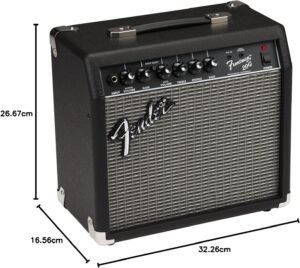
That amp? A Fender Frontman 10G.
And that decision has saved my ass at least three times since.
This article isn’t for beginners. It’s for players who already have a main amp – maybe a nice tube combo, a modeling powerhouse, or a vintage head and cab. You love your rig. But you know, in your gut, that electronics fail. Tubes blow. Transformers fry. Power surges happen.
You need a Fender Frontman 10G backup. Not as your main tone. As your insurance policy. And I’m going to tell you exactly why this $70-ish little box is the best emergency amp you’ll ever buy.
The Backup Amp Philosophy: Cheap, Small, Reliable, Good Enough
Let’s be clear about what a backup amp needs to do – and what it doesn’t.
A backup amp does NOT need to:
- Sound as good as your main rig
- Have all your favorite effects built in
- Look cool on stage
- Handle a loud rock drummer
- Impress anyone
A backup amp DOES need to:
- Work every single time you turn it on
- Be small and light enough to carry without thinking
- Cost little enough that you don’t mind owning it “just in case”
- Sound decent enough to get through a gig or practice session
- Survive bouncing around in your car trunk
The Fender Frontman 10G checks every box.
It’s a small emergency guitar amplifier that costs about as much as a nice dinner for two. It’s built like a brick. It runs on standard wall power. It has no tubes to break, no fan to fail, no digital screen to freeze. It’s analog solid-state simplicity.
And here’s the secret: it sounds fine. Not amazing. Not “wow.” But perfectly acceptable for getting through an emergency gig, a jam session, or a rehearsal when your main amp is in the shop.
Let me break down exactly why this affordable second amp belongs in every working guitarist’s vehicle.
Why the Frontman 10G Specifically? (Vs. Other Cheap Amps)
You might be thinking: “There are tons of small practice amps for under $100. Why this one?”
Great question. I’ve tested most of them.
Here’s what separates the Frontman 10G from the competition for backup duty:
1. Build Quality That Survives the Trunk
Most ultra-cheap amps are made of thin particle board or cheap plastic. The Frontman 10G uses a proper wooden enclosure (yes, it’s MDF, but it’s thick and well-braced) covered in Fender’s standard black vinyl. The corners are reinforced. The handle is screwed into the chassis, not glued.
I’ve kept one in my car trunk for two years through summer heat and winter cold. I’ve dropped it. I’ve thrown it into a duffel bag. It still works perfectly.
Try that with a plastic-bodied competitor.
2. Fender’s 2-Year Warranty
Most cheap amps have a 90-day warranty, if that. Fender gives you two full years.
That tells you something: Fender knows this amp is reliable. They’re not afraid to stand behind it. Register your Fender Frontman 10G backup online, and you’ve got 24 months of peace of mind.
3. It Actually Sounds Acceptable (Not Terrible)
Here’s the fear: you pull out your backup amp, plug in, and it sounds so bad that you can’t play through it. Thin, buzzy, lifeless tone that makes your guitar feel like a toy.
The Frontman 10G doesn’t do that. Is it a Deluxe Reverb? No. But the clean channel is warm and clear. The overdrive is usable for classic rock. The 6-inch speaker has surprising low end for its size.
In an emergency, you can absolutely finish a gig or a rehearsal with this amp. The audience won’t notice the difference as much as you think.
4. It Takes Pedals Well
If you’re a pedalboard user (and most gigging guitarists are), you can run your entire board into the Frontman 10G’s clean channel. Set the gain low, volume at noon, EQ flat, and let your pedals do the work.
The amp won’t color your tone too much. Your overdrive pedals will sound like themselves. Your delay and reverb will come through clearly. It’s not a pedal platform dream, but it’s good enough to get through a show.
5. It’s Stupidly Simple
In an emergency, you don’t want to troubleshoot. You don’t want to scroll through menus or figure out why there’s no sound.
You want to plug in, turn on, and play.
The Frontman 10G has one input, five knobs, and one switch. Anyone can operate it under stress. That’s a feature that doesn’t show up on spec sheets but matters enormously when the red light is on and the crowd is waiting.
Three Emergency Scenarios Where This Amp Saved My Gig
Let me get personal. I’ve used my Frontman 10G as a backup in three real-world disasters.
Scenario One: The Dead Tube Amp
Same as my opening story, but this time I was prepared. My main amp – a 40-watt tube combo – lost all volume during soundcheck. No idea why. Probably a preamp tube.
I ran to my car, grabbed the Frontman 10G, carried it in with one hand, plugged in, set the volume to about 7 (it was a small club), and played the entire set.
Was I as loud as usual? No. Did I sound as good? No. But the audience didn’t know the difference, and the band could hear me well enough to stay together.
After the show, three different people complimented my tone. I laughed.
Scenario Two: The House Party Jam
A friend called me at 8 PM: “Hey, we’re having a last-minute jam session at my place. Can you bring your gear?”
My main rig was at the rehearsal space, twenty minutes away. But the Frontman 10G was sitting in my trunk.
I showed up with just my guitar, a cable, and the little Fender. We played for three hours in a living room. The amp was plenty loud for a small room with acoustic drums played quietly. Everyone had a great time.
Without that travel guitar combo, I would have said no.
Scenario Three: The Rehearsal Emergency
My band was setting up for a Sunday afternoon rehearsal. Our bass player’s amp died instantly – smoking, popping, the works.
No backup bass amp in sight. Rehearsal was about to be canceled.
I handed him my Frontman 10G. He plugged in his bass (not ideal, but we were desperate). We kept the volume low, and it actually worked fine for bass at practice levels. We got through the whole setlist.
The amp survived. The bass player bought me a beer.
How to Use the Frontman 10G as a Backup (Practical Tips)
If you’re going to buy this small emergency guitar amplifier for backup duty, here’s how to integrate it into your gear life.
Keep It in Your Car or Gig Bag
Don’t leave it at home. The whole point is that it’s always with you. Throw it in your trunk, under your back seat, or in the bottom of your gig bag. You won’t notice the weight (about 7 pounds), but you’ll notice it when disaster strikes.
Test It Once a Month
Pull it out, plug in, play for five minutes. Make sure it still works. Check that the headphone jack and aux input function (in case you need them for silent practice in a green room). This takes almost no time and ensures the amp isn’t secretly broken.
Label Your Cables
It’s easy to forget which power cable belongs to which amp. Use a piece of colored tape or a label maker to mark the Frontman 10G’s power cord. That way, when you grab it in a panic, you’re not fumbling.
Set the Knobs to a Neutral Position Before Storing
I keep mine with: Gain at 4 (clean channel), Volume at 5, Treble at 5, Bass at 5, Overdrive switch in the up (clean) position. That way, when I plug in, it’s immediately usable. Adjust from there.
Consider a Small Bag
The amp is exactly 11 x 10.25 x 5.75 inches. A cheap padded laptop bag or small duffel works perfectly to protect it from trunk debris. I use an old backpack.
Sound Quality for Emergency Use (Realistic Expectations)
Let’s be totally honest about what this affordable second amp can and cannot do sonically.
Clean Tones: B+
The clean channel is genuinely pleasant. Warm, a little round in the mids, not harsh. For country, blues, jazz, pop, or any clean-based style, you’ll be fine. It won’t have the headroom of a Twin Reverb, but at small-club volumes (which is where you’d use this), it holds together.
Overdrive Tones: C+
The overdrive channel is… okay. It’s not inspiring. It’s a bit fuzzy and compressed at higher gain settings. But for classic rock crunch at moderate volumes, it’s serviceable. If you rely on amp distortion for metal or high-gain styles, this is not your solution. Use pedals instead.
With Pedals: B
As I said, running your pedalboard into the clean channel works surprisingly well. The amp is relatively neutral. Your drive pedals will sound similar to how they sound through a clean tube amp, just with less dynamic response. For emergency use, that’s plenty good.
Volume: C+ (for gigs), A (for practice)
Through the 6-inch speaker, 10 watts gets you to about 95dB at 1 meter. That’s loud enough for:
- Small coffeehouse gigs (unmiced)
- Living room jams
- Rehearsals with a quiet drummer
- As a stage monitor in a pinch
It is NOT loud enough for:
- Any gig with a loud drummer (you’ll need to mic it)
- Outdoor shows
- Competing with a cranked 100-watt half-stack
In most small to medium venues, you can mic the Frontman 10G into the PA. The speaker is surprisingly feedback-resistant.
Pros and Cons (Backup & Travel Edition)
Pros ✅
- Extremely affordable – About $70, less than most insurance deductibles
- Very small and light – Fits anywhere, weighs almost nothing
- Built tough – Survives car trunks, drops, and general abuse
- 2-year warranty – Fender has your back
- No tubes to fail – Solid-state reliability
- Simple enough to use in a panic – No learning curve
- Takes pedals well – Works with your existing board
- Also useful for silent practice – Headphone jack adds value
- Can run on standard power anywhere – No special requirements
- Works for bass in a pinch (low volume only) – Multi-instrument emergency
- Holds resale value – Fender name means you can sell it easily if you upgrade
Cons ❌
- Not loud enough for many gigs – You’ll need PA support
- Tone is merely acceptable, not great – Don’t expect magic
- 6-inch speaker beams highs – Off-axis sound can be thin
- No direct out for PA – Must use a mic
- No effects loop – All pedals go in front
- Can feel like a toy – Experienced players might be embarrassed (get over it – it’s a backup)
- Not a replacement for a real gigging amp – This is insurance, not your main ride
Backup Amp Q&A (From Working Guitarists)
Q: I already have a spare combo at home. Why do I need this?
A: Is that spare combo small enough to keep in your car 24/7? Does it cost under $80? If your main amp dies at a gig 30 miles from home, that spare in your basement does you no good. The Frontman 10G lives with you.
Q: Can I use this as a stage monitor for my modeler?
A: Yes, actually. If you use a modeling floor unit (Helix, Headrush, Quad Cortex, etc.), you can run the main outs to the PA and use the Frontman 10G’s aux input as a personal monitor. Set the amp’s volume to zero on the main channels and use the aux in to hear your modeler. It works fine.
Q: Is it worth buying if I never play gigs?
A: For home-only players, maybe not. But if you ever jam with friends, play at church, do open mics, or rehearse away from home, yes. It’s the ultimate grab-and-go amp.
Q: How does it compare to the Fender Champion 20 as a backup?
A: The Champion 20 is larger, more expensive, and has more features (including an effects section). But it’s also bigger and heavier. For backup duty, smaller is better. The Frontman 10G wins on portability.
Q: What about battery-powered options like the Blackstar Fly 3?
A: Those are even smaller, but they sound significantly worse. Their 3-inch speakers are tinny and thin. The Frontman 10G’s 6-inch speaker is a huge step up. Unless battery operation is essential, get the Fender.
Q: Will the 2-year warranty cover damage from trunk heat?
A: The warranty covers manufacturing defects, not environmental damage. But in practice, the Frontman 10G is very heat-tolerant. I’ve never heard of one failing from trunk storage.
Q: Can I use this to record scratch demos?
A: Yes. Mic it with a Shure SM57 into any interface. The sound is basic but usable for demos, songwriting sketches, or practice recordings.
Q: I’m a bass player. Would this work as a backup for me?
A: Not really. Guitar speakers aren’t designed for bass frequencies. You’d risk blowing the speaker. Get the Fender Rumble 15 instead. That said, for one emergency rehearsal at low volume, it survived. But I don’t recommend it.
The Cost-Benefit Analysis: Why $70 Is Nothing for Peace of Mind
Let’s do some simple math.
Your main amp cost, what? 500?1,000? $2,000? You’ve invested in that tone. You love it.
Now imagine it dies before a 500gig.Orbeforearecordingsessionyoupaid300 for. Or before an important rehearsal with a producer.
The cost of that lost opportunity is far more than $70. And that’s not even counting the embarrassment, the stress, the scrambling to borrow gear from strangers.
For less than the price of a new pedal, you can own a Fender Frontman 10G backup that sits silently in your trunk, waiting to save the day.
That’s not an expense. That’s insurance.
And unlike actual insurance, this policy pays out instantly, with no paperwork, no deductibles, and no adjuster telling you your claim is denied.
You just plug in and play.
A Story from Another Gigging Player (Not Me)
I asked a friend of mine – a Nashville session guitarist – what backup amp he keeps in his truck. Without hesitation, he said “Fender Frontman 10G.”
I was surprised. This guy plays on major label records. His main rig is a two-amp setup with vintage gear worth more than my car.
He explained: “I’ve had three different high-end amps fail on me mid-session. Now I keep a Frontman in the back. If my main dies, I grab the little Fender, set it on a chair, mic it up, and finish the take. The producer never knows the difference. It’s small enough to fit under the passenger seat. And if someone steals it? I’m out seventy bucks. Who cares?”
That’s the perfect mindset.
When You Should NOT Buy This as a Backup
Even I’ll tell you: the Frontman 10G isn’t for everyone.
Don’t buy it as a backup if:
- You only play at home and never transport your gear
- Your main amp is already a small, reliable solid-state combo (e.g., a Boss Katana 50 – just use that as its own backup)
- You regularly play un-miced gigs with a loud drummer (the Frontman won’t keep up)
- You need a direct line out to the PA
- You’re a touring professional with a tech and a spare rig in the trailer (you have different needs)
For the rest of us – weekend warriors, church players, jam session regulars, open mic-ers, and hobbyists who occasionally play out – this is perfect.
Final Verdict: Buy It, Throw It in Your Trunk, Forget It
Here’s what I love most about the Fender Frontman 10G as a backup amp: you don’t have to think about it.
It’s not precious. It’s not a collector’s item. It’s not your baby.
It’s a tool. A cheap, tough, reliable tool that exists solely to make sound when your expensive, finicky, wonderful main amp decides to take a day off.
And when you do finally need it – when that moment comes and your heart sinks as you realize your rig is dead – you’ll walk to your car, pull out this little black box, plug in, and feel a wave of relief wash over you.
Because you were smart. You spent the seventy bucks. You bought the insurance.
And now you’re going to finish the gig.
Ready to Buy the Best Insurance Policy You’ll Ever Own?
You don’t need to think about this. You don’t need to read more reviews. You don’t need to compare specs.
Just click the link below, add the Fender Frontman 10G to your cart, and next time you load up for a gig, throw it in the trunk.
Then forget about it.
Until the day you need it. And on that day, you’ll thank yourself.
[CLICK HERE TO BUY YOUR FENDER FRONTMAN 10G BACKUP AMP ON AMAZON]
Your main amp will probably never fail. But if it does… you’ll be ready.
As an Amazon Associate, I earn from qualifying purchases.
Check It Out!