
Finding New Songwriting Ideas Without Leaving Your Practice Room
As an Amazon Associate, we may earn from qualifying purchases. This comes at no extra cost to you and helps support our website.
Great Songs Often Start with a Single Sound
Songwriting has a funny way of appearing when it is least expected.
A guitarist sits down intending to practise scales, work on technique or learn a favourite song. Then a chord rings out differently. A tone catches their attention. A simple riff suddenly feels worth repeating.
Before long, practice has turned into creation.
Many musicians spend years searching for the perfect songwriting process, only to discover that inspiration rarely follows rules. Sometimes it arrives through a melody. Sometimes through a lyric. Quite often, it begins with a sound.
That is why the tools surrounding a guitar can play an important role in creativity. Different sounds encourage different emotions, and different emotions often lead to different musical ideas.
The Link Between Tone and Inspiration
Every guitarist knows that certain sounds make them play differently.
A bright clean tone may encourage delicate chord voicings and melodic passages.
A crunchy rhythm sound often leads to energetic riffs.
A saturated lead tone can inspire expressive bends and longer melodic phrases.
The sound coming from the speaker influences the music coming from the player.
This relationship becomes especially important during songwriting sessions.
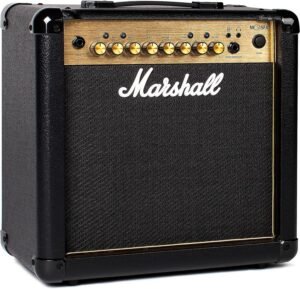
The Marshall MG30GFX Black & Gold offers multiple channels and built-in effects that allow musicians to move between different sonic landscapes without disrupting the creative flow.
Sometimes all it takes is a small tonal shift to unlock an entirely new idea.
Creating the Right Atmosphere for Creativity
Many songwriters talk about the importance of atmosphere.
Some prefer writing late at night.
Others enjoy early morning sessions before the day becomes busy.
Some need complete silence, while others surround themselves with instruments and recording equipment.
Regardless of individual preferences, the environment often influences creativity.
An amplifier capable of producing different moods can become part of that environment.
A touch of reverb can create a spacious feel.
Delay can add movement and rhythm.
Chorus can introduce texture that transforms simple chord progressions.
These subtle changes often influence the direction a song takes.
Mood Shapes Musical Decisions
Songwriting is not always a logical process.
Much of it comes from emotion and instinct.
The sounds available during a session can influence those instincts in interesting ways.
Different tones create different moods, and different moods often create different songs.
Moving Beyond Familiar Ideas
One challenge every songwriter faces is repetition.
The same chord progressions appear.
The same riffs emerge.
The same musical habits return again and again.
This is perfectly normal.
Every musician develops preferences and patterns over time.
However, introducing new sounds can help break those cycles.
Exploring a different channel or experimenting with an effect may encourage a guitarist to approach the instrument from a fresh angle.
A familiar progression suddenly feels different.
A standard riff evolves into something more interesting.
New sounds create opportunities for new musical decisions.
The Value of Experimentation
Not every songwriting session needs a clear destination.
Some of the most productive creative periods begin with simple experimentation.
Playing random chords.
Testing unusual note combinations.
Exploring effects.
Following ideas without worrying where they lead.
This playful approach often removes pressure from the process.
Instead of trying to write something impressive, musicians simply explore.
The MG30GFX supports this mindset by providing a variety of sounds within a single amplifier.
The result is less time adjusting equipment and more time following creative instincts.
Giving Yourself Permission to Explore
Creativity often flourishes when expectations disappear.
Many memorable songs begin as unfinished fragments.
A short melody.
A simple riff.
A chord sequence that feels interesting.
Experimentation creates space for those fragments to emerge naturally.
Capturing Different Musical Personalities
One of the most enjoyable aspects of songwriting is discovering different sides of your musical personality.
Some days call for energetic riffs.
Other days encourage atmospheric textures.
A player who usually writes straightforward rock songs may suddenly find inspiration in spacious effects and ambient sounds.
Likewise, someone known for clean tones might discover new ideas through heavier sounds.
Multiple channels create opportunities to explore these different identities without changing the entire setup.
The guitar becomes a vehicle for discovery rather than simply a tool for repetition.
Turning Practice Time Into Creative Time
Many musicians separate practice and songwriting into completely different activities.
In reality, the two often overlap.
A scale exercise may inspire a melody.
A rhythm drill could become the foundation of a song.
A warm-up riff might evolve into something worth developing.
When an amplifier encourages exploration, these transitions happen more naturally.
Practice stops feeling isolated from creativity.
Instead, every session contains the potential for new ideas.
This can make daily playing more rewarding because there is always the possibility of discovering something unexpected.
Building a Personal Sound
Songwriting is not only about creating songs.
It is also about developing a musical voice.
Over time, musicians begin identifying sounds, textures and tonal characteristics that resonate with them.
This process takes experimentation.
The ability to explore multiple channels and effects helps players understand what inspires them most.
Some may gravitate toward clean, spacious tones.
Others may prefer driven sounds with plenty of energy and character.
There are no right answers.
The goal is simply discovering what feels authentic.
Your Sound Evolves Over Time
Musical preferences rarely remain fixed.
What inspires a guitarist today may be different a year from now.
Exploring new sounds helps keep that evolution moving forward.
Each experiment adds another piece to a musician’s creative identity.
Making Home Playing More Productive
Not every guitarist has access to a professional studio or dedicated rehearsal space.
For many musicians, creativity happens at home.
The spare bedroom.
The home office.
The corner of a living room.
These spaces become songwriting environments.
An amplifier that combines flexibility and convenience fits naturally into these situations.
The auxiliary input can support backing tracks and musical references, while the range of available sounds encourages exploration without requiring additional gear.
The result is a setup that supports creativity whenever inspiration appears.
Inspiration Rarely Arrives on Schedule
One of the most important lessons songwriters learn is that inspiration cannot be forced.
Ideas arrive unexpectedly.
A random chord progression sparks interest.
A melody appears while experimenting with a new sound.
A simple practice session turns into an evening of writing.
The best approach is often to create conditions where inspiration has room to appear.
Having a versatile amplifier within easy reach helps support that process.
When experimentation feels effortless, creativity can flow more freely.
Supporting a Lifetime of Musical Ideas
Many guitarists begin playing because they love songs.
Eventually, some develop the desire to create their own.
Songwriting can be one of the most rewarding aspects of a musical journey because it allows players to transform ideas into something uniquely personal.
The Marshall MG30GFX Black & Gold naturally supports this creative process through its combination of channels, effects and practical home-playing features. Rather than focusing solely on amplification, it creates opportunities for exploration, experimentation and inspiration.
Whether developing complete songs, collecting riff ideas or simply enjoying an evening of creative discovery, the right sound can often be the spark that starts everything. For guitarists who enjoy chasing those moments of inspiration, having access to a variety of tones and textures can make every practice session feel full of possibility.
Check It Out!