
Universal Audio Volt 276 USB Audio Interface
As an Amazon Associate I earn from qualifying purchases.
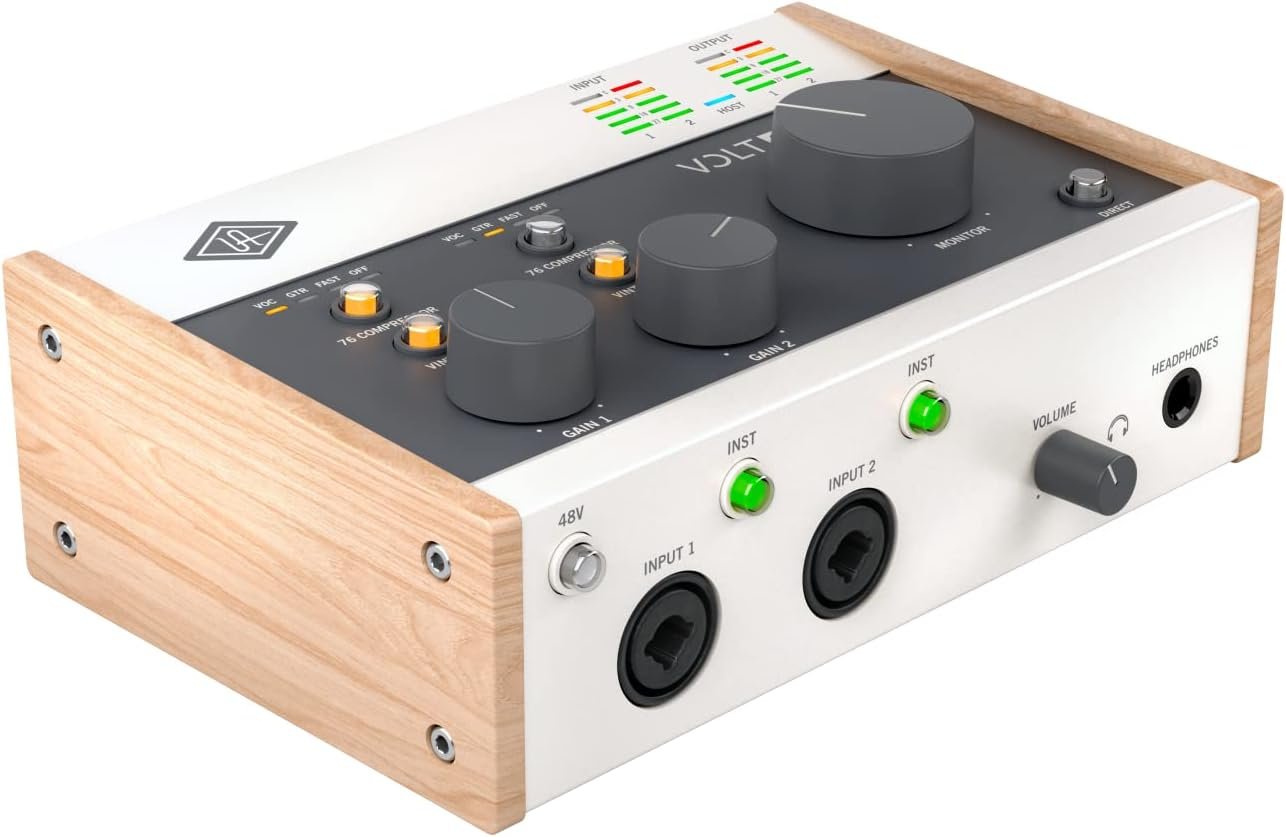
The Universal Audio Volt 276 USB Audio Interface brings traditional recording-studio character into a compact desktop unit. With two recording inputs, a vintage-inspired analogue preamp circuit and a built-in compressor, it offers guitarists and home musicians more than a straightforward connection between their instruments and a computer.
Designed for recording guitars, vocals, keyboards and other instruments, the Volt 276 combines 24-bit/192kHz audio conversion with hands-on controls that feel familiar rather than unnecessarily complicated.
Its Vintage mode draws inspiration from Universal Audio’s celebrated 610 valve preamp, while the built-in 76 Compressor uses analogue circuitry influenced by the company’s famous 1176 compressor.
For musicians working in a home studio, these features offer the opportunity to shape the sound before it reaches the recording software.
The appeal is not simply technical. The Volt 276 is designed to make recording feel more like making music and less like operating a computer.
Why It Works for Home Recording
A useful home recording interface should provide clean audio capture, practical connections and enough control to keep the musician focused on playing.
The Universal Audio Volt 276 approaches this with a relatively straightforward two-input design.
Both front-panel inputs accept microphones, instruments or line-level sources, allowing several common recording arrangements.
A guitarist can connect an electric guitar directly to one input, while a microphone can occupy the other.
Alternatively, the two inputs can capture a stereo keyboard or a pair of microphones.
This makes the Volt 276 particularly suitable for singer-songwriters, guitarists and musicians recording one or two sources simultaneously.
Its 24-bit audio conversion supports sample rates up to 192kHz, providing considerable flexibility for different recording projects.
For most home studios, recording at 44.1kHz or 48kHz is entirely reasonable. The higher available rates are useful options rather than requirements for making quality recordings.
The important benefit is that the interface provides a capable recording foundation without requiring an elaborate studio installation.
What It Feels Like to Use
The Volt 276 has a distinctive appearance.
Its grey metal enclosure, wooden side panels and large controls create a warmer, more traditional impression than many plain black audio interfaces.
The design feels visually connected to classic studio equipment, although the unit remains compact enough for an ordinary computer desk.
Measuring approximately 7.3 inches wide, 5.1 inches deep and 2.6 inches high, it takes up relatively little working space.
At approximately 1.8 pounds, it also has reassuring physical substance without becoming difficult to transport.
The top panel features clearly arranged gain controls, a large monitor-volume knob and illuminated buttons for the Vintage preamp and compressor.
The main connections are accessible from the front, making it convenient to change guitars, microphones or headphones without reaching behind the desk.
Separate headphone and monitor-volume controls are another practical detail.
For someone recording regularly, these small conveniences matter. They reduce the amount of time spent adjusting the equipment and allow more attention to remain on the performance.
The layout also avoids burying essential functions inside software menus.
Vintage Preamp Mode and Its Musical Character
One of the Volt 276’s most interesting features is its Vintage Mic Preamp mode.
Universal Audio designed this analogue circuit to provide tonal character inspired by its classic 610 valve microphone preamplifier.
It is not an actual valve preamp, but an analogue circuit intended to introduce some of the warmth and harmonic character associated with traditional recording equipment.
Each input has its own Vintage control, allowing the feature to be enabled independently.
This flexibility is useful when recording different sources.
A vocal may benefit from the additional character, while another instrument might be better captured with the Vintage circuit disabled.
Guitarists recording directly into software can also experiment with the preamp character before applying amplifier simulations or additional effects.
The important point is that Vintage mode is optional.
It provides another sound-shaping choice rather than forcing every recording through the same tonal character.
Players who prefer a more neutral signal can simply leave it switched off.
The Built-In 76 Analogue Compressor
The Volt 276’s analogue compressor is another feature that distinguishes it from simpler recording interfaces.
Inspired by Universal Audio’s 1176 compressor, the 76 circuit helps control changes in recording level before the audio enters the computer.
Compression can reduce the difference between louder and quieter passages, making performances more consistent and helping certain details remain audible.
Instead of requiring the user to adjust numerous compressor parameters, the Volt 276 provides three selectable presets.
VOC: Designed primarily for vocals, with compression characteristics suited to controlling singing dynamics.
GTR: Intended for guitars and bass, allowing transients to pass while helping sustain feel more consistent.
FAST: Uses particularly fast compression characteristics for more assertive control.
These modes can be used creatively with different sources rather than being restricted to their suggested applications.
For example, a guitarist might experiment with the VOC setting on acoustic guitar or try the FAST setting on a more aggressive electric guitar part.
Each channel has its own compressor control.
The practical advantage is speed. Instead of spending time configuring a complicated plug-in, the musician can select a suitable compression character directly from the interface.
However, because this is analogue processing applied before recording, its effect becomes part of the captured audio.
That makes sensible gain adjustment particularly important.
Recording Electric and Acoustic Guitars
The Volt 276 makes considerable sense for guitarists building a home recording setup.
Its instrument inputs support the high-impedance connection required by electric guitars and basses.
A guitar can therefore be connected directly to the interface without requiring a separate DI box for ordinary recording.
Once inside the computer, the signal can be processed through compatible amplifier-modelling software, effects plug-ins or a digital audio workstation.
This arrangement is useful when recording at home without using a loud conventional guitar amplifier.
For acoustic guitar, the microphone preamps provide another recording option.
Connecting a suitable microphone allows the player to capture the instrument’s natural acoustic sound, while the second input remains available for another source.
The interface also provides switchable 48V phantom power for condenser microphones that require it.
For guitarists who want more specialised instrument-input controls, our IK Multimedia AXE I/O ONE Guitar Audio Interface article explores an alternative designed specifically around guitar and bass recording.
Direct Monitoring and Comfortable Recording
One common frustration when recording through a computer is latency.
This is the slight delay that can occur between playing a note and hearing it through the recording software.
Even a small delay can make guitar playing or singing feel uncomfortable.
The Volt 276 addresses this with direct monitoring.
Instead of sending the input signal through the computer’s processing system before returning it to the headphones, direct monitoring allows the incoming signal to be heard directly from the interface.
The Volt provides both mono and stereo direct-monitoring arrangements.
This is useful when recording a single vocal or guitar, or when capturing two inputs as a stereo pair.
It helps musicians concentrate on timing and performance rather than compensating for distracting delays.
However, direct monitoring does not include effects being generated inside the recording software.
If a guitarist needs to hear a software amplifier simulation while performing, software monitoring may still be necessary.
The interface provides the choice, allowing users to select the monitoring method appropriate to their recording setup.
Connections and Studio Flexibility
The rear panel includes stereo monitor outputs for connecting suitable powered studio speakers or an external amplification system.
There is also MIDI input and output through traditional five-pin connections.
These are useful for connecting compatible keyboards, controllers, drum machines and other MIDI equipment.
USB-C connectivity handles communication with the computer.
The Volt 276 is class-compliant and supports compatible Mac, Windows and mobile recording systems.
It normally receives power through a suitable USB connection, although some mobile devices and computer connections may require an external 5V supply.
Universal Audio includes a USB-A to USB-C cable and a USB-A to barrel power cable.
These connections make the Volt 276 adaptable to different home studio arrangements without demanding a large number of additional interfaces.
Recording Software and Everyday Workflow
The Volt 276 works with compatible digital audio workstations, including Universal Audio’s LUNA recording software.
Universal Audio also offers a selection of recording plug-ins and software with the interface, although the current included package and eligibility requirements should be checked before purchasing.
For someone starting a home studio, having suitable recording software available is useful.
However, the real advantage of the Volt 276 is its physical recording workflow.
The musician connects an instrument, selects the appropriate input, adjusts the gain and chooses whether to engage Vintage mode or compression.
From there, the recording software handles capturing, editing and mixing the performance.
The hardware provides enough creative control to influence the sound without attempting to replace an entire recording studio.
The Drawbacks
The Universal Audio Volt 276 has several attractive features, but its two-channel format and analogue processing introduce limitations worth understanding.
These become particularly important for musicians planning to expand their home recording arrangements.
Only Two Recording Inputs
The most obvious limitation is the number of simultaneous recording inputs.
Two channels are sufficient for recording a guitar and vocal, a stereo keyboard or two microphones.
However, they quickly become restrictive when recording a complete band or a drum kit using several microphones.
There are no additional analogue recording channels waiting to be enabled, and the interface lacks digital input expansion such as ADAT.
Anyone expecting to record multiple musicians simultaneously may find that a larger interface would be a more practical long-term investment.
For solo musicians, two inputs may be perfectly adequate. For expanding studios, they can become the first significant restriction.
The Compressor Has Limited Adjustment
The built-in 76 Compressor is convenient, but it does not provide the detailed controls found on a standalone studio compressor.
There are no independent attack, release, ratio or threshold adjustments.
Instead, users select between the three prepared operating modes or switch compression off.
This makes the feature approachable but less flexible for experienced recording engineers.
Some performances require particularly gentle compression, while others benefit from more precise control over transients and dynamics.
The Volt’s presets provide useful starting points, but they cannot accommodate every possible recording requirement.
Those wanting detailed compression settings will still need suitable software or external processing equipment.
Analogue Compression Cannot Be Undone
This is one of the most important considerations.
The Volt 276 applies its analogue compressor before the signal is recorded.
Once that compressed signal has been captured, its original dynamics cannot simply be restored by disabling a plug-in.
Excessive compression can flatten the natural expression of a performance, particularly with acoustic instruments or vocals.
The compressor may also increase the signal level, making it necessary to readjust the input gain to avoid clipping.
For inexperienced users, there is a temptation to engage compression simply because the feature is available.
A better approach is to begin with conservative settings, listen carefully and leave the compressor disabled when it is not needed.
The same principle applies to Vintage mode: recording a coloured signal is a creative decision that should be made deliberately.
Direct Monitoring Has Limitations
Direct monitoring eliminates the delay associated with sending an input signal through recording software.
However, it also bypasses software-based processing for the monitored input.
For example, a guitarist using a software amplifier simulation may hear a clean direct guitar signal instead of the processed amplifier sound when relying on hardware direct monitoring.
To hear the simulated amplifier while performing, the player may need to enable monitoring inside the recording software.
That reintroduces the possibility of latency, depending on the computer, software and buffer settings.
The Volt therefore offers useful monitoring flexibility, but it does not completely eliminate every latency-related issue.
There Is Only One Headphone Output
The Volt 276 includes a dedicated headphone amplifier, but only one physical headphone connection.
This is perfectly adequate for someone recording alone.
However, recording a singer while another person operates the computer can become less convenient.
Both people may want to hear the performance, sometimes at different listening levels.
Accommodating this requires additional equipment such as a headphone amplifier.
The interface also does not provide independent headphone mixes for different performers.
For collaborative recording, these limitations can become noticeable.
Phantom Power Is Shared
The interface supplies 48V phantom power to both XLR microphone inputs together.
It cannot be independently enabled for only one microphone channel.
For many recording arrangements, this causes no difficulty.
However, users combining different microphone types need to understand the electrical requirements of their equipment.
Certain ribbon microphones and specialist devices may require particular care around phantom power.
Universal Audio advises switching phantom power off before connecting or disconnecting microphones.
This is not an unusual limitation for a compact interface, but it is worth recognising.
Limited Physical Output Expansion
The Volt 276 provides one stereo pair of monitor outputs.
That suits a straightforward desktop studio with a pair of powered monitors.
However, users wanting to connect several independent speaker systems, external effects processors or complicated routing arrangements may find the available outputs restrictive.
MIDI connectivity adds useful flexibility for electronic instruments, but MIDI connections do not create additional audio recording channels.
For a growing studio, an interface with more physical inputs and outputs may prove more adaptable.
Mobile Recording May Require Extra Power
The Volt 276 can work with compatible tablets and phones, but its power requirements deserve attention.
A normal computer USB connection can usually supply the necessary power.
Some mobile devices, adapters and USB hubs may not provide enough.
In those circumstances, an external 5V power connection may be required.
This means a portable recording arrangement can become less convenient than expected, particularly when travelling with limited charging facilities.
Checking device compatibility and available power connections before relying on a mobile setup is sensible.
No Built-In Guitar Amplifier Modelling
Although the Volt 276 includes a Vintage preamp circuit and analogue compressor, it is not a standalone guitar amplifier modeller.
It does not provide built-in guitar amplifier simulations, speaker cabinet emulation or a complete selection of guitar effects.
Guitarists wanting convincing amplified tones will need suitable software, an external processor or another appropriate signal chain.
The Volt captures and processes audio, but it does not replace every piece of equipment required to create a finished electric guitar sound.
Software Setup Still Takes Time
The interface is designed to be approachable, but beginning home recording involves more than plugging in a USB cable.
Users may need to install drivers, configure recording software, activate software licences and select the correct audio inputs and outputs.
Newcomers also need to understand gain staging, monitoring and recording levels.
The physical controls are straightforward, but the surrounding recording system still has a learning curve.
Universal Audio provides guidance and supporting software, yet buyers should expect some initial setup before everything works comfortably.
Who It Suits Best
The Universal Audio Volt 276 is particularly suitable for guitarists, singer-songwriters and home musicians who mainly record one or two sources at a time.
Its analogue Vintage mode and compressor appeal to people interested in shaping their recorded sound before reaching for software processing.
The sturdy desktop construction and straightforward controls also suit musicians who prefer hands-on equipment.
However, those wanting a simpler interface without analogue compression may find our Focusrite Scarlett Solo 4th Gen Audio Interface article useful when considering alternatives.
Players expecting to record full bands or manage complicated studio monitoring systems should consider equipment with more channels and expansion options.
Is the Universal Audio Volt 276 Worth the Studio Space?
The Universal Audio Volt 276 combines capable audio conversion, practical recording connections and genuinely interesting analogue processing in an attractive compact enclosure.
Its Vintage preamp mode and 76 Compressor provide creative options that are not normally available on the simplest recording interfaces.
The physical controls, independent headphone volume and direct monitoring make it particularly appealing for regular home recording.
Its limitations are equally important. Two inputs, one headphone output and restricted compressor adjustment mean it is not intended to replace a larger professional studio interface.
Nevertheless, for guitarists and musicians who value straightforward recording with some traditional analogue character, the Volt 276 provides a thoughtfully designed solution.
It is a useful choice for someone who wants to spend more time recording performances and less time navigating complicated equipment.
Explore more microphones, interfaces and recording equipment in our Recording & Studio collection.
As an Amazon Associate I earn from qualifying purchases.


3 Comments
Comments are closed.