Keeley Compressor Plus Pedal
As an Amazon Associate I earn from qualifying purchases.
Some guitar pedals make an immediate impression with dramatic distortion, swirling modulation or long atmospheric echoes. A good compressor works differently. Its contribution can be more subtle, helping notes sustain, balancing uneven playing levels and giving a guitar sound greater consistency.
The Keeley Compressor Plus Pedal is designed to offer that control without sacrificing the natural character of the instrument.
Built in the USA, this analogue compressor combines four familiar controls with a useful pickup selector and a Blend function that allows the original guitar signal to remain part of the sound.
For guitarists who appreciate expressive clean tones, controlled dynamics and a little extra sustain, the Keeley offers a carefully considered approach to tone shaping.
Why Compression Deserves a Place on Your Pedalboard
A compressor works by controlling differences in signal level.
Louder notes can be reduced relative to quieter ones, helping produce a more consistent overall sound.
This can be particularly useful when moving between delicate picking, rhythm chords and more forceful playing.
Compression can also increase the perceived sustain of individual notes, allowing them to remain audible for longer as their natural volume fades.
For clean guitar playing, that additional consistency can make melodic passages and chord sequences feel more balanced.
The Keeley Compressor Plus combines traditional compression with an expander and sustainer circuit, giving players considerable flexibility over how the effect responds.
Rather than simply making every note sound equally loud, the pedal allows the guitarist to decide how much compression is appropriate.
That flexibility is one reason the Keeley has become a familiar choice among musicians who want a compressor suitable for regular use rather than an occasional special effect.
Four Controls That Shape the Sound
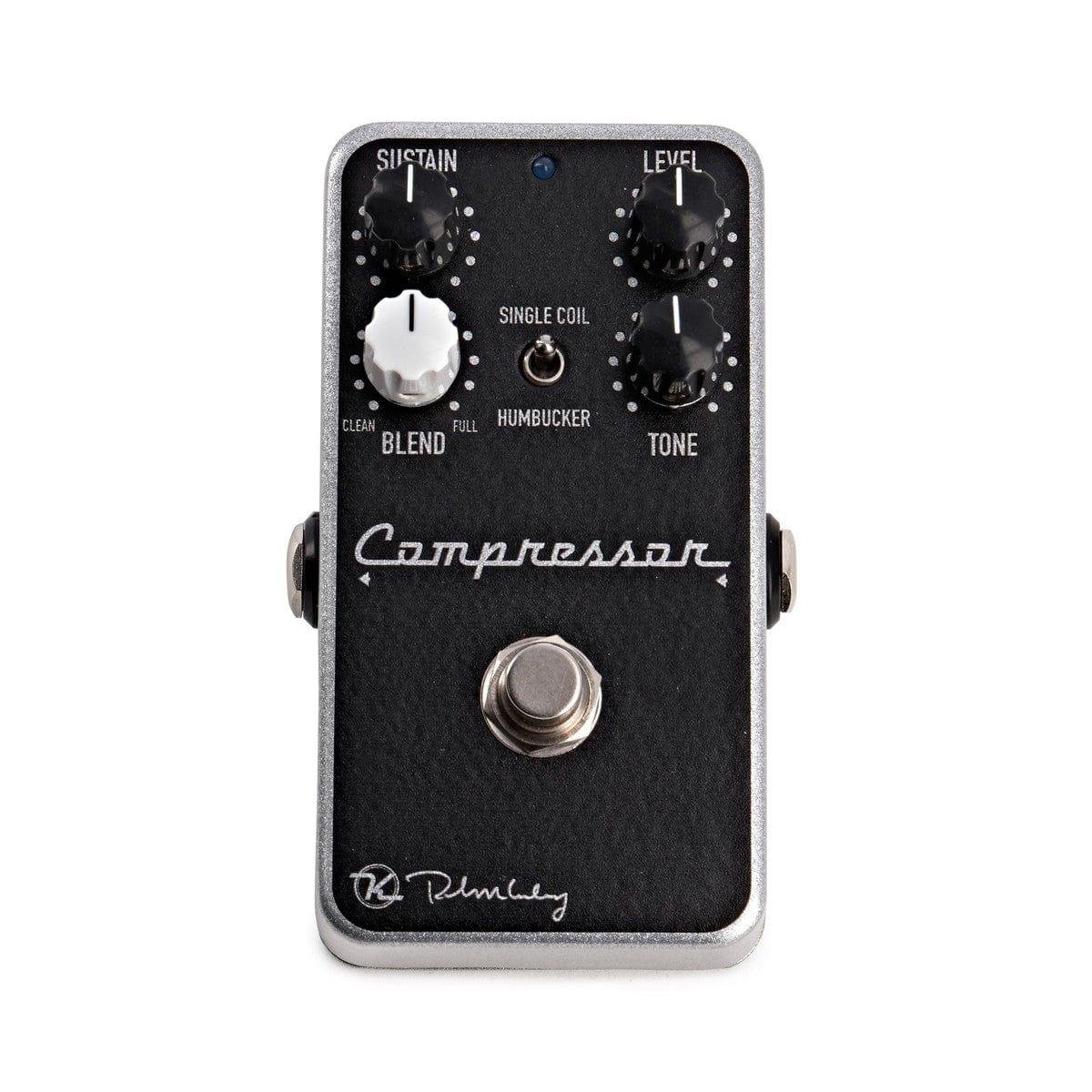
The Keeley Compressor Plus features Sustain, Level, Blend and Tone controls.
Each performs a distinct function, allowing the pedal to be adjusted around different guitars and playing styles.
Sustain determines the amount of compression and helps extend the audible life of notes.
Lower settings can provide gentle dynamic control, while increasing Sustain produces a more pronounced compressed character.
Level adjusts the output volume, allowing the compressed signal to be balanced against the bypassed guitar or used for additional output boost.
Blend is particularly important because it mixes the processed signal with the original, uncompressed guitar sound.
This allows the player to retain some of the natural attack of their picking while benefiting from the compressor’s sustain.
Tone adjusts the brightness of the output and can help restore high-frequency detail that may become less prominent during compression.
Together, these controls provide a useful range of sounds without requiring complicated digital menus.
The physical knobs also make adjustments straightforward, particularly for musicians who prefer listening and making small changes rather than managing presets.
The Blend Control Makes a Real Difference
One of the strongest reasons to consider the Compressor Plus is its parallel compression capability.
Traditional compression can sometimes reduce the differences between soft and forceful playing.
That is useful when an even sound is wanted, but it can also make a guitar feel less expressive if the effect is applied too heavily.
The Keeley’s Blend control offers another approach.
By mixing part of the original signal back into the compressed sound, the player can preserve more of the natural picking attack while adding sustain underneath.
This is especially appealing for clean rhythm playing, fingerstyle passages and melodic guitar work.
A guitarist can use compression to support notes without necessarily making every phrase sound heavily processed.
The result depends on the chosen settings and playing technique, but the available control makes the Keeley more adaptable than a compressor offering only basic intensity adjustment.
It also complements other effects within a guitar signal chain.
For example, our MXR Carbon Copy Analog Delay M169 article explores a different type of tone enhancement, adding warm repeats and atmosphere rather than controlling dynamics.
Used thoughtfully, compression and delay can contribute different qualities to the same guitar sound.
Designed for Single-Coil and Humbucker Guitars
Not all guitar pickups behave alike.
Single-coil pickups and humbuckers can differ considerably in output, tonal balance and the way they drive an effects pedal.
Keeley addresses this with a small toggle switch offering settings labelled Single Coil and Humbucker.
The switch changes the compressor’s attack and release behaviour to suit the general characteristics of those pickup types.
This helps the pedal accommodate guitars with different outputs without requiring the user to adjust a collection of additional timing controls.
For someone who regularly changes between a Stratocaster-style guitar and a humbucker-equipped instrument, this is a particularly convenient feature.
It also makes the Compressor Plus approachable for players who are unfamiliar with detailed compressor settings.
Rather than working through complicated attack and release adjustments, they can begin with the setting appropriate to their guitar.
The remaining controls then allow the sound to be refined.
Compact Analogue Construction
The Keeley Compressor Plus follows the familiar compact stompbox format.
Its metal enclosure measures approximately 112 × 68 × 51mm and weighs around 280g.
That makes it suitable for a conventional pedalboard without occupying an excessive amount of space.
The black enclosure, silver detailing and clearly arranged controls give the pedal an understated professional appearance.
Its substantial metal housing is appropriate for equipment intended to be operated by foot, while the straightforward layout keeps the important controls accessible.
The pedal uses an entirely analogue signal path and includes true-bypass switching.
When disengaged, the effect is bypassed rather than remaining permanently active in the guitar signal.
The Keeley operates from a suitable 9V centre-negative power supply or a 9V battery, with a low current requirement of approximately 10mA.
These specifications make it relatively straightforward to incorporate into a conventional guitar pedalboard.
For players interested in more elaborate signal arrangements, our BOSS IR-2 Amp & Cabinet guide explores another compact pedal that can serve as the amplifier and cabinet section of a modern guitar setup.
Useful for More Than One Playing Style
Compression is often associated with country guitar, funk rhythm playing and clean studio sounds.
However, the Keeley Compressor Plus is not limited to those applications.
Blues players may appreciate additional sustain for expressive single-note phrases.
Clean rhythm guitarists can use gentle compression to balance chord attacks.
Funk players can explore tighter, more consistent picking dynamics.
Ambient musicians may find compression helpful when creating sustained layers that feed into delay and reverb effects.
The Level control also allows the pedal to provide additional output when required.
Because the available settings range from restrained to more obvious compression, the pedal can be adapted to different musical preferences.
The attraction lies in being able to refine an existing guitar sound rather than completely replace it with something unfamiliar.
The Drawbacks
The Keeley Compressor Plus is a capable and thoughtfully designed pedal, but compression is not universally useful, and its particular approach has limitations worth understanding before buying.
Compression can reduce natural playing dynamics.
This is the most important consideration.
A guitarist’s touch naturally creates variations in volume and attack.
Those differences can be an essential part of expressive playing.
Compression reduces some of that variation, which can be beneficial when a more consistent sound is wanted.
However, excessive compression can make soft and hard picking sound too similar.
Players who particularly enjoy the unrestricted response of a guitar plugged directly into a valve amplifier may find that heavy settings change the feel of their playing.
The Blend control helps manage this compromise, but it does not eliminate the fundamental behaviour of compression.
High Sustain settings can increase audible noise.
As the compressor increases gain around quieter parts of the signal, background noise may become more noticeable.
Single-coil pickup hum, amplifier hiss and noise from other pedals can become more apparent when sustaining notes or between phrases.
Keeley’s own instructions caution that higher Sustain settings can produce additional noise when the guitarist is not playing.
This is not necessarily a defect.
It reflects the way compression and sustain processing affect the signal.
Good cables, suitable power supplies and sensible control settings remain important.
The effect may initially seem too subtle.
Someone accustomed to distortion, chorus or dramatic delay effects may expect the Compressor Plus to produce an equally obvious transformation.
At moderate settings, compression can be comparatively difficult to identify.
Its contribution may become more apparent through note consistency, sustain and the relationship between soft and forceful playing.
Beginners may therefore need time to understand what they are hearing and how each control changes the result.
For some musicians, a compressor is an essential finishing touch.
For others, the improvement may not feel significant enough to justify another pedal.
The pickup selector is not continuously adjustable.
Keeley provides two attack and release behaviours through its Single Coil and Humbucker switch.
This simplifies operation, but it also limits detailed adjustment.
Studio-style compressors and more advanced guitar pedals sometimes provide independent controls for attack and release timing.
The Compressor Plus does not offer that level of precision.
Players who want to shape compressor timing in considerable detail may prefer a more sophisticated design.
The Keeley instead prioritises approachable operation and musical flexibility.
There is no display or preset storage.
Every adjustment is made using the physical controls.
This is convenient for musicians who prefer a traditional analogue pedal, but it means favourite settings cannot be recalled electronically.
If the guitarist uses several radically different compression arrangements, those settings need to be adjusted manually.
There is also no display showing exact parameter values.
A photograph of the knob positions may be helpful when returning to a particular sound.
It requires space and suitable power.
Although relatively compact, the Compressor Plus is another physical component within the guitar signal chain.
It requires instrument connections and either a suitable 9V centre-negative supply or battery operation.
The external power supply is not included as standard.
While the current requirement is modest, guitarists using several pedals must still consider their complete power distribution arrangement.
The metal enclosure is manageable in size, but even small pedals contribute to the weight and complexity of a larger board.
Compression does not replace overdrive or distortion.
The Level control can provide additional output and potentially push the next stage of the signal chain harder.
However, the Compressor Plus is not designed as a dedicated distortion or overdrive pedal.
Someone seeking aggressive saturation, heavy crunch or dramatic tonal changes will still require suitable additional equipment.
Its central purpose is dynamic control, sustain and tonal refinement.
Expecting it to behave like an entirely different category of effect would lead to disappointment.
Heavily distorted guitar sounds may benefit less.
Distortion already introduces compression as part of its behaviour.
When a heavily overdriven amplifier or high-gain pedal is producing substantial sustain and reduced dynamic range, adding another compressor may provide comparatively little benefit.
It may also increase noise or make the sound feel unnecessarily compressed.
The Keeley can still be useful in particular arrangements, but guitarists who play almost exclusively with high-gain distortion should consider whether a separate compressor is a priority.
The pedal cannot correct every aspect of playing technique.
Compression may help balance differences in note level, but it cannot replace accurate timing, controlled picking or careful muting.
In some circumstances, heavy compression can actually make unwanted string noise more audible.
Players developing their technique should regard the effect as a useful musical tool rather than a solution to inconsistent performance.
The best position in the signal chain may require experimentation.
Compressors are commonly placed early in the effects chain, often before overdrive and modulation pedals.
However, the final sound changes depending on the position of the compressor relative to other effects.
Placing compression before distortion can alter how the distortion responds.
Placing it elsewhere may influence noise, attack and overall dynamics.
There is no single arrangement that suits every guitarist.
Anyone using a complicated pedalboard should expect some experimentation before finding a suitable position.
Not every guitarist needs an always-on compressor.
The Keeley is particularly attractive to players who appreciate controlled dynamics and additional sustain.
However, some musicians prefer the completely uncompressed response of their instruments.
Others may already achieve sufficient sustain through their amplifier and existing pedals.
A compressor is not an essential purchase simply because it is popular.
Its usefulness depends on the player’s sound, technique and musical requirements.
These considerations help define the Keeley Compressor Plus as a specialist tone-shaping tool rather than a universal improvement for every guitar rig.
Who Will Appreciate the Keeley Compressor Plus?
The Compressor Plus is especially appealing to guitarists who enjoy clean and lightly driven sounds.
Country, funk, blues and expressive melodic playing can all benefit from controlled sustain and carefully balanced dynamics.
Its Blend control makes it suitable for musicians who want to preserve some of their natural picking character while adding compression.
The pickup selector is also useful for players who alternate between single-coil and humbucker guitars.
Home recording enthusiasts may appreciate the ability to make their guitar signal more consistent before it reaches other equipment.
Compression can also be useful when building layered guitar arrangements.
Our Electro-Harmonix 720 Stereo Looper article explores how musicians can create repeating phrases and overdubs for practice, songwriting and performance.
A thoughtfully adjusted compressor can be one part of that broader creative setup.
For more equipment ideas, explore our guitar pedals guides, covering effects designed to shape, enhance and expand your guitar sound.
Is the Keeley Compressor Plus Worth Buying?
The Keeley Compressor Plus combines the familiar appeal of an analogue stompbox with genuinely useful control over sustain and playing dynamics.
Its four-knob arrangement is straightforward, while the Blend control provides a particularly valuable way to balance compression with the original guitar signal.
The pickup selector also makes it convenient for musicians who regularly use different guitars.
It is not an effect that everyone needs, and its contribution can be much more subtle than distortion, delay or modulation.
Nevertheless, for guitarists who want smoother note levels, additional sustain and greater control over their clean or lightly driven sounds, the Keeley deserves serious consideration.
It offers a refined approach to guitar compression without turning a traditional pedalboard into something unnecessarily complicated.
As an Amazon Associate I earn from qualifying purchases.