MXR Carbon Copy Analog Delay M169
As an Amazon Associate I earn from qualifying purchases.
The MXR Carbon Copy Analog Delay M169 is aimed at guitarists who want delay to add warmth and space without turning their pedalboard into a control centre. Its straightforward layout keeps things simple, while the analogue circuitry gives the repeats a softer, darker character that sits behind the original guitar signal rather than fighting with it.
It can handle everything from a short slapback to longer atmospheric repeats, making it useful for players who want one delay pedal that can cover several different jobs.
Why it works for guitar
Delay can easily become too prominent, particularly when playing with distortion or in a busy mix. The Carbon Copy takes a different approach. Its repeats naturally soften as they continue, allowing the dry guitar tone to remain at the front.
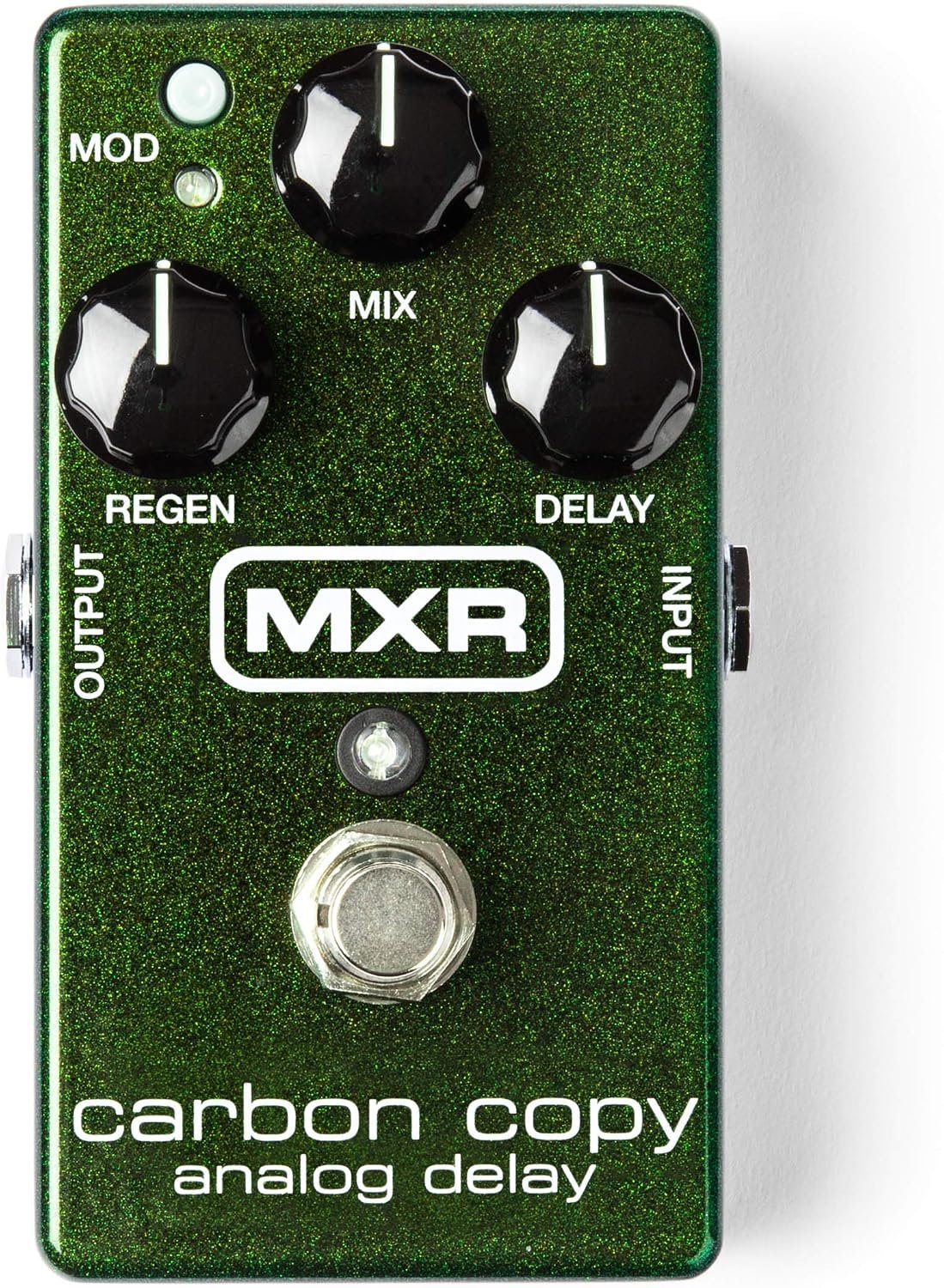
Three main controls handle Mix, Regen and Delay. Mix determines how much delay you hear, Regen controls the number of repeats, and Delay changes the time between the original note and the repeat.
There is also a modulation switch. Turning it on adds movement to the delayed signal, giving the repeats a slightly wavering quality that can add width and atmosphere without changing the basic character of the guitar.
For everyday playing, that simple arrangement is one of the pedal’s strongest qualities. You can make useful changes quickly without having to work through menus, presets or displays.
What it feels like to use
The Carbon Copy has the reassuringly solid feel associated with a traditional compact stompbox. There are only three large control knobs, one small modulation button and the footswitch, so very little gets between you and the sound.
For a subtle delay, the Mix can be kept fairly low with only a few repeats behind the guitar. This adds depth without making the delay obvious.
Increase the Regen and Delay controls and the pedal becomes much more atmospheric. Chords can trail away behind each other, while single-note lines gain a thicker sense of space.
The modulation option changes the texture again. Rather than producing perfectly clean, clinical repeats, it can give them a gently moving quality reminiscent of older echo effects.
That slightly dark, rounded character is an important part of the Carbon Copy’s appeal. The repeats feel more like a layer underneath the guitar than a duplicate of the original note.
The drawbacks
The simplicity that makes the Carbon Copy appealing also places some limits on it.
There are no presets. If you regularly switch between several carefully dialled-in delay settings during a performance, you will have to adjust the controls manually. Guitarists who need instant access to multiple delay sounds may be better served by a more advanced digital delay.
The maximum delay time is also more modest than that offered by many modern digital pedals. This isn’t usually an issue for conventional slapback, lead and ambient guitar sounds, but players experimenting with very long delays may eventually want more range.
The darker analogue repeats will not suit everyone either. If you want every repeat to sound almost identical to your original guitar signal, a clean digital delay is likely to be a better match. The Carbon Copy deliberately allows the echoes to soften and lose some definition.
Its modulation controls are another compromise. You can switch modulation on and off from the front of the pedal, but deeper adjustment of its speed and width is handled internally. Players who constantly alter modulation settings may find that less convenient than having dedicated controls on the top panel.
There is also no tap-tempo footswitch. For players who need delay times precisely matched to different song tempos on stage, that omission is worth considering.
None of these limitations makes the Carbon Copy particularly difficult to use. They simply reflect what the pedal is designed to be: a straightforward analogue delay rather than an all-purpose programmable delay workstation.
Who it suits best
The MXR Carbon Copy makes most sense for guitarists who value sound and simplicity over a long feature list.
It suits blues, rock, country and alternative players who want a little slapback or ambience, but it can also produce much larger atmospheric sounds when the delay and regeneration are increased.
It is particularly attractive if you prefer pedals with physical controls that can be adjusted by ear. There is no screen to read and no menu structure to remember. You turn the controls until the guitar sits where you want it.
Players building a relatively traditional pedalboard should also appreciate the compact format. It gives you genuine analogue delay without requiring a large amount of pedalboard space.
Is it worth the pedalboard space?
For a guitarist who wants warm analogue delay without unnecessary complexity, the MXR Carbon Copy Analog Delay M169 remains an appealing option.
Its strength isn’t the number of features it can offer. It is the combination of simple controls and the way its softer repeats sit naturally around the guitar.
If presets, tap tempo and pristine digital repeats are priorities, another type of delay will make more sense. But for players who want to step on a pedal, add anything from a hint of depth to a wash of echo, and carry on playing, the Carbon Copy has a very clear purpose.
Explore more pedals and tone-shaping gear in our Effects & Pedals section.
As an Amazon Associate I earn from qualifying purchases.