Squier Classic Vibe 60s Jazz Bass – Daphne Blue
As an Amazon Associate I earn from qualifying purchases.
Some bass guitars have a character that is immediately recognisable, even before the first note is played. The Squier Classic Vibe ’60s Jazz Bass in Daphne Blue is one of those instruments.
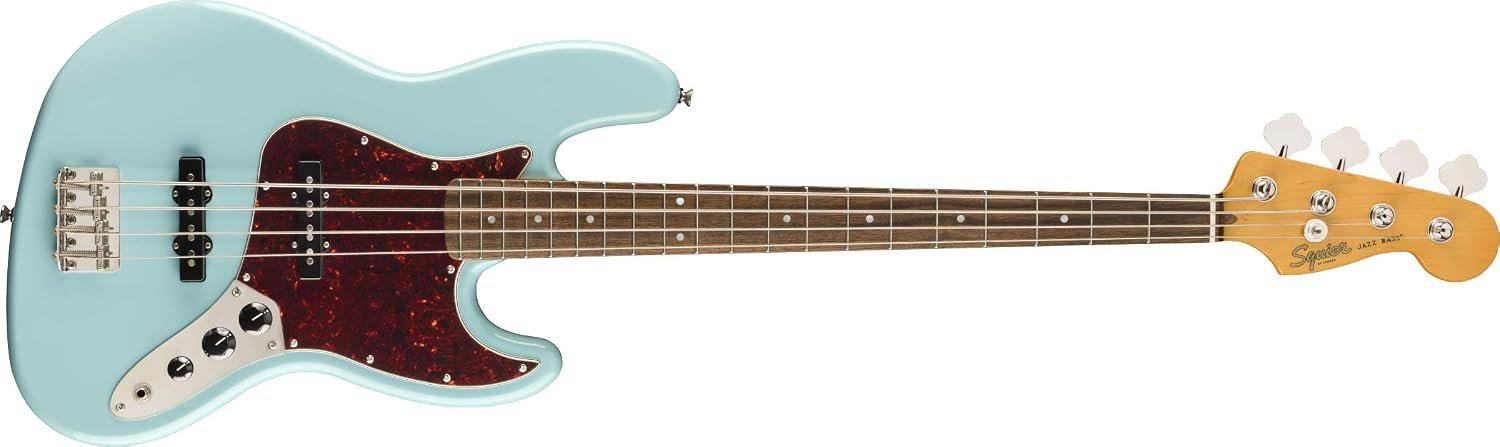
Inspired by the original Fender Jazz Bass designs of the 1960s, it combines a traditional offset body, slim maple neck, two Fender-designed Alnico single-coil pickups and vintage-style hardware.
The soft blue finish, tortoiseshell pickguard and aged-looking neck give it an attractive, understated appearance that feels connected to the history of electric bass.
But this isn’t simply an instrument chosen for its looks.
The Classic Vibe ’60s Jazz Bass offers the familiar versatility of a dual-pickup Jazz Bass, with independent volume controls that allow players to explore different tonal combinations.
For bassists interested in traditional styling, expressive playing and a straightforward instrument without complicated electronics, it deserves consideration.
Why it works as a versatile electric bass
The Jazz Bass design has remained popular because it combines a comfortable playing layout with a broad range of usable sounds.
The Squier Classic Vibe ’60s follows that established formula.
Its poplar body uses the familiar offset-waist Jazz Bass shape, while the contoured construction is intended to sit comfortably against the player.
The maple neck features a slim C-shaped profile, with a 9.5-inch-radius Indian laurel fingerboard and 20 narrow-tall frets.
These proportions give the instrument a relatively approachable feel for a full-scale bass.
The 34-inch scale length is traditional, providing familiar spacing and string tension for standard bass tuning.
Two Fender-designed Alnico single-coil pickups offer the classic Jazz Bass sound, with individual volume controls for each pickup and a shared tone control.
This arrangement allows players to move between fuller, rounded sounds and more articulate, bridge-focused tones without relying on active electronics.
For musicians who enjoy adjusting their sound directly from the instrument, the simple control layout is particularly appealing.
What it feels like to play
The narrow neck is one of the most attractive features of a traditional Jazz Bass.
At the nut, the Classic Vibe ’60s measures approximately 38.1mm, giving it a noticeably slimmer feel than many Precision Bass designs.
That difference can be especially welcome for players moving from a six-string electric guitar.
Although the full 34-inch scale still requires the familiar reach of a conventional bass, the narrower neck provides a comfortable starting point for fingerstyle playing.
The maple neck has a vintage-tinted gloss finish.
Visually, this creates the warm, aged appearance associated with older Fender instruments.
The glossy surface also gives the neck a smooth, polished feel beneath the fretting hand.
Some musicians enjoy that traditional finish, while others prefer the drier sensation of satin.
The Indian laurel fingerboard introduces a darker surface that contrasts attractively with the maple neck.
Narrow-tall frets offer a slightly different feel from low, vintage-style frets, providing enough height for controlled fretting without introducing the more pronounced feel of jumbo fretwire.
The offset body shape is designed to provide a comfortable playing position, particularly when seated.
As with any full-sized bass, actual weight and balance can vary between individual instruments.
A suitable strap and proper playing position remain important during longer sessions.
Two Alnico pickups with traditional controls
The pickup configuration is central to the character of this bass.
Squier uses two Fender-designed Alnico single-coil pickups, positioned in the traditional neck and bridge locations.
Each pickup has its own volume control, with a third knob providing master tone adjustment.
This may look simple compared with modern active bass systems, but it offers considerable flexibility.
With both pickups operating together, the bass can produce the balanced, familiar Jazz Bass character associated with countless recordings.
Emphasising the neck pickup generally creates a fuller, rounder sound that works well for traditional fingerstyle bass lines.
Increasing the contribution of the bridge pickup adds a more focused midrange character, which can be useful for articulate playing and parts that need to remain clearly defined.
The tone control allows the player to soften the upper frequencies when a warmer response is preferred.
These changes can be made quickly without navigating menus, selecting presets or relying on batteries.
For comparison, our Fender American Professional II Precision Bass guide explores an instrument with a different pickup arrangement and tonal character.
The Jazz Bass places greater emphasis on blending two separate pickup positions, while the traditional Precision Bass approach is centred around its distinctive split-coil pickup.
Neither arrangement is universally better. They offer different ways of shaping the foundation of a musical performance.
Vintage-inspired construction and appearance
The Daphne Blue finish gives this Squier much of its personality.
It’s a softer, more restrained colour than many modern metallic guitar finishes, providing a pleasing contrast with the four-ply tortoiseshell pickguard.
The black pickup covers and control knobs complement the darker fingerboard.
Nickel-plated hardware and vintage-style tuning machines complete the traditional appearance.
The bridge uses a four-saddle vintage-style arrangement with threaded steel saddles.
Individual saddles allow the string height and intonation to be adjusted, while the threaded design provides some flexibility in string positioning.
At the headstock, the period-inspired Squier graphics reinforce the instrument’s 1960s influence.
The result is a bass that looks familiar without appearing overly elaborate.
There are no unnecessary switches, coloured displays or decorative features competing for attention.
For someone who enjoys classic instruments, that restraint is part of the attraction.
Playing through amplifiers and recording equipment
The Classic Vibe Jazz Bass uses passive electronics, meaning its pickups operate without an onboard battery.
A standard instrument cable connects the bass to an appropriate bass amplifier, effects processor or recording interface.
The two-pickup arrangement makes it useful for different musical settings.
A warmer neck-focused sound can provide a comfortable foundation for blues, soul and slower arrangements.
Blending both pickups produces a versatile everyday bass tone.
The bridge pickup can introduce additional definition for funk, more prominent bass lines and detailed recording work.
For players wanting additional sound-shaping options, our Valeton Dapper Bass guide explores a bass-focused preamp and multi-effects unit.
An external effects system can add compression, overdrive and other processing without requiring the instrument itself to contain active electronics.
The Squier is equally suitable for musicians who prefer a simpler arrangement.
A good bass amplifier, appropriate cable and thoughtful playing technique are enough to explore its traditional character.
For home recording, the instrument can also be connected directly to a suitable audio interface.
Our IK Multimedia AXE I/O ONE guide explains a recording interface designed with guitar and bass players in mind.
Direct recording allows bass parts to be captured without placing a microphone in front of an amplifier, although the final sound will still depend on monitoring, gain settings and any processing used.
The drawbacks
The Squier Classic Vibe ’60s Jazz Bass has several attractive qualities, but its traditional design also introduces compromises.
The first consideration is the full 34-inch scale length.
Although the slim neck makes the bass relatively approachable, the instrument is still a conventional full-scale bass.
Players moving from a six-string electric guitar will notice the longer distance between frets, particularly towards the nut.
First-position stretches can require more effort, especially for musicians with smaller hands or limited experience playing bass.
The longer neck also makes the instrument less convenient to transport than a short-scale bass.
Someone looking primarily for a compact instrument for occasional home playing may find a smaller design more comfortable.
The gloss neck finish won’t suit everyone.
Squier’s vintage-tinted gloss finish looks attractive and reinforces the traditional appearance.
However, heavily polished neck finishes can feel slightly sticky to some players, especially when their hands become warm during longer sessions.
A satin-finished neck often feels drier and allows the hand to move with less noticeable surface resistance.
This is largely a matter of personal preference, but it’s worth considering for bassists accustomed to modern satin necks.
The Vintage Tint appearance is appealing, but visual character and playing comfort aren’t always the same thing.
Traditional single-coil pickups can introduce unwanted noise.
The Classic Vibe ’60s uses two passive single-coil pickups rather than a completely noiseless pickup system.
Depending on the pickup-volume settings and surrounding electrical environment, some hum may become audible.
When both pickups are blended appropriately, their combined operation can help cancel certain types of interference.
However, that doesn’t guarantee completely silent performance under every condition.
Recording near computers, power supplies, lighting equipment or poorly shielded electronics can make unwanted noise more noticeable.
Players who regularly use substantial gain or compression should consider this limitation.
There are no active electronics or onboard EQ.
The passive control system is simple, reliable and easy to understand.
Nevertheless, players accustomed to modern active basses may miss having dedicated bass, middle and treble controls.
The single tone knob primarily changes the upper-frequency response.
It doesn’t provide the same immediate flexibility as an onboard multi-band equaliser.
More extensive adjustments must be made through the amplifier, external effects or recording equipment.
For musicians who prefer to shape everything directly from the instrument, this may feel restrictive.
The bridge is traditional rather than modern.
The four-saddle threaded bridge fits the bass’s vintage appearance, but it lacks some features found on more elaborate modern bridge systems.
Individual saddles allow normal height and intonation adjustments, yet the design may not provide the same substantial feel or adjustment convenience as certain high-mass bridges.
Players who regularly experiment with unusual string gauges or precise string spacing may prefer another arrangement.
As with any bridge, careful setup remains important.
The vintage styling shouldn’t be interpreted as a guarantee that every instrument will arrive perfectly adjusted.
Its 20-fret fingerboard limits the highest available notes.
Twenty frets are entirely sufficient for many traditional bass-playing styles.
Most rhythm and accompaniment work takes place well below the highest positions.
However, bassists who enjoy extended soloing, tapping or more technically demanding upper-register playing may prefer an instrument with 22 or 24 frets.
The Jazz Bass body shape also doesn’t offer the same upper-fret accessibility as certain modern bass designs with deeper cutaways and sculpted neck joints.
For traditional bass playing, this may be unimportant.
For more specialised techniques, the limitation becomes more noticeable.
The instrument isn’t especially lightweight by design.
A full-sized Jazz Bass has a substantial body, long neck and four relatively large tuning machines.
Although the body contours improve comfort, the instrument may still feel physically demanding during extended standing performances.
Individual instrument weights can vary, so it’s difficult to guarantee how a particular example will balance.
A wide, comfortable strap may help distribute the weight more effectively.
Bassists who have experienced shoulder or back discomfort may want to compare it with lighter instruments before deciding.
The factory setup may need attention.
String height, neck relief, intonation and pickup height all influence how comfortably a bass plays.
An instrument arriving from a warehouse may not have exactly the setup an individual player prefers.
A slightly high action can make fretting unnecessarily tiring.
An action set too low may produce unwanted fret buzz, particularly when the player uses a stronger picking attack.
The threaded bridge saddles and adjustable truss rod provide ways to correct the setup, but inexperienced owners may prefer professional assistance.
A good setup can make a substantial difference to the playing experience.
The supplied strings may not suit every playing style.
Fender specifies nickel-plated steel strings in a .045–.105 gauge for this model.
That’s a familiar standard set, but string preference varies considerably.
Some players prefer lighter strings for reduced finger resistance.
Others favour heavier gauges or flatwound strings for a different feel and tonal response.
Changing strings can alter the balance and setup of the instrument, particularly when moving to a significantly different gauge.
This isn’t a problem unique to the Squier, but it’s worth considering when judging the bass straight from the box.
The glossy body finish needs sensible care.
Daphne Blue is visually attractive, especially beside the tortoiseshell pickguard.
However, glossy polyurethane surfaces can reveal fingerprints, fine scratches and ordinary handling marks.
The pickguard provides some protection where the playing hand moves, but the rest of the body remains exposed to straps, clothing and nearby equipment.
A suitable instrument cloth and careful storage can help preserve the appearance.
The pale finish may also make certain marks more noticeable than on a darker instrument.
The vintage-style tuning machines are functional but fairly conventional.
They provide the familiar appearance associated with older Jazz Bass instruments.
However, players looking for ultralight tuners, modern locking mechanisms or unusually compact hardware won’t find those features here.
Tuning stability also depends on correct string installation, nut condition and proper setup.
The tuning machines alone cannot compensate for strings that have been poorly fitted or insufficiently stretched.
It’s not supplied as a complete playing setup.
The standard Fender specification does not include a dedicated bass amplifier, hard case or gig bag.
Anyone purchasing their first bass will need to consider those essentials separately.
A guitar amplifier is not automatically a suitable alternative to a bass amplifier, particularly when playing at higher volumes.
Bass frequencies place different demands on speakers and cabinets.
A proper bass amp or suitable recording arrangement is therefore important for enjoying the instrument safely and effectively.
Finally, the Classic Vibe’s vintage character won’t appeal to everyone.
The passive pickups, traditional bridge, glossy neck and restrained controls are deliberate design choices.
They make the instrument feel closely connected to an earlier generation of Jazz Bass models.
However, bassists interested in modern active electronics, extended-range tuning, unusually light construction or advanced switching may prefer something more contemporary.
A traditional bass can be versatile without being the right instrument for every player.
The important thing is to choose it for its familiar sound and straightforward design rather than expecting it to provide every modern feature.
Who it suits best
The Squier Classic Vibe ’60s Jazz Bass is particularly suitable for players who appreciate traditional bass design and want a useful selection of classic sounds.
Its slim neck may appeal to guitarists moving into bass playing, although the full-scale length still requires adjustment.
The passive electronics and familiar control layout make it suitable for musicians who prefer straightforward operation.
It should appeal to players interested in rock, blues, funk, soul, pop and general-purpose bass playing.
Home-recording musicians may also appreciate being able to adjust the blend between the two pickups before capturing a direct signal.
Its Daphne Blue finish gives the instrument additional personality without introducing unusual construction or unnecessary electronics.
For musicians exploring other plugged-in instruments, our Electric Guitars guides cover a range of traditional and modern designs with different playing characteristics.
Is it worth the guitar space?
The Squier Classic Vibe ’60s Jazz Bass in Daphne Blue offers an appealing interpretation of a familiar instrument.
Its traditional body shape, slim maple neck, Indian laurel fingerboard and Fender-designed Alnico pickups provide a useful foundation for everyday bass playing.
The separate pickup-volume controls give musicians a straightforward way to explore different tones, while the vintage hardware and understated finish create an attractive overall appearance.
There are compromises.
The full-scale neck won’t suit everyone, the glossy finish is a matter of personal taste, and the passive single-coil pickups can introduce unwanted noise in certain situations.
Players seeking advanced onboard electronics or particularly modern features may find another bass more appropriate.
Nevertheless, for musicians who want a traditional Jazz Bass experience without unnecessary complexity, the Classic Vibe ’60s offers a convincing combination of familiar design, usable sounds and distinctive styling.
Its appeal isn’t built around elaborate technology.
It’s a bass that encourages players to concentrate on their technique, their tone and the music they want to make.
As an Amazon Associate I earn from qualifying purchases.