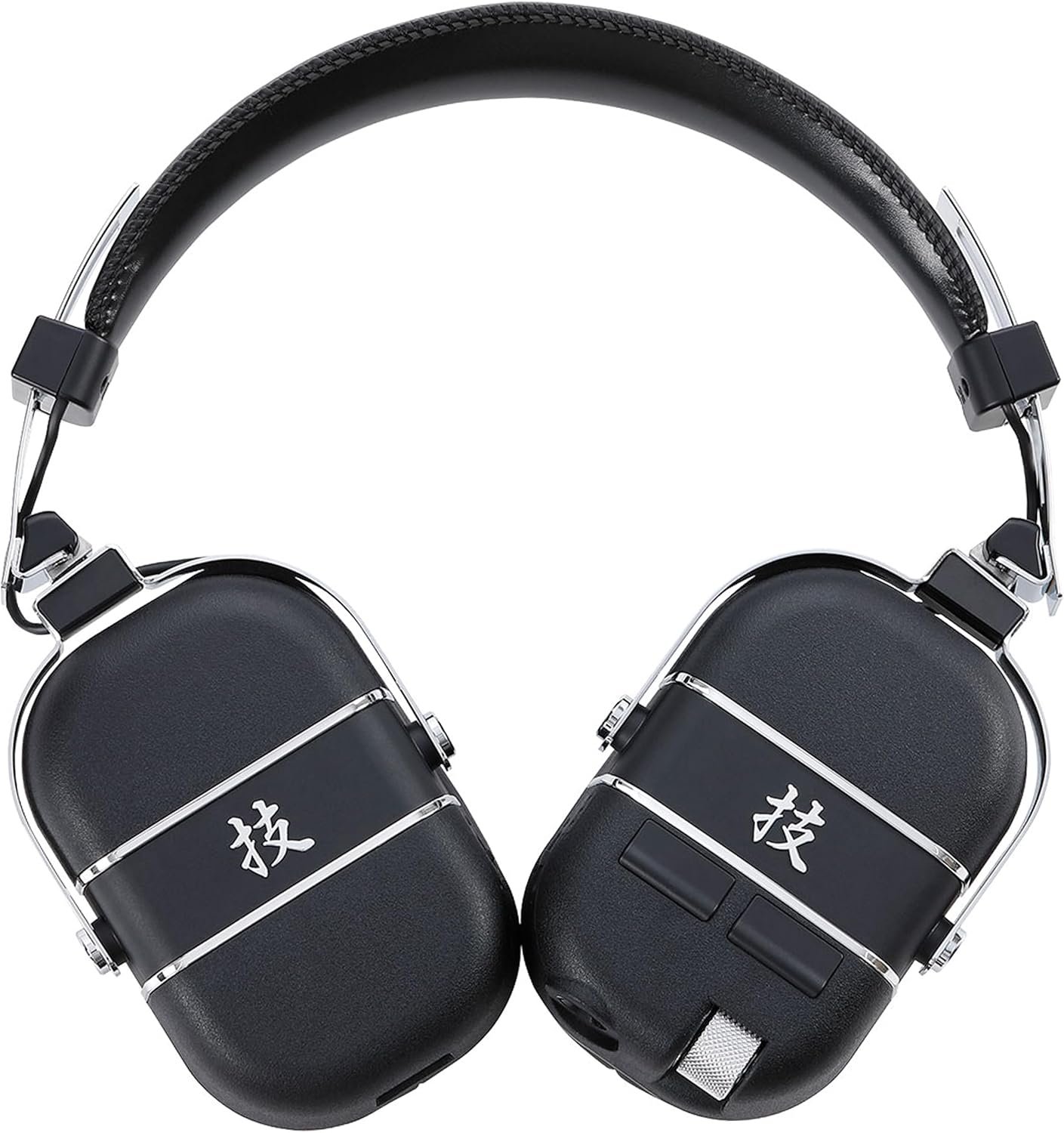
BOSS Waza-Air Wireless Guitar Headphones
As an Amazon Associate I earn from qualifying purchases.
The BOSS Waza-Air Wireless Guitar Headphones offer a rather different approach to personal guitar practice. Instead of connecting an ordinary pair of headphones to an amplifier, BOSS has combined a complete guitar amplification system, effects processor and wireless listening arrangement into one over-ear design.
The result is a self-contained practice system that allows guitarists to play without a conventional amplifier or trailing instrument cable.
Its most distinctive feature is BOSS’s spatial audio technology, which uses an integrated gyro sensor to create the impression of playing through an amplifier positioned within a virtual room.
Alongside that technology are five amplifier types, more than 50 effects, Bluetooth music playback and programmable tone memories.
For guitarists who want to practise quietly without reducing everything to the flat, close-up sound sometimes associated with headphone playing, the Waza-Air offers an interesting alternative.
However, it is important to understand what this system does well and where its limitations become apparent.
It is primarily a dedicated personal guitar-playing system rather than a conventional pair of Bluetooth headphones or a replacement for a complete home recording setup.
Why it works for personal guitar practice
Playing electric guitar at home often involves compromises.
A conventional guitar amplifier can sound excellent at a reasonable volume, but that volume may not be suitable for every household.
Apartments, shared accommodation and homes with young children can make regular amplified practice difficult.
Even a small amplifier may be too loud when used late in the evening.
Connecting headphones to an amplifier is one solution, but it introduces another problem.
The sound heard through conventional headphones can feel very different from the sound of an amplifier operating in a room.
There is no physical speaker moving air nearby, and the sound arrives directly at the ears rather than interacting with the surrounding space.
For some players, this can make headphone practice feel isolated or unnatural.
The BOSS Waza-Air attempts to improve that experience.
It uses dedicated guitar amplification processing together with spatial audio technology intended to create a more convincing sense of position and room ambience.
The guitar connects wirelessly using the included transmitter.
The headphones process the signal internally, providing amplifier sounds and effects without requiring a separate pedalboard or guitar amplifier.
This arrangement is particularly convenient when a guitarist wants to pick up an instrument and practise for a short period.
There is no amplifier to position, no speaker volume to negotiate and no instrument cable running across the floor.
The system is designed around the experience of playing rather than simply listening to recorded music.
Wireless guitar connection without an instrument cable
The Waza-Air includes a BOSS WL-T wireless transmitter.
This plugs into the guitar’s output jack and sends the instrument signal directly to the headphones.
The guitar connection uses BOSS’s proprietary 2.4 GHz digital wireless technology rather than ordinary Bluetooth audio.
That distinction is important.
Conventional Bluetooth audio can introduce noticeable latency when used to monitor a live instrument.
Even a relatively small delay between playing a note and hearing it can make guitar practice uncomfortable.
BOSS designed the Waza-Air wireless guitar connection for low-latency instrument monitoring.
The aim is to preserve a responsive playing experience without requiring a physical cable between the guitar and headphones.
Setting up the system involves connecting the transmitter to the headphones for the automatic wireless connection procedure and then inserting it into the guitar.
Once configured, the transmitter and headphones communicate wirelessly.
This arrangement gives the player considerably more freedom of movement than a conventional wired headphone setup.
It can be useful when practising standing up, moving around the room or working through exercises without being restricted by a cable.
The transmitter also has its own rechargeable battery.
However, wireless operation is still subject to the usual considerations surrounding rechargeable equipment, compatible instrument sockets and possible interference in busy wireless environments.
Five amplifier types derived from BOSS Katana technology
The Waza-Air uses amplifier sounds developed from BOSS’s Katana amplifier technology.
There are five amplifier types, providing a range of tonal characters suitable for different playing styles.
Clean is intended for clear, natural guitar sounds.
It provides a useful starting point for chord playing, melodic passages and techniques where the character of the guitar and the player’s touch should remain prominent.
Clean sounds are particularly useful when practising timing, articulation and note separation.
Crunch offers a more driven response.
This is appropriate for blues, classic rock and rhythm guitar playing where a degree of natural distortion helps create a fuller sound.
It allows picking dynamics to remain an important part of the performance.
Lead provides a broader range of gain, extending from driven tones into higher-gain sounds.
This makes it useful for guitarists practising sustained single-note lines, solos and more aggressive rhythm passages.
Brown provides the higher-gain character associated with BOSS’s Waza Brown amplifier voicing.
It is intended for players who want a more saturated, assertive guitar sound.
The fifth setting is Flat/Bass/Acoustic, which provides a wider-range response suitable for acoustic-electric guitar, bass guitar and other appropriate electronic instruments.
This is a useful addition because the headphones are not limited entirely to conventional electric guitar sounds.
The range of amplifier types makes it possible to move between clean playing, blues, rock and more heavily driven styles without connecting several different pieces of equipment.
However, the Waza-Air should not be confused with a large standalone guitar amplifier.
It recreates amplifier characteristics through digital processing and headphones.
The physical sensation of playing through an actual speaker cabinet remains different.
More than 50 built-in effects
Amplifier modelling is only part of the Waza-Air’s capability.
BOSS also provides access to more than 50 effects through its Tone Studio app.
These include familiar guitar effects such as overdrive, distortion, modulation, delay and reverb.
For a guitarist who normally uses several pedals, this can be particularly useful.
Instead of connecting a drive pedal, chorus, delay and reverb to a practice amplifier, the Waza-Air can provide a selection of those sounds internally.
Overdrive and distortion allow further adjustment of the guitar’s driven character.
Modulation effects introduce movement and texture.
Chorus can add width to clean guitar parts, while other modulation sounds can create more dramatic tonal movement.
Delay provides repeating echoes that can be used for rhythmic playing, lead passages and atmospheric sounds.
Reverb adds a sense of space to the guitar signal.
These effects are useful for practising the types of sounds used in finished songs.
A player working on a lead guitar passage may want delay and reverb rather than a completely dry signal.
Someone learning clean rhythm parts might prefer a little chorus.
The Waza-Air allows these combinations to be created and stored without requiring a separate pedalboard.
The main limitation is that detailed editing depends on the smartphone app.
This makes the effects system flexible, but less immediately hands-on than a collection of conventional pedals with dedicated controls.
Immersive 3D spatial audio
The most unusual feature of the BOSS Waza-Air is its spatial audio processing.
Traditional headphones generally present sound directly to the left and right ears.
Even when high-quality amplifier modelling is used, the experience can feel as though the guitar sound is located inside the listener’s head.
BOSS approaches this differently.
The Waza-Air uses an integrated gyro sensor to track movement of the player’s head.
Its processing then changes the apparent position of the guitar sound to create the impression of an amplifier within a virtual space.
The intention is to reproduce some of the directional and environmental cues associated with playing through a guitar amplifier in a room.
This can make the experience feel less like ordinary headphone monitoring.
It is an interesting idea because the relationship between a guitarist and an amplifier is not purely about frequency response.
The direction from which the sound appears to arrive can also influence the playing experience.
BOSS offers three principal spatial settings: Surround, Static and Stage.
Each takes a different approach to the virtual environment.
The experience remains a simulation, and individual reactions will vary, but the technology is what makes the Waza-Air different from a conventional headphone amplifier.
Surround, Static and Stage modes
Surround mode places the guitar sound within a virtual room.
The aim is to create a wider, more spacious listening environment than the close presentation associated with ordinary headphones.
This can be appealing during general practice because it provides a more open sense of the instrument’s sound.
Static mode uses the gyro sensor to create a more fixed impression of an amplifier’s position.
As the player moves their head, the apparent relationship between the listener and the virtual amplifier changes.
This is intended to resemble the experience of sitting or standing in a room with an amplifier positioned in a particular location.
The sound does not simply remain locked to the ears in the usual headphone arrangement.
Stage mode creates a virtual performance environment with the guitar amplifier appearing behind the player.
This is particularly interesting when practising alongside music.
The guitar and accompanying audio can be presented in a way intended to resemble playing with a band.
For someone accustomed to rehearsing through a traditional amplifier, Stage mode offers a different perspective from ordinary headphone listening.
The three modes are not simply different amounts of reverb.
They alter the spatial presentation of the sound.
This makes experimentation worthwhile, as one mode may feel more natural or comfortable than another.
There is no requirement to use the most dramatic setting.
For some players, a relatively subtle spatial arrangement will be more useful than a pronounced virtual environment.
Playing along with backing tracks
The Waza-Air also supports Bluetooth audio streaming from a compatible smartphone or tablet.
This allows guitarists to play along with songs, backing tracks and suitable practice material.
The guitar signal uses the dedicated BOSS wireless transmitter, while the accompanying audio arrives through Bluetooth.
Both can be heard through the headphones.
This arrangement is particularly useful for practising rhythm and timing.
Instead of playing alone, a guitarist can work through songs while listening to the accompanying music.
Backing tracks can also provide a more musical context for practising scales, chord changes and improvised solos.
A blues guitarist might use a simple backing track to practise phrasing.
Someone learning rock rhythm guitar could play along with a favourite recording.
A beginner could use suitable lesson audio while concentrating on the instrument.
The Waza-Air provides controls for Bluetooth playback and volume, reducing the need to handle the phone for every basic adjustment.
Separate guitar-volume control helps the player balance the instrument against the accompanying audio.
This makes the system a practical learning tool as well as a personal amplification device.
It is important to distinguish between Bluetooth music playback and recording.
The ability to receive backing tracks wirelessly does not turn the headphones into an audio interface for capturing guitar performances.
That requires a different arrangement.
BOSS Tone Studio app
The BOSS Tone Studio app is an important part of the Waza-Air system.
Available for compatible iOS and Android devices, it provides access to detailed amplifier, effects and spatial audio settings.
The app allows the guitarist to adjust amplifier parameters, select effects and create personal tone combinations.
It can also be used to manage the six available tone memories.
This makes it possible to prepare different settings for particular instruments or playing styles.
For example, one memory could contain a clean sound with a little reverb.
Another could use a lightly driven amplifier with delay.
A third might provide a more saturated lead sound.
The app also allows users to manage saved tones and access additional sound content through BOSS’s supporting services.
This gives the Waza-Air more flexibility than would be possible using only a handful of controls on the headphones.
However, it introduces an important dependency.
Anyone wanting to make detailed sound adjustments will need a suitable mobile device and a working connection to the app.
For guitarists comfortable with modern digital equipment, this may be entirely normal.
For players who prefer to adjust amplifier controls and pedals directly, it may feel less convenient.
The app adds significant capability, but it is also part of the system’s overall complexity.
Six programmable tone memories
The Waza-Air provides six onboard tone memories.
Each can store a customised arrangement of amplifier settings, effects and spatial audio preferences.
These memories can be recalled directly from the headphones.
This is particularly useful once the guitarist has created a few reliable practice sounds.
A player could save a clean rhythm setting, a blues tone, a classic-rock crunch sound and a higher-gain lead sound.
The remaining memories could be used for more specialised effects or a different instrument.
Once stored, these settings can be selected without repeatedly opening the Tone Studio app.
This makes everyday practice considerably more convenient.
It also helps maintain consistency.
Rather than spending the first part of every session trying to recreate a favourite sound, the player can recall it and begin practising.
Six memories will be sufficient for many home guitarists.
However, players accustomed to large multi-effects processors with extensive preset libraries may find the onboard capacity restrictive.
The Tone Studio app provides additional organisation options, but the number of directly accessible memories remains limited.
Built-in guitar tuner
The Waza-Air includes a guitar-tuning function.
The headphones provide audible indications that help the player determine whether a string is sharp, flat or correctly tuned.
This is useful because a separate tuner is not essential for basic practice.
The tuner can be activated using the headphone controls.
BOSS Tone Studio also provides a visual chromatic tuner, which may be more convenient for players who prefer to see the pitch displayed.
The built-in arrangement is particularly useful for someone who wants a compact practice system without carrying additional accessories.
However, the audible tuning method may feel unfamiliar to guitarists accustomed to conventional pedal tuners.
Some players will prefer the visual feedback provided through the app.
Nevertheless, including a tuner helps make the Waza-Air a more complete personal guitar practice system.
What it feels like to use
The Waza-Air uses an over-ear headphone design with large, custom-designed 50 mm drivers.
These are intended to provide a full sound for both guitar playing and music listening.
The earcups use conforming pads, while the headband is designed to distribute pressure across the top of the head.
The headphones also have a folding design.
The earcups can be swivelled into a flatter arrangement, making the system easier to store or carry in suitable luggage.
This matters because guitar practice headphones are likely to be used in different situations.
They may be brought out for short evening sessions, carried to another room or packed alongside a guitar when travelling.
The absence of an instrument cable is a genuine practical advantage.
There is no need to remain physically connected to an amplifier or processor.
The guitar itself also remains easier to handle without a lead trailing from the output jack.
The headphones include controls for guitar volume, Bluetooth playback and changing tone memories.
These provide access to the most frequently used functions without requiring constant interaction with a phone.
For more detailed sound adjustments, the Tone Studio app remains necessary.
Comfort is naturally a personal matter.
The shape of the player’s head, the fit of the earcups and the length of the practice session will all influence how comfortable the headphones feel.
Although the design is intended for extended use, over-ear headphones can become warm during lengthy sessions.
The Waza-Air is therefore best viewed as a convenient practice system whose fit and comfort should still be considered carefully.
Battery life and charging
Both the headphones and the wireless guitar transmitter contain rechargeable lithium-ion batteries.
BOSS specifies approximately five hours of continuous use for the headphones.
The included WL-T transmitter has a longer specified operating time of approximately 12 hours.
Actual battery performance depends on conditions and usage.
The difference between the two figures is worth understanding.
Although the transmitter may continue operating for substantially longer, the headphones themselves will normally require charging sooner.
BOSS specifies a charging time of approximately three hours for each component.
The headphones and transmitter are charged using USB connections.
BOSS has used different headphone charging-port arrangements across production periods, so buyers should check the specific unit and supplied cables rather than assuming every Waza-Air uses the same USB connector.
The system also includes standby and wake functions intended to conserve battery power.
These are useful when the headphones are left unused between practice sessions.
For occasional playing, the battery arrangement may be perfectly satisfactory.
For someone who practises for many hours every day, regular charging will become part of the routine.
The important point is that this is a rechargeable wireless system, not a conventional pair of headphones that can be left connected to an amplifier indefinitely.
The drawbacks
The BOSS Waza-Air offers an unusual and appealing approach to guitar practice, but several limitations deserve serious consideration.
The first drawback is the relatively modest headphone battery life.
BOSS specifies approximately five hours of continuous use.
For short daily practice sessions, this may be entirely sufficient.
However, a guitarist spending several hours practising, learning songs or working through material may reach the limit sooner than expected.
The transmitter’s longer battery life does not solve this, because both components must have sufficient charge for wireless guitar operation.
A player who forgets to recharge the headphones may find the system unavailable when it is needed.
This is different from using conventional wired headphones with a mains-powered guitar amplifier.
The Waza-Air also requires time to recharge.
Someone who frequently practises at unpredictable times will need to develop a regular charging routine.
There is also no conventional wired guitar-input alternative.
The Waza-Air is designed around its wireless transmitter.
It does not provide the familiar arrangement of connecting an instrument cable directly to an amplifier input on the headphones.
This makes the supplied transmitter an essential part of the guitar-playing system.
If it is misplaced, damaged or uncharged, the headphones cannot simply be connected to the guitar using an ordinary cable.
That is a practical limitation compared with conventional headphone amplifiers or multi-effects processors.
The wireless convenience is appealing, but it introduces dependence on a separate electronic component.
Anyone travelling with the Waza-Air should take particular care to keep the transmitter safely stored.
The transmitter may not fit every guitar comfortably.
BOSS designed the WL-T for common guitar output-jack arrangements.
Nevertheless, guitars with recessed, unusually positioned or non-standard jack sockets can create compatibility problems.
Certain active pickup wiring arrangements can also require special consideration.
A transmitter that fits a conventional Stratocaster-style or Les Paul-style guitar may not sit equally comfortably on every instrument.
The location of the jack can affect whether the transmitter projects awkwardly from the body or interferes with the player’s movement.
For owners of unusual guitar designs, this deserves checking before purchase.
An instrument’s appearance alone is not enough to guarantee perfect transmitter compatibility.
Wireless operation can also be affected by the surrounding environment.
The system uses a 2.4 GHz digital wireless connection.
This is a commonly used frequency range shared by various wireless devices.
In particularly busy environments, other equipment may compete for wireless capacity.
BOSS incorporates automatic wireless connection technology, but no consumer wireless system should be assumed to operate without interruption in every possible location.
Where wireless problems occur, repositioning equipment or repeating the connection procedure may be necessary.
For home practice in a relatively straightforward environment, this may never become a significant issue.
For someone who values an entirely predictable signal path, a wired connection remains simpler.
The spatial audio effect may not appeal to everyone.
The Waza-Air’s gyro-controlled audio positioning is its most distinctive feature.
It is also one of the most subjective.
Some guitarists may enjoy the impression of an amplifier positioned in a virtual room.
Others may prefer a conventional headphone sound that remains fixed and centred.
The movement of the apparent sound position can initially feel unusual.
In Static or Stage modes, turning the head changes the perceived relationship between the player and the virtual amplifier.
Although this is intentional, it may not feel natural to everyone.
A guitarist accustomed to studio headphones or direct monitoring may actually prefer a more familiar presentation.
The Waza-Air is attractive partly because of its immersive processing, but that does not mean every player will prefer it.
The head-tracking system may occasionally require adjustment.
Because the spatial presentation depends on gyro-sensor information, the perceived sound position may need resetting or recalibration during use.
BOSS provides controls for managing the gyro system.
Nevertheless, this introduces another element that is absent from ordinary guitar amplifiers.
Someone who simply wants to hear a consistent guitar sound without thinking about virtual positioning may find the additional adjustment unnecessary.
The system is designed to create a particular experience.
It is not the most straightforward route to conventional headphone monitoring.
The Tone Studio app is necessary for detailed editing.
This is another significant consideration.
The Waza-Air provides useful onboard controls, but extensive adjustments to amplifier sounds, effects and spatial settings are handled through the app.
That means access to a compatible smartphone or tablet is important.
A player who dislikes using mobile devices while practising may not enjoy this arrangement.
Bluetooth pairing and app connectivity can also introduce occasional inconvenience.
Software updates and changes in mobile operating systems may affect the experience over time.
The headphones can recall stored settings independently, but creating and refining those settings is more convenient through Tone Studio.
For a guitarist who prefers physical amplifier knobs and dedicated effects pedals, this dependence on an app may be a genuine disadvantage.
Six onboard memories may be restrictive for some players.
Six stored tones provide a useful selection for home practice.
They could accommodate several clean, crunch and high-gain sounds without difficulty.
However, a guitarist who regularly uses many songs with different tone requirements may need a larger collection of presets.
Modern multi-effects processors can often provide much more extensive onboard storage.
The Waza-Air is designed primarily for personal practice, so its six memories are understandable.
Nevertheless, someone expecting it to manage a large performance setlist may find the arrangement limiting.
Changing between saved sounds is convenient only when the required sounds are already available in the onboard memory positions.
The amplifier and effects controls are less immediate than physical pedals.
A traditional amplifier gives the guitarist direct access to controls such as gain, bass, middle, treble and master volume.
Effects pedals normally provide individual knobs for adjusting their most important functions.
With the Waza-Air, much of that control is transferred to a smartphone screen.
This allows sophisticated editing without making the headphones physically bulky.
However, it changes the relationship between the player and the equipment.
Some musicians enjoy experimenting with digital menus and stored presets.
Others prefer to reach down, turn a knob and hear the result immediately.
The Waza-Air is better suited to someone comfortable with digital editing.
It is less appealing to players who want to make every adjustment directly on the hardware.
The system is not a replacement for a dedicated recording interface.
This is particularly relevant for musicians who enjoy recording at home.
The Waza-Air is designed to provide personal guitar amplification and monitoring.
Its Bluetooth connection allows music playback from a mobile device, while its dedicated transmitter carries the guitar signal to the headphones.
That does not mean the system can function as a conventional computer audio interface.
It lacks the usual recording outputs and USB audio capabilities found on equipment specifically designed for home recording.
A guitarist who wants to record guitar directly into music-production software will generally need a suitable audio interface or another recording device.
This limitation does not undermine the Waza-Air’s practice capabilities.
It simply means the product should be selected for the purpose it was designed to perform.
The headphones do not reproduce the physical experience of a guitar amplifier.
The spatial processing creates an impression of an amplifier operating within a virtual room.
However, headphones cannot reproduce every aspect of playing through a physical speaker cabinet.
A traditional guitar amplifier interacts with the room and produces sound that reaches the entire body.
The player may feel low-frequency energy and changes in air pressure.
The Waza-Air recreates aspects of the listening experience using digital processing, but it does not physically move air around the room in the same way.
This distinction matters for guitarists who are particularly sensitive to the response of a loud amplifier.
Someone expecting the exact sensation of standing beside a driven valve amplifier may be disappointed.
The Waza-Air is better understood as a sophisticated alternative for private playing rather than a complete physical replacement.
It is not designed primarily for critical studio mixing.
The Waza-Air contains dedicated amplifier modelling, effects and spatial processing.
These are excellent features for personal guitar practice.
However, they are not the characteristics normally prioritised when choosing neutral studio-monitoring headphones.
For critical mixing, engineers generally want consistent reproduction without unnecessary tonal or spatial processing.
The Waza-Air is intended to make guitar playing enjoyable and immersive.
It should not automatically be treated as a substitute for conventional studio headphones chosen for accurate monitoring.
Musicians who already own suitable recording headphones may therefore still need both products.
Comfort during long sessions is another personal consideration.
The Waza-Air uses an over-ear design with substantial earcups.
BOSS has incorporated conforming pads and a broad headband to improve comfort.
Nevertheless, headphones worn for several hours can become warm.
Clamping pressure and the fit around the ears will also vary between users.
Someone who wears glasses may experience additional pressure where the glasses’ arms pass beneath the earpads.
The approximate 320-gram weight is not excessive for this type of wireless system, but it still places more weight on the head than lightweight earbuds.
This may become noticeable during extended practice.
A comfortable fit is especially important because the system is intended to replace an amplifier that would otherwise remain separate from the player.
The rechargeable batteries introduce long-term considerations.
Both the headphones and transmitter rely on rechargeable batteries.
As with other rechargeable electronic equipment, battery capacity can decline with age and repeated charging cycles.
A conventional guitar amplifier can remain useful for many years without relying on an internal battery.
Wireless headphones are different.
Their long-term convenience depends partly on the condition of their rechargeable power systems.
Owners should follow BOSS’s charging and storage guidance.
Anyone considering the Waza-Air as a long-term practice solution should understand that rechargeable components may eventually require service or replacement.
The headphones also require more care than a basic wired system.
There are two rechargeable devices, wireless connections, software settings and an app.
Each introduces another possible source of inconvenience.
A guitarist may occasionally need to reconnect the transmitter, check battery levels or adjust the Bluetooth connection.
Firmware maintenance may also be necessary.
None of these tasks is particularly unusual for modern digital equipment.
However, they make the Waza-Air more complicated than plugging a guitar into a small amplifier and connecting a conventional pair of headphones.
The extra technology is worthwhile only when the additional convenience and sound-shaping capability justify it.
The effects system may duplicate equipment already owned.
A guitarist with a sophisticated multi-effects processor or modelling amplifier may already have access to numerous amplifier sounds, effects and programmable presets.
In that situation, the Waza-Air’s internal sound-shaping features could overlap with existing equipment.
The wireless headphone arrangement and spatial audio would remain distinctive.
Nevertheless, buyers should consider whether those features alone justify adding another digital guitar-processing system.
Someone who already uses a compact modelling device with headphones may find their existing arrangement entirely satisfactory.
The Waza-Air is most compelling when the player specifically values its self-contained, cable-free design.
Finally, the system encourages an individual playing experience.
This is not necessarily a disadvantage, but it is an important distinction.
The Waza-Air is designed primarily for personal guitar playing.
It does not fill a room with sound for other musicians.
That makes it excellent for quiet practice, but less useful for rehearsing with other players who need to hear the guitar through shared amplification.
The Bluetooth backing-track feature can create the impression of playing with a band, but it does not replace the interaction of musicians performing together in the same room.
For someone whose principal goal is quiet practice, this is entirely appropriate.
For someone seeking equipment that can move easily between private practice and group rehearsals, a conventional amplifier or modelling system with external outputs may provide greater flexibility.
The Waza-Air performs a specialised task extremely well on paper, but that task remains specialised.
Who it suits best
The BOSS Waza-Air is particularly well suited to electric guitarists who need to practise quietly without giving up satisfying amplifier sounds.
Apartment residents, people sharing accommodation and musicians who practise late in the evening may find the wireless arrangement especially useful.
It should also appeal to guitarists who travel with their instruments and want a compact practice system that does not require a separate amplifier.
Players learning songs will appreciate the ability to stream backing tracks from a phone while hearing their guitar through the headphones.
Those interested in effects and amplifier modelling can use Tone Studio to create different sounds without assembling an extensive pedalboard.
The spatial audio technology is likely to appeal most to guitarists who find conventional headphone practice uninspiring.
However, someone looking primarily for studio-monitoring headphones, a direct recording interface or a conventional guitar amplifier may be better served by a different product.
The Waza-Air makes the most sense when personal practice is the central requirement.
Is it worth the practice space?
The BOSS Waza-Air Wireless Guitar Headphones provide a distinctive solution to a common problem faced by guitarists.
They allow an electric guitar to be played privately without requiring a conventional amplifier, instrument cable or separate effects processor.
The five amplifier types and extensive effects selection provide a useful range of sounds for different styles of playing.
Bluetooth backing-track playback makes it easier to practise songs, improve timing and work on improvisation.
The six tone memories help keep favourite sounds available without repeated editing.
Most importantly, the spatial audio system offers an alternative to the direct, enclosed presentation associated with conventional headphone monitoring.
It is an ambitious feature, and one that will appeal more strongly to some players than others.
The drawbacks are significant enough to deserve consideration.
Battery life requires planning, detailed editing depends on the smartphone app, and the wireless transmitter is essential for guitar operation.
The system also cannot replace a dedicated recording interface, conventional studio headphones or a physical amplifier in every situation.
Nevertheless, those limitations reflect its specialised purpose.
For guitarists who want to enjoy quiet practice with convincing amplifier sounds, useful effects and complete freedom from a guitar cable, the Waza-Air is an interesting and capable option.
It is not simply a pair of headphones with a guitar connection added.
It is a purpose-built personal guitar amplification system designed to make practising privately a more engaging experience.
For the right guitarist, that combination could make the difference between occasionally picking up the instrument and finding more opportunities to play regularly.
For more guitar amplifiers, personal practice systems and equipment that helps you get the most from your playing, explore our Amplifiers guides.
As an Amazon Associate I earn from qualifying purchases.