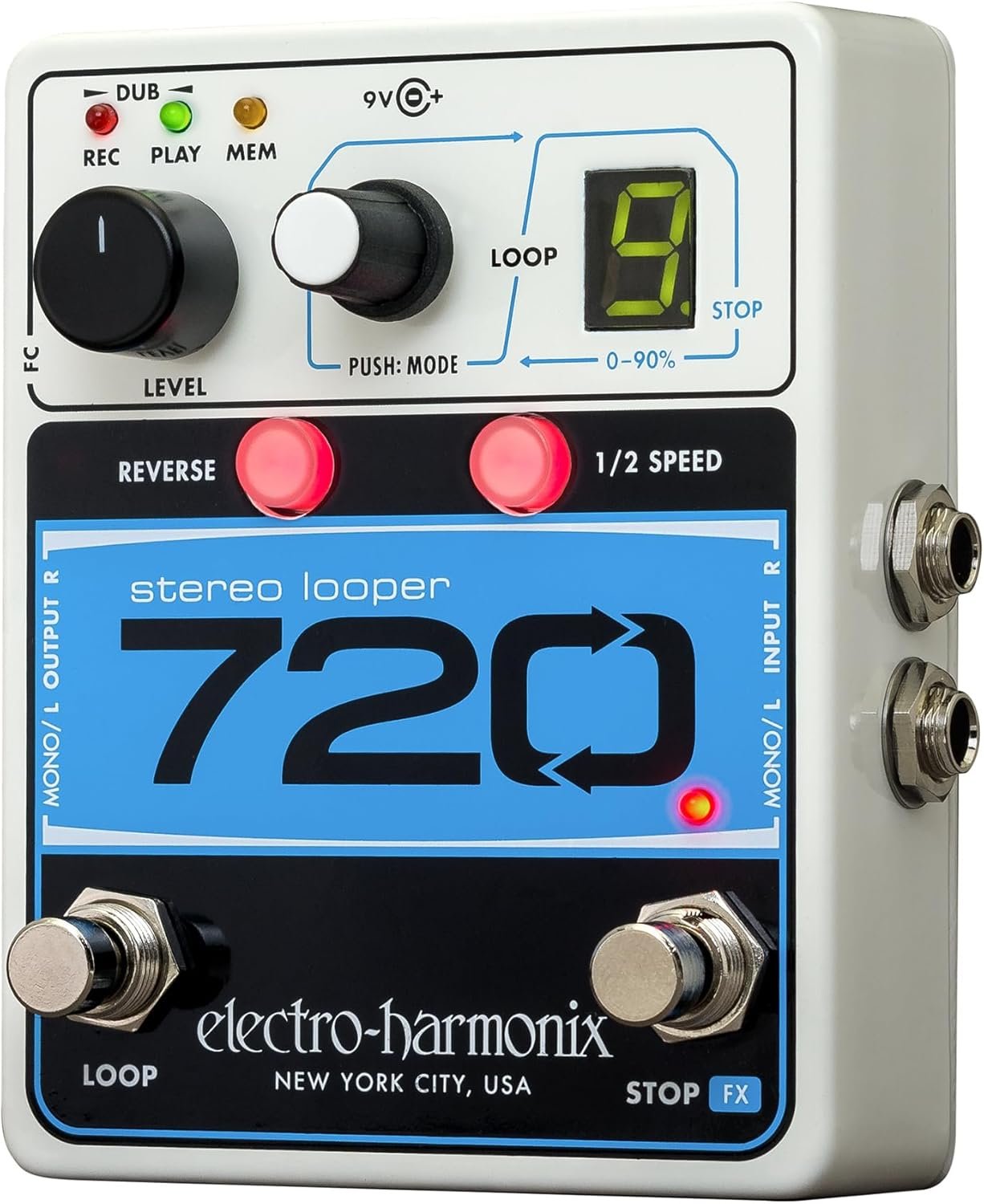
Electro-Harmonix 720 Stereo Looper
As an Amazon Associate I earn from qualifying purchases.
The Electro-Harmonix 720 Stereo Looper is designed for guitarists who want looping to be useful without turning the pedalboard into a workstation.
It gives you 12 minutes of stereo recording time spread across 10 independent loop memories, with unlimited overdubbing and the ability to keep loops stored until you deliberately erase them. That makes it useful not only for building layers while playing, but also for saving chord progressions, song ideas and practice loops that you want to return to later.
For a guitarist working on timing, improvisation or songwriting, that combination of memory and straightforward foot control gives the 720 a clear purpose.
Why it works for guitar practice
A looper is one of those pedals that can make practising feel much more musical.
Record a simple chord progression and you immediately have something to practise scales, melodies or lead parts over. Add a second rhythm part and you can start hearing how different guitar lines sit together.
The 720 stores 10 separate loops, so you do not have to erase one idea every time you want to record another. Those loops remain in memory until you remove them yourself.
That is particularly useful when you have several songs or exercises you regularly return to.
The pedal also supports unlimited overdubbing. Once the first loop is recorded, additional parts can be layered over it repeatedly, letting you build anything from a simple rhythm-and-lead exercise to a much denser arrangement.
An undo/redo function gives you some protection when an overdub goes wrong, rather than forcing you to throw away the complete loop and start again.
What it feels like to use
The 720 has two main footswitches, which makes it easier to operate than very small loopers that ask one switch to handle almost everything.
The main looper footswitch controls the basic recording, playback and overdubbing functions. The second footswitch can be programmed to act as a dedicated stop control or to operate the pedal’s effects.
That separate stop function can be surprisingly important in actual use.
On a single-switch looper, stopping playback can involve carefully timed double taps. With a dedicated stop switch, ending the loop becomes much more deliberate, particularly when playing standing up.
A small display shows the selected loop memory and can also provide playback-progress information, giving you a useful visual reference while a loop is running.
There is one large level control for setting the volume of the recorded loop against your dry guitar signal. Physically, the pedal feels much more like a conventional stompbox than a menu-driven digital processor.
Stereo looping and sound quality
The 720 provides left and right inputs and outputs, so it can record and play loops in stereo as well as operate normally with a mono guitar setup.
That matters if the looper sits after stereo delay, chorus, reverb or another effect that creates a wide signal.
Instead of collapsing those effects back into mono, the 720 can preserve the stereo image through the loop.
Electro-Harmonix specifies uncompressed 24-bit audio at a 44.1kHz sample rate, which is reassuring for a pedal designed to repeat recorded guitar parts again and again.
For ordinary guitar practice, the technical numbers are less important than the practical result: the loop is intended to retain enough clarity that layered parts remain usable rather than quickly becoming a murky approximation of the original signal.
Reverse and half-speed effects
The 720 includes two simple creative effects that can completely change a recorded loop.
Reverse plays the loop backwards. It can be activated during playback or overdubbing, producing the swelling, unfamiliar attack that reversed guitar parts are known for.
The half-speed function cuts the playback speed in half and drops the loop by an octave. It can also be used while overdubbing, which creates some interesting possibilities when the loop is later returned to normal speed.
These are not replacements for a full multi-effects processor, but they make the looper more useful as a songwriting tool.
A simple guitar progression can become a completely different texture without changing the notes you originally recorded.
Useful control beyond basic looping
The 720 includes a few thoughtful functions that become more valuable once you use a looper regularly.
Playback can be set to fade out rather than stopping abruptly, with the fade time adjustable. The recording order can also be configured as either Record/Play/Overdub or Record/Overdub/Play, allowing the pedal to behave in the sequence you find more natural.
An optional external footswitch can provide additional control over loop selection and undo/redo functions.
That means the basic pedal can remain relatively uncluttered while still allowing a more elaborate setup if your looping becomes more involved.
The drawbacks
The first limitation is recording capacity.
Twelve minutes sounds generous when you are recording guitar phrases and song sections, and for many players it will be plenty. But newer loopers can provide dramatically longer recording times, so musicians who want to store lengthy performances or large libraries of material may find the 720 restrictive.
The 10 loop memories create the same sort of boundary.
They are extremely useful compared with a looper that stores only the current phrase, but 10 memories can fill surprisingly quickly if you start using the pedal for several songs, practice exercises and songwriting ideas at once.
You then have to decide what stays and what gets erased.
There is also no large screen or descriptive naming system.
The loops are identified by memory numbers rather than useful names such as “Verse Idea” or “Blues Practice.” Once several memories are occupied, you need to remember what you put where.
The pedal does not offer the kind of advanced song construction you find on larger workstation-style loopers either.
There are no multiple independent tracks that can be separately started, stopped and mixed. The 720 is fundamentally built around one stereo loop with overdubs layered onto it.
For straightforward guitar looping, that simplicity is a strength. For someone wanting to build complete live arrangements with separate verse, chorus, percussion and bass tracks under independent foot control, it may eventually feel limiting.
The reverse and half-speed effects are useful but intentionally simple.
You can switch them on or off, but this is not a deep effects-processing environment with detailed parameter control. If creative sound manipulation is the main goal, a more sophisticated looper or separate effects pedals will provide far more control.
The physical size is another small consideration.
It is still a compact pedal, but it occupies more board space than the tiniest single-switch loopers. That extra space buys you the second footswitch and more direct control, so whether it feels worthwhile depends on how crowded your pedalboard already is.
Looping itself also has a learning curve.
The pedal may be simple, but clean loops depend heavily on foot timing. Starting or ending the recording fractionally late can create a noticeable gap or timing bump when the phrase repeats.
That is not a fault with the 720; it is part of learning to use any conventional looper. Beginners should expect the first few attempts to sound rough.
There is no automatic rhythm correction that quietly fixes the timing for you.
For practice, that can actually be beneficial because the looper exposes inconsistent timing very clearly. For instant live performance, it means some rehearsal is necessary before operating it becomes second nature.
Another limitation is the absence of built-in drum patterns or backing rhythms.
Some modern practice loopers combine looping with drum machines, metronomes and song tools. The 720 stays focused on recording and replaying audio.
If you want percussion underneath your loop, it needs to come from another source.
Finally, the pedal can become a distraction if you spend more time constructing layers than actually practising the guitar.
Loopers are excellent tools, but they can encourage endless stacking of parts. Used with some discipline, the 720 helps expose timing, chord changes and improvisation weaknesses. Used without any purpose, it can simply become another way of avoiding the difficult part of practice.
Who it suits best
The Electro-Harmonix 720 Stereo Looper makes most sense for guitarists who want more control than a tiny one-switch looper provides without moving into a large multi-track looping station.
It should suit players practising improvisation over chord progressions, songwriters capturing ideas, and musicians who want to build simple layered arrangements.
The stored loop memories make it particularly useful for anyone who regularly returns to the same backing parts rather than recording a completely new loop every session.
Stereo inputs and outputs also make it a strong choice for guitarists running stereo modulation, delay or reverb effects.
Is it worth the pedalboard space?
The Electro-Harmonix 720 Stereo Looper sits in a useful middle ground.
It offers enough recording time and memory to be genuinely practical, two footswitches make live operation easier than the smallest loopers, and reverse and half-speed functions add some creative possibilities without complicating the basic controls.
Its 12-minute capacity and 10 memories are modest compared with more elaborate modern loopers, and musicians building complex multi-part performances may eventually need something more sophisticated.
But for practice, songwriting and straightforward layered guitar playing, the 720 provides the features that matter most without surrounding them with unnecessary complexity.
Explore more pedals and looping gear in our Effects & Pedals section.
As an Amazon Associate I earn from qualifying purchases.