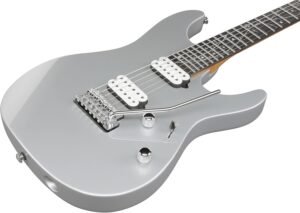

Yamaha Revstar Standard RSS20 Electric Guitar
As an Amazon Associate I earn from qualifying purchases.
The Yamaha Revstar Standard RSS20 Electric Guitar takes a familiar two-humbucker electric-guitar formula and gives it a character of its own.
Its shape draws inspiration from Yamaha’s motorcycle heritage, but underneath the distinctive body is a carefully thought-out combination of a chambered mahogany body, maple top, set mahogany neck and dual Alnico V humbuckers.
The RSS20 is not simply about looks. Yamaha has designed the body chambers to reduce unnecessary weight and influence resonance, while the five-way pickup selector and passive Focus Switch give the two-humbucker layout considerably more tonal flexibility than the controls initially suggest.
Why the chambered body matters
The RSS20 uses a maple top over a chambered mahogany body.
Rather than leaving the mahogany completely solid, Yamaha removes material from carefully chosen areas inside the body. The company developed the chambering through its Acoustic Design process, with the intention of shaping resonance as well as reducing weight.
That is an important part of what separates this generation of Revstar from a straightforward solid slab of mahogany.
The guitar still has the substantial feel associated with a set-neck, dual-humbucker instrument, but the chambering helps prevent the body from becoming unnecessarily heavy.
The maple top also adds structural and tonal contrast to the mahogany back while giving the Revstar its clean sculpted appearance.
For the FGR version, the finish code simply means Flash Green. It is one of Yamaha’s café-racer-inspired Revstar finishes rather than a different construction or pickup specification.
What it feels like to play
The RSS20 uses a 24¾-inch scale length, which is slightly shorter than the 25½-inch scale used on many other electric guitars.
That shorter scale generally means the strings feel a little more forgiving at the same gauge and tuning, particularly when bending notes.
Yamaha fits the guitar with a 3-piece mahogany set neck, reinforced with carbon, and finishes the neck in satin polyurethane. The rosewood fingerboard has a 12-inch radius and carries 22 jumbo stainless-steel frets.
Stainless-steel frets are a useful feature on an instrument intended for regular playing because they are considerably more resistant to wear than traditional nickel-silver fretwire.
The neck measures around 41.9 mm at the nut, giving it familiar electric-guitar proportions without feeling excessively wide.
The satin neck finish also avoids the heavily glossy surface found on some guitars, while the set-neck construction creates a smooth transition into the body.
Upper-fret access is helped by the Revstar’s double-cutaway shape, so the guitar does not feel as though it was designed only for rhythm playing around the lower frets.
Two Alnico V humbuckers
This is one of the most important corrections to the older article.
The RSS20 does not use P90 pickups.
Yamaha fits it with a VH5n Alnico V humbucker at the neck and VH5b Alnico V humbucker at the bridge.
The P90-style pickups belong to the related RSS02T, not the RSS20.
The neck humbucker provides the fuller, rounder side of the guitar, useful for clean chords, bluesier lead sounds and warmer overdriven tones.
The bridge pickup brings more bite and definition, making it better suited to stronger rhythm work and lead parts that need to stand out.
With both pickups selected, the guitar has the familiar blended character of a two-humbucker instrument.
But Yamaha does something more interesting with the five-way switch.
Five-way switching is more than pickup selection
On many two-humbucker guitars, a three-way selector simply gives you neck, both pickups or bridge.
The RSS20 uses a five-position selector.
Positions 1, 3 and 5 provide the more familiar pickup combinations, while positions 2 and 4 introduce subtle phase shifting to create different in-between sounds.
This is not the same thing as coil splitting.
That distinction matters because older descriptions of the RSS20 sometimes incorrectly describe the additional settings as split-coil sounds.
Yamaha’s system keeps the humbuckers at the heart of the guitar but changes the relationship between the frequencies in those intermediate positions.
The result is extra tonal variety without covering the instrument in switches.
For a player moving between clean rhythm, crunch and lead sounds, the five-way arrangement gives more usable colours than the simple control layout initially suggests.
The Focus Switch is not a coil split
The push-pull tone control is another feature that is frequently misunderstood.
Pulling the tone knob activates Yamaha’s passive Focus Switch.
It does not split either humbucker.
Instead, Yamaha describes the effect as behaving somewhat like an overwound pickup: the high frequencies become darker while the mids and lows become more prominent and the overall character becomes more forceful.
That can be useful when moving from a clearer rhythm sound into a thicker lead tone.
Because the system is passive, there is no battery to maintain.
The guitar therefore retains the straightforward reliability of traditional passive electronics while giving you another meaningful sound from the same pair of pickups.
Combined with the five-way selector, the Focus Switch is one of the main reasons the RSS20 feels more versatile than its two-knob control layout might imply.
Straightforward hardware
Yamaha keeps the hardware conventional.
The RSS20 uses a Tune-O-Matic bridge with stopbar tailpiece and die-cast tuning machines.
There is no tremolo system.
For players who rarely use a vibrato arm, that simplicity can be an advantage. There are fewer moving parts, string changes are straightforward, and the bridge arrangement will already feel familiar to anyone who has owned a traditional dual-humbucker guitar.
Yamaha supplies the RSS20 with .010–.046 strings and includes a deluxe gig bag.
The gig bag is worth mentioning because it makes the guitar easier to transport immediately without requiring a separate case purchase.
A guitar that can cover more than one style
The RSS20 is difficult to place into a single musical box.
The humbuckers provide enough output and body for rock, blues and heavier overdriven sounds, but the five-way switching means it is not limited to thick humbucker tones.
The intermediate positions give cleaner and more open alternatives, while the Focus Switch can push the guitar towards a stronger mid-focused character when needed.
That makes the RSS20 particularly useful for somebody who wants one guitar to cover a broad set rather than switching instruments every few songs.
It can move from cleaner rhythm parts into crunch and lead work without needing complicated onboard electronics.
The 24¾-inch scale and dual humbuckers may feel familiar to players coming from more traditional set-neck guitars, but the Revstar shape and switching system stop it feeling like a copy of something else.
The drawbacks
The RSS20 has plenty of strengths, but its design will not suit every player.
The first limitation is the lack of a tremolo system.
The Tune-O-Matic bridge and stopbar arrangement is simple and stable, but if vibrato-arm techniques are central to your playing, the RSS20 will not provide them.
You would need to look at a different Revstar model or another guitar altogether.
The five-way selector also requires a little learning.
With a conventional two-humbucker guitar, the relationship between the switch position and the pickups is immediately obvious.
On the RSS20, positions 2 and 4 use phase-shifted voicings rather than simply selecting another physical pickup.
That creates useful sounds, but a new owner may need some time experimenting before remembering exactly which position works best for each part.
The Focus Switch can cause similar confusion.
Because it is built into a push-pull tone control, somebody seeing the guitar for the first time may assume it is a coil split.
It is not.
Players specifically looking for genuine single-coil operation from the humbuckers should understand that the RSS20’s Focus Switch works differently.
The thicker Focus setting will not necessarily suit every amplifier or effects chain either.
If your basic sound is already heavy in the low mids, activating the Focus Switch may make the result denser than you want.
Like any tonal control, it is useful because you can choose when to use it rather than because it improves every sound automatically.
The 24¾-inch scale is another matter of preference.
Many players enjoy the slightly softer string feel, particularly for bending.
Others are firmly accustomed to a 25½-inch scale and may initially notice the difference in fret spacing and tension.
Neither scale is inherently better, but switching between them can feel noticeable if you have spent years playing only one type.
The body design is distinctive too.
The Revstar shape is one of its strongest visual features, but it does not attempt to resemble the most familiar classic electric-guitar outlines.
Some players will immediately love the café-racer-inspired styling.
Others may prefer a more traditional body shape.
The chambered construction reduces unnecessary mass, but this is still a substantial set-neck electric guitar rather than an ultra-light travel instrument.
Anyone particularly sensitive to guitar weight should try the individual instrument where possible because wood varies naturally from guitar to guitar.
The two Alnico V humbuckers also define much of the instrument’s character.
They provide plenty of body and power, but somebody who primarily wants the sharper attack of traditional single coils may prefer the P90-equipped RSS02T or another guitar entirely.
The phase-shifted switch positions broaden the RSS20’s range, but they do not turn the VH5 humbuckers into conventional Strat-style single coils.
There are no locking tuners either.
The standard die-cast machines are perfectly conventional, but players accustomed to locking tuners may miss the faster string changes and easier winding they provide.
Likewise, the included gig bag is convenient for everyday transport but does not provide the same protection as a rigid hard case.
For local rehearsals and careful transport, a good gig bag may be all you need.
For frequent air travel or situations where heavy equipment could be stacked around the guitar, more substantial protection would be sensible.
The glossy polyurethane body finish may also show fingerprints and handling marks more readily than a satin finish.
The neck itself is satin, which is useful for movement, but the body will benefit from the occasional wipe if you like keeping a guitar looking immaculate.
Finally, the RSS20 offers versatility through clever passive switching rather than through complex active electronics or modelling.
That is part of its appeal, but players wanting dozens of instantly programmable tones will still rely on pedals, amplifiers or external processing.
The guitar gives you a broad and useful foundation.
It is not trying to replace the rest of your rig.
Who it suits best
The Yamaha Revstar Standard RSS20 makes particular sense for players who like dual-humbucker guitars but want more tonal variety than a basic three-way switch provides.
Rock and blues players should feel immediately at home with the shorter scale, set neck and substantial humbucker tones.
Indie, alternative and cleaner players can make good use of the phase-shifted positions to find more open textures.
The distinctive Revstar body also suits somebody who wants a guitar with a recognisable identity without moving into something awkward or deliberately unconventional.
It is particularly appealing for players who prefer passive electronics and straightforward physical controls but still want several genuinely useful sounds available directly from the guitar.
Is it worth the guitar space?
The Yamaha Revstar Standard RSS20 manages to feel familiar without being ordinary.
Its maple-topped chambered mahogany body, carbon-reinforced 3-piece mahogany neck, rosewood fingerboard and dual Alnico V humbuckers provide a solid traditional foundation.
The five-way selector and passive Focus Switch then give that foundation considerably more range than a standard two-humbucker control layout.
There are compromises.
There is no tremolo, no genuine coil split, no locking tuners, and the unusual body shape will appeal more strongly to some players than others.
But those choices also keep the RSS20 relatively straightforward.
For somebody who wants a distinctive electric guitar that can move comfortably between clean, crunch and stronger humbucker tones without complicated onboard electronics, the Revstar Standard RSS20 tells a convincing story of its own rather than simply repeating a design that has existed for decades.
Explore more guitars in our Electric Guitars section.
As an Amazon Associate I earn from qualifying purchases.