Wisuce Bamboo Multi-Guitar Stand
As an Amazon Associate I earn from qualifying purchases.
For guitarists who own several instruments, finding a practical and attractive way to store them can become surprisingly difficult. Individual guitar stands work well when there are only one or two instruments, but a growing collection can soon occupy a considerable amount of floor space.
The Wisuce Bamboo Multi-Guitar Stand offers a different approach, bringing several guitars together in one organised rack.
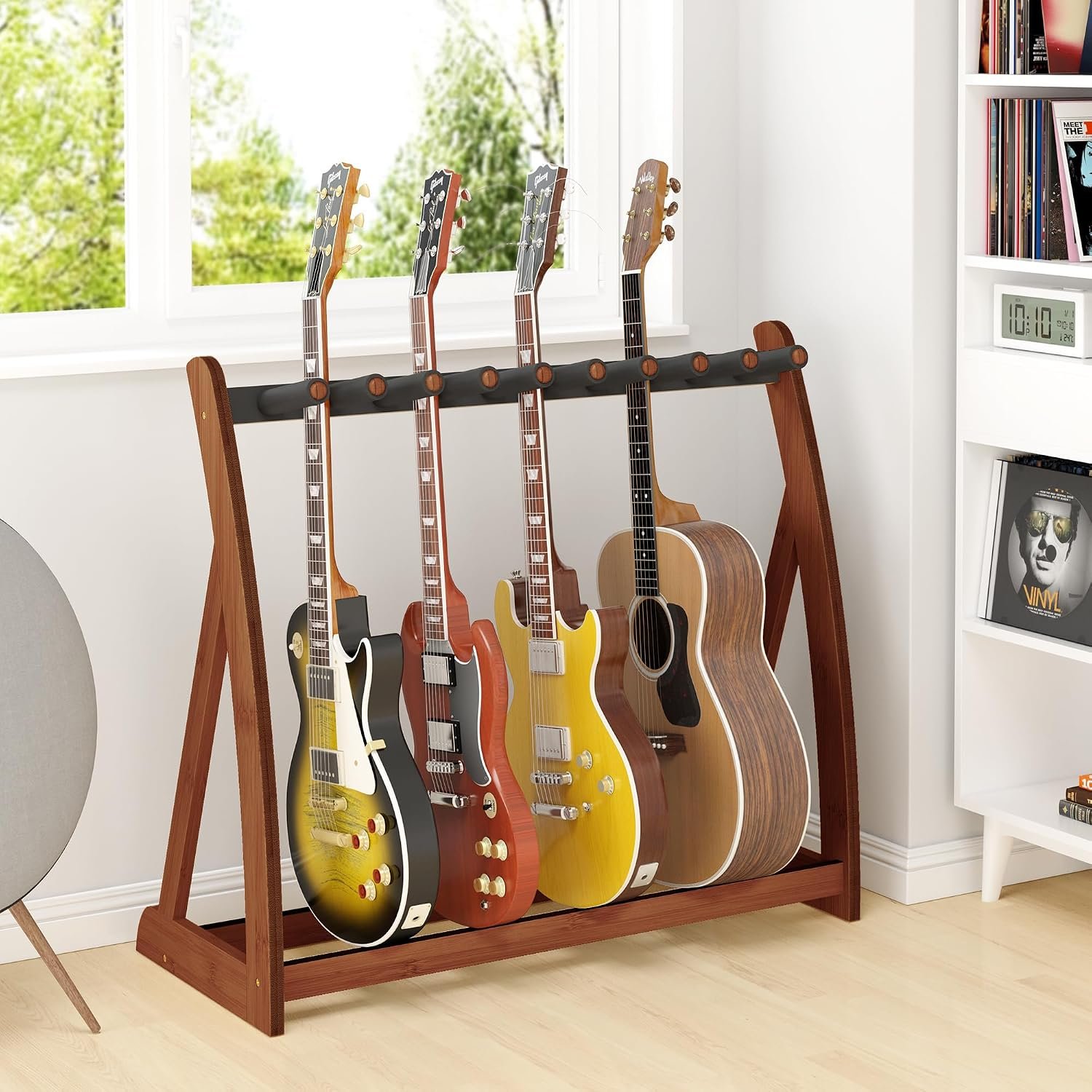
Made from bamboo with a walnut-coloured finish, the stand has a more furniture-like appearance than many conventional metal guitar racks. Its open design allows instruments to remain visible and accessible, while removable and adjustable dividers help accommodate different guitar sizes.
The manufacturer advertises a maximum capacity of nine electric guitars, although the actual number depends on the instruments being stored and the spacing required.
For a collection containing acoustic guitars, electric guitars and basses, the adjustable arrangement is particularly useful.
Instead of relying on permanently fixed compartments, the rack allows the space between instruments to be adapted to the collection.
Soft padding is provided at the contact points to help reduce rubbing and protect guitar surfaces during ordinary use.
The stand also includes a grooved upper rail intended for convenient guitar-pick storage.
Its main appeal is the combination of accessible storage, an adjustable arrangement and a finish that looks appropriate in a living room or home studio.
However, the Wisuce stand is not a replacement for a protective guitar case, and its padded supports should not automatically be assumed safe for every instrument finish.
There are also practical considerations involving floor space, assembly, stability and the number of guitars that can comfortably fit.
Understanding those details is important before deciding whether this style of rack is suitable for a particular guitar collection.
Why it works in a home studio
A multi-guitar rack makes sense when several instruments are used regularly.
Someone who plays electric and acoustic guitar may keep different instruments available for different styles of music.
A guitarist might also own instruments with alternative tunings, different pickup arrangements or different string gauges.
Having them positioned together makes it easier to choose the appropriate guitar without repeatedly opening cases.
The Wisuce Bamboo Multi-Guitar Stand provides a single storage location for this type of collection.
Its layout allows guitars to stand side by side rather than occupying separate positions around a room.
This can make a home studio appear more organised.
It can also make routine tasks more convenient.
For example, a player recording several guitar parts may want to alternate between a solid-body electric, a semi-acoustic and a steel-string acoustic.
Keeping the instruments together reduces the need to retrieve each one from a separate cupboard or case.
The open design also makes it easier to see which instruments are available.
This is a simple advantage, but one that can make a difference when several guitars are used frequently.
The stand is particularly suitable for a dedicated music room or recording space where accessibility matters.
It is less appropriate for environments where instruments need maximum protection from knocks, dust or changes in humidity.
A guitar rack provides organised storage, but it does not provide the enclosed protection of a properly fitted hard case.
Bamboo construction with a walnut finish
One of the most appealing features of this Wisuce stand is its appearance.
Rather than using an entirely metal framework, the product is constructed from bamboo.
Bamboo is commonly used in furniture and household products because it can provide a useful combination of strength, rigidity and an attractive natural appearance.
The walnut-coloured finish gives this particular version a warmer look than unfinished or lightly coloured bamboo.
It is worth distinguishing the finish from the material.
The product is described as bamboo with a walnut colour, rather than solid walnut timber.
That matters for anyone choosing the stand because they want a particular type of wood.
The frame has a relatively simple structure, with angled side supports, an upper rail and a lower section for supporting guitar bodies.
In the product photographs, the dark padded contact areas contrast with the brown frame.
This gives it a more considered appearance than a basic collection of individual folding stands.
For a living room, bedroom music corner or home studio, that design may be a significant attraction.
Many guitarists enjoy displaying their instruments rather than keeping them completely out of sight.
The Wisuce stand can become part of the room’s furniture while still serving a practical purpose.
However, bamboo construction does not guarantee resistance to every type of damage.
The finish can still be marked, joints can loosen and the frame can be damaged by inappropriate handling.
It should be treated as a piece of assembled furniture designed for instrument storage, not as equipment that can withstand unlimited rough treatment.
Adjustable dividers for different instruments
The removable and adjustable dividers are among the stand’s most useful features.
Guitars vary considerably in width, shape and body depth.
A solid-body electric guitar usually requires less space than a full-size acoustic.
A large dreadnought acoustic may need more room than a compact electric guitar, while a hollow-body instrument can have its own storage requirements.
Fixed-width guitar racks can become restrictive when a collection includes several different instrument types.
The Wisuce design allows the divider positions to be altered.
This helps create more appropriate spacing between instruments.
For example, a collection containing several slim electric guitars may allow relatively close positioning.
A collection containing large acoustic guitars may require fewer divisions with wider gaps.
The ability to rearrange the layout is a practical advantage because guitar collections often change.
Someone might initially use the rack for three guitars and later add another instrument.
Alternatively, a guitarist may replace a slim electric with a larger semi-hollow model.
Adjustable dividers make it easier to adapt the storage arrangement without necessarily replacing the entire stand.
However, correct spacing remains essential.
Guitars should not be pushed tightly together simply to maximise the number stored.
There should be enough room to place and remove each instrument without striking its neighbours.
The dividers are useful for organisation, but careful positioning is still the owner’s responsibility.
How many guitars will it hold?
The manufacturer advertises the Wisuce stand as accommodating up to nine electric guitars.
That figure represents a maximum arrangement rather than a guaranteed capacity for every collection.
The number of instruments that fit comfortably depends on their body widths, shapes and the space required between them.
Nine relatively slim electric guitars will occupy a different amount of room from nine large acoustic guitars.
Likewise, a collection containing a mixture of solid-body electrics, hollow-body guitars and basses may require wider spacing.
For that reason, the advertised maximum should be treated as a useful indication of the rack’s capacity rather than a promise that any nine instruments will fit.
A sensible approach is to plan the arrangement around the largest guitars in the collection.
Measure the body widths and consider the way each instrument will rest on the lower support.
The upper sections also need enough space to accommodate the necks without unwanted contact.
It is particularly important to consider guitars with angled headstocks or unusually shaped bodies.
These can need more clearance than their body width alone suggests.
Allowing a little extra space between instruments is preferable to filling every available position.
For some households, the stand may work best with four or five larger instruments.
For others, it may accommodate considerably more.
Its real advantage is the flexibility to create a suitable arrangement rather than the advertised maximum number alone.
Padded supports for everyday guitar storage
Protecting the instruments is one of the most important considerations when choosing a multi-guitar stand.
The Wisuce rack uses soft padding around its support areas.
These padded sections are intended to reduce direct contact between guitar surfaces and the harder bamboo frame.
The padding also provides some grip, helping the instruments remain in position.
This is preferable to resting a polished guitar body directly against an unprotected wooden or metal edge.
The lower supports carry the instruments while the upper section helps maintain their position.
For ordinary home use, the arrangement is designed to keep guitars accessible without allowing them to rest directly against exposed frame surfaces.
However, padding should not be confused with complete protection.
An instrument can still be scratched if it is dropped carelessly into the rack or dragged across another guitar.
Metal bridge components, strap buttons and protruding hardware can also make contact with neighbouring instruments.
The owner should check that each guitar rests against the intended padded surfaces.
Padding should be examined periodically for wear, movement or damage.
A damaged contact area should be corrected before valuable instruments are returned to the stand.
The Wisuce rack offers padded storage, but careful handling remains an essential part of keeping guitars in good condition.
Important considerations for nitrocellulose finishes
Guitar finish compatibility deserves particular attention.
Some guitars, including certain Gibson models and vintage-style instruments, use nitrocellulose lacquer.
This type of finish can react with certain rubber, foam and plastic materials used on guitar stands.
The reaction may cause discolouration, marking or damage to the lacquer.
That means a stand described as padded or scratch-resistant is not automatically suitable for every guitar.
The Wisuce product information describes soft sponge padding, but I have not found confirmation that its contact materials have been specifically tested and approved for nitrocellulose finishes.
Owners of nitro-finished guitars should therefore avoid assuming compatibility.
The safest approach is to obtain written confirmation from the stand manufacturer and follow the instrument manufacturer’s storage guidance.
Gibson advises protecting vulnerable finishes from direct contact with incompatible stand materials and recommends soft cotton cloth barriers where appropriate.
However, placing fabric over padding should not be treated as a guarantee that an unsuitable stand becomes completely safe.
Any covering must remain secure and must not interfere with the way the guitar is supported.
For a particularly valuable vintage instrument or one with a delicate finish, a suitable hard case may remain the better storage option.
This issue is not unique to the Wisuce stand.
It is a general consideration with many padded guitar racks and stands.
Nevertheless, it is important enough to check before placing an expensive instrument in contact with unfamiliar support materials for extended periods.
Storage for electric guitars
Electric guitars are a natural fit for this style of rack.
Their relatively slim bodies can make efficient use of the available width.
A guitarist with several solid-body instruments may be able to arrange them with reasonably even spacing.
For example, a collection containing Stratocaster-style, Telecaster-style and similar solid-body guitars could work well with the adjustable divider system.
The main advantage is accessibility.
Different instruments can remain visible and ready to pick up.
This is useful for musicians who move between pickup configurations or keep guitars in different tunings.
The rack also provides a more organised alternative to leaving several individual stands scattered around the room.
However, not all electric guitars have simple body shapes.
Offset instruments, heavily contoured designs and guitars with unusual lower edges may require more careful positioning.
The body must rest securely against the lower supports without creating a tendency to twist or slide.
Headstock shape also matters.
Some guitars have angled headstocks or tuning pegs that extend farther than expected.
These parts should not contact adjacent instruments.
The rack can accommodate electric guitars, but the safest layout is one that gives each instrument enough clearance.
Storage for acoustic guitars
Acoustic guitars introduce different considerations.
Their bodies are generally deeper than those of solid-body electric guitars.
Larger instruments, such as dreadnoughts and jumbos, also have broad lower bouts that need additional space.
The adjustable dividers can help accommodate these differences.
However, storing several acoustics will usually reduce the number of available positions compared with a collection of slim electrics.
The instrument’s body should rest securely on the lower support while the neck leans naturally against the upper section.
Care is needed when removing an acoustic guitar from the rack.
Its wider body may pass close to the strings, bridge or hardware of the instrument next to it.
This is particularly important when guitars are tightly spaced.
The open arrangement makes acoustic guitars easy to access, but it also leaves their delicate surfaces exposed.
Wooden acoustic guitars can be sensitive to changes in humidity.
A rack does not provide the environmental protection available from a suitably maintained case.
For instruments that are used frequently in a stable indoor environment, open storage may be convenient.
For a valuable acoustic guitar that is played only occasionally, a hard case with appropriate humidity management may still be preferable.
Storage for bass guitars
The Wisuce stand is also advertised as suitable for bass guitars.
This is useful for musicians who play both guitar and bass or maintain a small collection of different instruments.
However, bass guitars introduce two additional considerations.
The first is their length.
A full-scale bass has a longer neck than many electric guitars.
Its headstock may therefore extend higher above the stand.
The second is balance.
Some basses are relatively heavy, while others have body shapes or weight distribution that require careful support.
The rack needs to provide secure contact without encouraging the instrument to lean awkwardly.
A bass should never be forced into a divider space that is too narrow.
There should also be adequate clearance around tuning pegs and other hardware.
A mixed guitar-and-bass arrangement can be practical, but it needs to be planned around the actual dimensions of the instruments.
The adjustable dividers make that easier.
Nevertheless, the user should confirm that each bass rests securely before leaving it unattended.
Keeping guitars accessible for regular playing
One of the biggest advantages of an open guitar rack is convenience.
When instruments are stored in cases, playing can involve several small tasks.
The case must be retrieved, opened and moved somewhere suitable.
The guitar then has to be returned after the session.
None of these steps is particularly difficult, but they add to the process of picking up an instrument.
A rack simplifies access.
The player can see the guitars immediately and choose one without opening a case.
This can be particularly useful during recording.
A musician may want to record an acoustic rhythm part, switch to an electric guitar for a lead passage and then use a bass for another section.
Keeping the instruments together makes these changes more straightforward.
The same advantage applies to ordinary practice.
A guitarist might use one instrument for fingerstyle playing and another for heavier electric parts.
The Wisuce stand creates a central storage location for those instruments.
However, accessibility does not mean the guitars should be handled casually.
Each instrument still needs to be lifted clear of its divider and returned carefully.
The benefit comes from reducing storage inconvenience, not eliminating the need for attention.
A more organised music room
A collection of individual guitar stands can make a room feel crowded.
Tripod bases, neck supports and separate storage positions may spread across a considerable area.
A multi-guitar rack offers a more consolidated arrangement.
The Wisuce stand brings the instruments into a single row.
This can help create a neater music room or recording area.
The walnut-coloured finish also gives the rack a more domestic appearance.
That may be attractive to guitarists who use a living room or bedroom as their main practice space.
The guitars become part of an organised display rather than equipment temporarily left around the room.
This is particularly relevant when music equipment shares space with ordinary furniture.
A rack that looks reasonably consistent with the room can be preferable to several unrelated metal stands.
However, the stand still has a substantial floor footprint.
It needs enough width for the collection and enough surrounding clearance to remove each guitar safely.
A multi-guitar rack can organise a room, but it does not automatically make a large collection occupy very little space.
Its effectiveness depends on choosing an appropriate position.
Where to position the stand
The best location is a stable, level section of floor where the instruments can be accessed without obstruction.
A dedicated music room is an obvious choice.
A living room corner or bedroom practice area may also work, provided sufficient clearance is available.
The rack should not be placed where people regularly pass close to the instruments.
Doorways, narrow walkways and areas where furniture is moved frequently are less suitable.
A guitar that extends above the rack remains vulnerable to an accidental knock.
The position should also avoid direct sunlight, radiators and other sources of excessive heat.
These conditions are undesirable for many guitar finishes and wooden instruments.
Humidity is another consideration.
A rack provides no sealed or controlled environment.
If the room experiences large changes in humidity, sensitive acoustic instruments may require additional protection.
The stand should also be kept away from locations where pets or young children could pull at the instruments.
Once assembled, the frame should sit evenly on the floor without rocking.
If the rack does not feel secure when empty, it should be checked before any guitars are added.
Careful placement contributes as much to practical storage as the rack’s design itself.
Assembly and initial setup
The Wisuce guitar rack is supplied for assembly.
Product information describes an installation process supported by instructions and an included screwdriver.
The frame needs to be assembled correctly before instruments are placed inside it.
This is important because the rack supports several guitars simultaneously.
The sensible approach is to assemble it on a clean, level surface with enough working room.
Before tightening everything fully, the parts should be checked for correct alignment.
The side supports, lower section and upper rail need to fit together securely.
Any supplied hardware should be installed according to the instructions.
The divider positions can then be arranged to suit the instruments.
It is worth doing this before filling the stand.
Placing the largest guitars first can help establish a useful layout.
Smaller instruments can then be positioned in the remaining space.
Once assembled, the rack should be checked for movement or instability.
Each support should be secure, and all padded contact areas should be properly positioned.
It is sensible to begin with one instrument.
Confirm that it rests safely before adding the remaining guitars.
This approach takes a little more time initially but reduces the risk of discovering a problem once the stand is full.
Small details that add convenience
The Wisuce stand includes a grooved upper rail designed to hold guitar picks.
It is a small feature, but a practical one.
Picks are easily misplaced during a practice session.
Having a convenient place to keep a few can make the rack more useful as part of a regular playing area.
However, the grooves should be treated as storage for suitable small accessories, not as a general-purpose shelf.
Heavy equipment should not be placed on the upper rail unless the manufacturer explicitly permits it.
The removable dividers are another practical detail.
They allow the layout to be changed when instruments are added, removed or replaced.
This flexibility helps the stand adapt to an evolving guitar collection.
The rack also keeps instruments in view.
For guitarists who enjoy the appearance of their instruments, that may be an important part of the appeal.
A well-organised collection can become an attractive feature of the room.
The product combines these modest practical touches with a design that serves the main purpose of keeping guitars together.
What it feels like to use every day
For everyday use, the Wisuce stand is straightforward once it has been assembled and positioned.
The guitarist chooses an instrument and lifts it clear of the dividers.
After playing, the guitar is carefully returned to an appropriate opening.
The lower section supports the body while the upper padded area helps maintain its position.
The adjustable spacing means the stand does not need to be arranged identically for every collection.
A group of electric guitars can be positioned differently from a mixture containing acoustics and basses.
This is a useful advantage.
A rack with fixed compartments can sometimes leave unused space while still making larger instruments difficult to fit.
The Wisuce design gives the owner more control over the layout.
The walnut-coloured bamboo frame also has a different visual character from a typical black metal studio rack.
For a home musician, that may make the stand more pleasant to keep in a shared living area.
However, the guitars remain exposed.
Dust can settle on them, sunlight can reach their finishes and an accidental impact remains possible.
There is no locking mechanism enclosing the instruments in a protected compartment.
The best experience will therefore come from using the rack in a suitable indoor location and handling each guitar carefully.
Cleaning and maintenance
The Wisuce stand should require only straightforward routine attention, but the frame and padded contact points should be checked regularly.
Dust can accumulate on the upper rail, dividers and lower supports.
A clean, soft cloth is suitable for removing ordinary surface dust.
Cleaning products should be chosen with care to avoid damaging the stand’s finish or leaving residue on areas that contact guitars.
Harsh solvents and abrasive materials should be avoided unless specifically approved by the manufacturer.
The padded sections deserve particular attention.
They may gradually collect dust and dirt transferred from instruments or their cases.
If padding becomes loose, compressed, torn or contaminated, it should be addressed before an instrument is placed against it.
The assembled joints should also be checked occasionally.
Furniture-style racks can develop movement if fixings loosen during use or relocation.
Any loose hardware should be secured according to the assembly instructions.
It is also sensible to inspect the lower supports for wear.
Regular checks are especially important when the stand holds several relatively heavy instruments.
Keeping the rack in good condition helps maintain an organised and secure storage arrangement.
The drawbacks
The Wisuce Bamboo Multi-Guitar Stand has an attractive design and useful adjustable storage, but there are several limitations that should be considered before choosing it.
These drawbacks become particularly important when the stand is intended for valuable guitars or a collection containing instruments with different sizes and finishes.
The advertised nine-guitar capacity is not guaranteed for every collection.
The manufacturer advertises room for up to nine electric guitars.
That does not mean nine full-size acoustic guitars will fit comfortably.
Instrument dimensions vary considerably.
A collection containing wide acoustic bodies, semi-hollow guitars and basses will require more space than a collection of slim solid-body electrics.
The owner should plan the layout around the actual instruments rather than relying entirely on the maximum advertised figure.
For some collections, leaving several potential positions unused may be the safest arrangement.
Trying to squeeze too many guitars into the rack can increase the risk of accidental contact and damage.
Nitrocellulose finish compatibility has not been confirmed.
This is one of the most important limitations.
Some guitar finishes can react with materials commonly used on stand supports.
The presence of soft padding does not establish that a stand is safe for nitrocellulose lacquer.
I have not found confirmation that the Wisuce padding is specifically approved for these finishes.
Owners of vintage guitars, nitro-finished Gibson instruments and other guitars with delicate lacquer should check compatibility before use.
If suitable confirmation is unavailable, a purpose-approved storage solution or an appropriate hard case is the safer choice.
The manufacturer of the guitar should also be consulted where necessary.
Potential damage to an expensive finish is a much more serious concern than the convenience of open storage.
A rack does not offer the protection of a hard case.
The Wisuce stand is designed to keep guitars organised and accessible.
It does not enclose them.
Dust, accidental knocks, changes in humidity and other environmental conditions remain concerns.
An instrument stored on an open rack can also be reached by children, visitors and pets.
For valuable guitars that are used infrequently, a fitted hard case may provide more appropriate protection.
The Wisuce stand is better suited to instruments that are regularly played in a controlled indoor environment.
The frame requires assembly.
Unlike a single-piece guitar stand, this rack needs to be assembled before use.
Correct assembly is essential because the structure supports several instruments.
The joints must be secure, the frame must be properly aligned and the dividers need to be positioned correctly.
Someone who prefers equipment that can be unpacked and used immediately may find this inconvenient.
The stand also needs to be checked after assembly rather than assuming every connection is secure.
The quality of the final setup depends partly on how carefully those steps are completed.
The stand takes up a considerable amount of floor space.
Although it consolidates several guitars into one rack, the Wisuce is not a compact accessory.
It needs enough width to accommodate the collection and enough clearance for the instruments to be removed safely.
This could be inconvenient in a small bedroom or a heavily furnished living room.
The stand should not be positioned where protruding guitar necks could be knocked by someone walking past.
Before choosing it, the available floor area should be measured.
The layout also needs to account for the depth of acoustic guitar bodies and the space needed to lift instruments out.
Guitars can still strike each other.
The adjustable dividers help create separate positions, but they do not eliminate the possibility of contact.
A guitar can swing slightly while being lifted.
Its headstock, tuners, bridge or strap button may strike a neighbouring instrument.
This is particularly likely when the rack is filled close to capacity.
Careful handling and adequate spacing are therefore essential.
The rack should not encourage users to treat a closely packed collection casually.
Expensive instruments can be damaged even when the stand itself is properly padded.
The stand is not ideal for every guitar shape.
Traditional acoustic and electric guitars are the obvious intended instruments.
However, unusual body shapes can create difficulties.
Explorer-style guitars, V-shaped bodies, offset designs and instruments with unusual lower edges may not rest against the supports in the expected way.
The adjustable dividers help with spacing, but they cannot change the shape of the lower support.
Owners of unusually shaped instruments should check that the body sits securely before leaving it unattended.
A stand that accommodates a standard electric guitar may not automatically suit every specialist design.
Heavy instruments require additional care.
Bass guitars, larger acoustics and some electric guitars can place considerable weight on the rack.
The combined weight of several instruments also needs to be considered.
I have not verified a specific maximum total load rating for this exact Wisuce configuration.
For that reason, it would be unwise to assume the stand can safely carry any combination of heavy instruments.
The manufacturer’s current load guidance should be checked where available.
The rack must remain stable and properly assembled, with the weight distributed sensibly across its supports.
It is not an enclosed or lockable storage system.
The Wisuce stand is designed around convenience and display.
It does not provide the security of a lockable instrument cabinet.
That may not matter in a private music room.
In a shared rehearsal space, public venue or room regularly accessed by other people, the lack of physical security may be a disadvantage.
Anyone concerned about theft or unauthorised handling should consider whether an open rack is appropriate.
The padding can become worn or dirty.
Padded contact surfaces are useful, but they still need maintenance.
Over time, padding may compress, move or become damaged.
Dirt trapped against a support can also create unwanted friction against a guitar’s finish.
The owner should inspect the pads regularly.
Worn or contaminated padding should not be ignored simply because the stand still appears structurally sound.
The protective quality of the rack depends on the condition of those contact surfaces.
The walnut finish may not suit every room.
The appearance is part of the stand’s attraction, but it is also a matter of preference.
Some musicians prefer understated black metal equipment that blends into a studio.
Others may prefer a natural bamboo finish rather than a darker walnut colour.
The Wisuce rack has a more furniture-like appearance, which may be attractive in a domestic setting.
However, the finish should be chosen because it suits the intended room, not because it is necessarily superior to other designs.
The stand may require rearranging when instruments change.
Adjustable dividers provide flexibility, but that does not mean the rack automatically adapts.
Adding a larger guitar may require moving several dividers.
The existing instruments will need to be removed while the layout is changed.
For someone who frequently changes the contents of the rack, this may become an occasional inconvenience.
A collection of similarly sized guitars is likely to require less rearrangement than a varied collection.
Open storage exposes guitars to changing room conditions.
This is particularly relevant for wooden acoustic instruments.
Temperature and humidity changes can affect wood movement, neck relief and other aspects of a guitar’s setup.
The Wisuce stand offers no humidity control.
In rooms with unstable conditions, sensitive instruments may be better stored in suitable cases with appropriate humidity management.
The rack should not be used as an excuse to overlook the normal care requirements of acoustic guitars.
It is not a convenient travel stand.
Although the rack can be disassembled, it is not equivalent to a small folding guitar stand.
Its multiple sections and adjustable dividers make it more involved to pack and set up.
For a touring musician who needs equipment that can be deployed quickly at different venues, a purpose-designed folding rack may be more convenient.
The Wisuce stand is more naturally suited to a permanent or semi-permanent indoor location.
It could be used elsewhere, but portability is not its principal attraction.
It may be unnecessary for a small collection.
Someone who owns one or two guitars may not need a multi-instrument rack.
A suitable single-guitar stand or wall hanger could provide adequate storage with a smaller footprint.
The Wisuce design becomes more useful when several instruments need to be organised together.
Choosing it for a very small collection may leave much of its available width unused.
The stand makes most sense when the owner has enough instruments to benefit from its adjustable arrangement.
The instruments remain vulnerable when being removed.
Taking a guitar out of a multi-guitar rack requires more attention than simply lifting it from a widely spaced individual stand.
The instrument may need to be guided carefully past neighbouring bodies and headstocks.
This is especially important with large acoustics or guitars with delicate finishes.
A tightly arranged rack can make routine access more awkward.
Leaving generous clearance reduces this problem, but it may also reduce the total storage capacity.
That is an unavoidable trade-off between the number of instruments stored and the convenience of accessing them.
There is no guarantee of long-term finish durability.
The bamboo frame and walnut-coloured finish create an attractive appearance, but appearance alone does not establish long-term durability.
The stand may be exposed to sunlight, cleaning products and repeated contact during normal use.
Over time, visible wear may develop.
It is therefore worth positioning the rack carefully and cleaning it with suitable materials.
The stand should be treated as furniture requiring sensible care rather than as equipment that can withstand rough handling indefinitely.
Taken together, these limitations show that the Wisuce stand is best suited to careful indoor storage rather than maximum protection or heavy-duty transport.
Its success depends on correct assembly, appropriate guitar spacing and the compatibility of the support materials with the instruments being stored.
Who it suits best
The Wisuce Bamboo Multi-Guitar Stand is particularly suitable for guitarists who own several instruments and want them organised in one accessible location.
It may appeal to home musicians who regularly alternate between acoustic and electric guitars.
A guitarist with different instruments for recording, practice or alternative tunings may appreciate being able to keep them together.
The adjustable dividers are especially useful for collections containing different guitar body sizes.
The rack may also appeal to musicians who want their instruments to form part of the room’s appearance.
Its walnut-coloured bamboo frame has a warmer, more furniture-like character than a conventional black metal rack.
For a dedicated home studio or music room, this could be a desirable detail.
The stand is less suitable for someone who needs frequent portability, enclosed protection or storage for a collection of delicate vintage instruments without confirmed finish compatibility.
It is also unnecessary for many guitarists who own only one instrument.
The ideal user is someone with a growing collection who values accessibility, adjustable spacing and an attractive indoor storage arrangement.
Is it worth the floor space?
The Wisuce Bamboo Multi-Guitar Stand offers a useful combination of flexible storage and attractive design.
Its bamboo construction and walnut-coloured finish help it look more at home in a living room or dedicated music space than many basic metal racks.
The removable and adjustable dividers are its strongest practical feature.
They allow the owner to arrange different combinations of electric guitars, acoustic guitars and basses without relying entirely on fixed compartments.
Soft padded contact points provide a degree of surface protection, while the open layout keeps instruments visible and accessible.
For someone who owns several guitars, this can make everyday practice and recording more convenient.
However, the stand needs to be chosen with realistic expectations.
The advertised maximum capacity depends on instrument dimensions, and the padding should not be assumed compatible with delicate nitrocellulose finishes.
It also requires assembly, adequate floor space and careful positioning.
Most importantly, an open guitar rack cannot replace the protection offered by a suitable hard case.
For frequently used guitars in a stable indoor environment, the Wisuce stand provides an attractive way to bring a collection together.
Its appeal lies in practical organisation rather than unnecessary features.
If the available space is suitable and the instruments can be stored securely with adequate clearance, it is a worthwhile guitar-storage accessory to consider.
For more practical guitar accessories, instrument storage solutions and useful equipment for musicians, explore our Accessories guides.
As an Amazon Associate I earn from qualifying purchases.