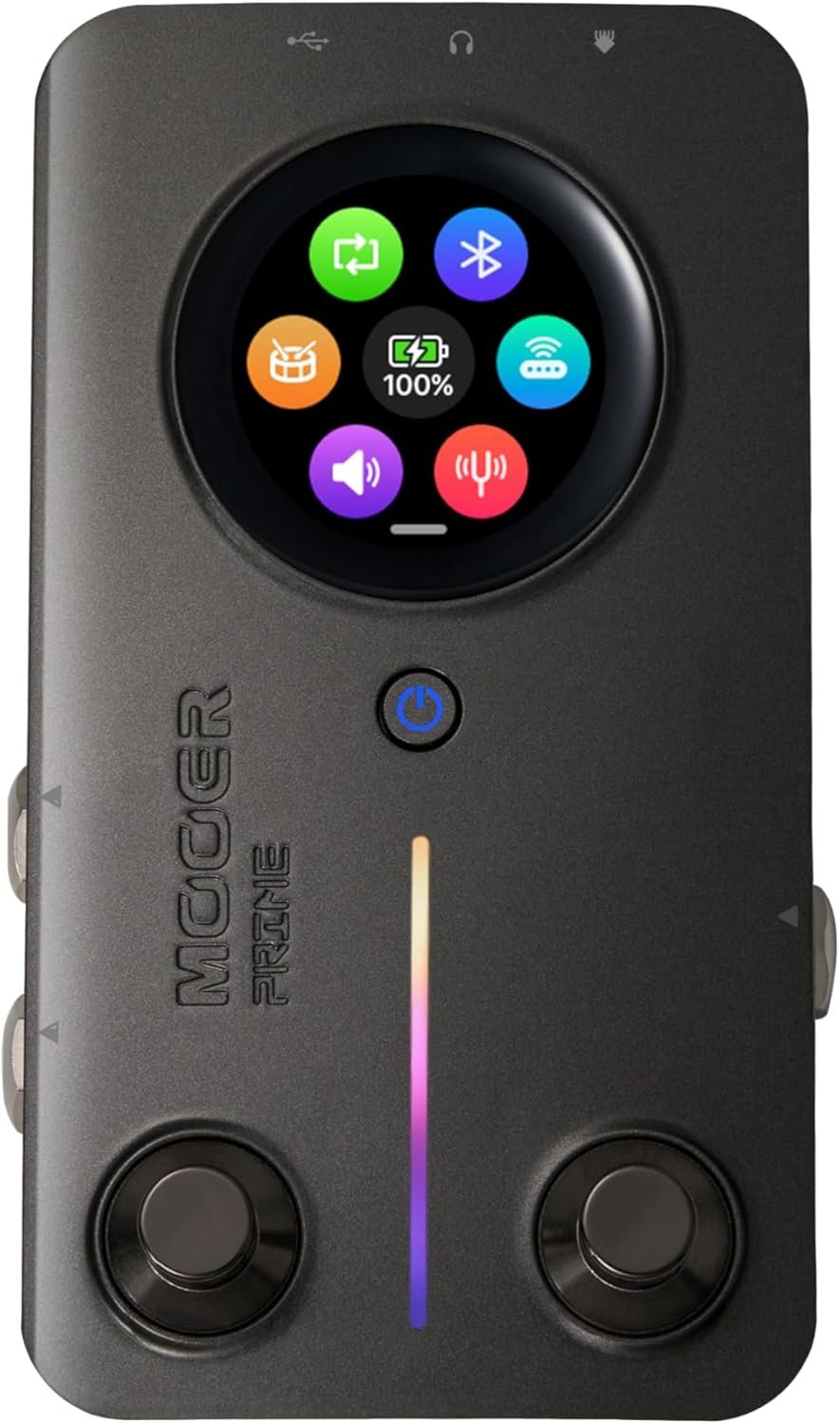
MOOER Prime M2 Multi-Effects Processor
As an Amazon Associate I earn from qualifying purchases.
The MOOER Prime M2 Multi-Effects Processor packs a surprisingly large guitar setup into a unit small enough to disappear into a gig bag.
Inside are 194 effect models covering drives, preamps, cabinets, modulation, delay, reverb and other tone-shaping tools. There are 80 preset slots, support for MOOER MNRS tone samples and third-party impulse responses, plus a touchscreen that gives you direct access to the sounds without relying entirely on a phone or computer.
But the Prime M2 is not simply about having a long effects list. With a built-in looper, drum machine, headphone output, Bluetooth audio and USB recording, it can work just as naturally for practising at home as it can for building a compact guitar rig.
Why it works for guitar
The Prime M2 gives you enough flexibility to build complete guitar sounds rather than simply adding one effect at a time.
Its 194 models include amp and cabinet simulations alongside familiar pedal-style effects, so a preset can become an entire signal chain. The dynamic effect-chain design also allows the same type of effect module to be used more than once when a particular sound calls for it.
That opens up quite a bit of room for experimentation. A clean amp sound can be paired with compression, modulation and delay, while another preset might combine higher gain with EQ, cabinet modelling and ambience.
Up to 80 presets can be stored, which is enough to keep favourite practice sounds alongside more specialised patches.
The ability to load third-party IR files is particularly useful for guitarists who already have preferred cabinet impulse responses. MOOER’s own MNRS samples can also be added, giving the unit more room to grow beyond the factory sounds.
What it feels like to use
The Prime M2 is genuinely compact.
It weighs around 228g and measures roughly 74mm by 125mm by 49mm, so it feels more like carrying a chunky stompbox than a conventional multi-effects floorboard.
Despite that small footprint, there are two physical footswitches and a 1.28-inch touchscreen.
The touchscreen is useful because a device this small simply does not have room for rows of dedicated knobs. Effects, presets and deeper settings can be approached visually rather than trying to remember complicated button combinations.
The two footswitches make preset and performance control more practical when the M2 is on the floor. For players who need more control, MOOER also supports external MIDI and its F4 wireless footswitch.
There is a 3.5mm headphone output for quiet playing, which makes the Prime M2 particularly useful as a personal practice rig.
Bluetooth 5.0 audio playback lets you send backing tracks or songs from another device and play along through the same headphones. That is a simple feature, but one that can make everyday practice considerably more convenient.
More than an effects processor
The practice tools are one of the Prime M2’s stronger features.
Its looper provides up to 80 minutes of total recording time spread across 10 save slots. Record, overdub, undo and redo functions make it useful for practising rhythm parts, building ideas or putting down a progression to improvise over.
The built-in rhythm section adds 56 drum grooves and four metronome types. The drum machine and looper can also be synchronised, which makes them considerably more useful together than two unrelated practice features.
There is an onboard tuner as well, reducing the amount of additional equipment needed for a small practice setup.
USB-C OTG recording provides another useful route for capturing ideas. Rather than treating the Prime M2 purely as something that sits between the guitar and an amplifier, it can become part of a compact recording setup too.
Stereo quarter-inch outputs give you more options when connecting to suitable amplification, recording equipment or other stereo gear.
The drawbacks
Packing this many functions into such a small enclosure inevitably brings compromises.
The first is control space. The touchscreen helps enormously, but anyone accustomed to a large floor processor with several dedicated knobs and footswitches may find the Prime M2 physically cramped.
Two onboard footswitches can only do so much. For simple preset changes and basic control they are useful, but a guitarist who wants instant foot access to several individual effects during a song may eventually want an external controller.
The touchscreen itself will divide opinion.
If you are comfortable using phones and modern digital equipment, tapping through settings should feel natural. Guitarists who prefer every function to have a dedicated physical knob may find it less satisfying. There is a very different tactile feel between reaching for a substantial rotary control and navigating a small touchscreen.
There are also 194 effects, which sounds attractive but can become a distraction. More choices do not automatically produce better guitar sounds. It is quite easy with a multi-effects processor to spend more time browsing models and presets than actually practising.
The same applies to the 80 preset slots. They provide plenty of storage, but organising a large collection of sounds takes some discipline if you want to find the right one quickly.
The rechargeable battery is convenient but finite. MOOER rates the integrated 3000mAh battery for up to around six hours, with a charging time of roughly three hours. A long rehearsal or extended session away from power therefore requires some planning.
And unlike a conventional pedal powered from a standard supply, an integrated rechargeable battery will eventually age. That is worth considering if you normally keep guitar equipment for many years.
Another limitation is the small display. The touchscreen makes the interface possible, but at 1.28 inches it cannot offer the same spacious editing experience as a large processor with a wide colour screen.
For deeper preset management, MOOER provides its Prime mobile app and MOOER Studio desktop software. That is useful, but it also means the fullest experience can involve another device rather than everything happening directly on the pedal.
Bluetooth is also for audio playback rather than replacing the physical guitar connection. The guitar still plugs into the M2 normally.
There is no built-in speaker either. Headphones make it an excellent private practice tool, but playing aloud still requires suitable amplification or another audio system.
Finally, a player who already owns an amplifier they love and a carefully chosen collection of individual pedals may not gain much from consolidating everything into one digital unit.
The Prime M2 makes the most sense when its compactness and breadth of functions solve a genuine problem rather than simply adding more options.
Who it suits best
The MOOER Prime M2 should suit guitarists who want a lot of sound and practice functionality without carrying a traditional multi-effects floorboard.
It makes particular sense for home players. Connect a guitar and headphones and you have amps, cabinets, effects, drums, looping and backing-track playback in a very small setup.
Travelling guitarists may appreciate it for the same reason. At only 228g, it adds very little weight to a bag.
It can also work well for someone exploring effects for the first time. Instead of buying numerous individual pedals immediately, the M2 provides access to many different effect types and lets you discover which ones you actually enjoy using.
More experienced players may be attracted for different reasons: custom IR support, MIDI control, stereo outputs and the ability to create a remarkably compact secondary rig.
Is it worth the pedalboard space?
The interesting thing about the MOOER Prime M2 is just how little pedalboard space it actually asks for.
It combines 194 effects with amp and cabinet modelling, presets, looping, rhythm tools, headphones, Bluetooth and recording capability in a unit barely larger than many individual pedals.
That does not make it a replacement for every amplifier or carefully assembled pedalboard. The compact controls and touchscreen interface involve compromises, and some guitarists will always prefer dedicated pedals under their feet.
But for practice, travel, recording ideas or building a deliberately small guitar setup, the Prime M2 offers an unusually broad collection of genuinely useful tools without requiring much room.
Explore more guitar effects and processors in our Effects & Pedals section.
As an Amazon Associate I earn from qualifying purchases.